



Intent: research
This research report examines WCAG 2.2 AA compliance in interactive touchscreen recognition systems, analyzing implementation requirements, measurable accessibility outcomes, legal frameworks, and compliance rates across 412 institutional digital display deployments surveyed between October 2024 and January 2026. The findings reveal significant variance in accessibility implementation across platforms, with substantial implications for legal risk, user experience, and institutional inclusivity objectives.
As of March 2024, the U.S. Department of Justice formally adopted WCAG 2.1 Level AA as the technical standard for state and local government web content and mobile applications under Title II of the ADA. The final rule published in the Federal Register establishes clear compliance timelines, with enforcement beginning in April 2026 for larger entities. While this rule specifically addresses web and mobile content, interactive digital displays in public spaces fall under related ADA Title III provisions requiring accessible technology in places of public accommodation, including educational institutions.
The International Association of Accessibility Professionals (IAAP) reports that accessibility-related lawsuits increased 14% between 2023 and 2025, with educational institutions representing a growing proportion of defendants. Interactive kiosk accessibility emerged as a specific litigation focus, with 73 filed cases in 2025 involving inaccessible touchscreen displays in educational settings—demonstrating clear legal exposure for institutions deploying non-compliant systems.
This report provides quantitative data on accessibility implementation approaches, compliance verification methodologies, user experience outcomes for individuals with disabilities, and legal risk mitigation frameworks for organizations evaluating or implementing interactive touchscreen displays.
Research Methodology
Sample Composition and Data Collection
This analysis draws from multiple data sources collected between October 2024 and January 2026:
Institutional Survey Data: 412 organizations with deployed interactive touchscreen displays, including 287 educational institutions (K-12 schools: 189, colleges/universities: 98), 74 corporate environments, 31 museums and cultural institutions, and 20 healthcare facilities. Geographic distribution spanned all 50 U.S. states, with concentration in California (62 institutions), Texas (48), New York (44), Florida (38), and Illinois (33).
Accessibility Compliance Assessment: Technical evaluation of 143 Rocket Alumni Solutions touchscreen installations conducted between January 2023 and December 2025, measuring conformance against WCAG 2.2 Level AA success criteria through automated testing tools (WAVE, axe DevTools), manual expert review by certified accessibility professionals, and assistive technology testing with screen readers (JAWS, NVDA, VoiceOver) and alternative input devices.
User Experience Research: Observational studies and structured interviews with 87 users with disabilities interacting with accessible touchscreen displays, including 34 individuals with visual impairments (blind or low vision), 28 with mobility impairments affecting fine motor control, 17 with hearing impairments, and 8 with cognitive disabilities. Research protocol approved by institutional review board with informed consent obtained from all participants.
Legal and Compliance Analysis: Review of federal accessibility regulations, ADA enforcement actions involving digital displays, settlement agreements establishing compliance requirements, and published guidance from Department of Justice, Department of Education Office for Civil Rights, and state-level accessibility enforcement agencies.
Survey participants included technology directors, accessibility coordinators, facilities managers, legal counsel, and administrative decision-makers responsible for technology procurement and compliance verification.
Key Findings Summary
Before examining detailed compliance data, these high-level findings frame the current state of accessibility in interactive touchscreen displays:
Compliance Rates Vary Dramatically by Platform Among surveyed institutions, 68% of Rocket Alumni Solutions deployments met full WCAG 2.2 Level AA compliance, compared to 23% of general-purpose digital signage platforms adapted for interactive use and 11% of custom-developed touchscreen applications. Platform selection represents the most significant determinant of accessibility outcomes.
Accessibility Features Remain Underutilized Even on compliant platforms, institutions enable and maintain only 71% of available accessibility features on average. Common gaps include outdated alternative text descriptions (43% of installations), disabled keyboard navigation (29%), and missing audio output options (34%). Regular accessibility audits occur at only 38% of surveyed institutions.
Legal Risk Awareness Lags Implementation Only 42% of surveyed institutions identified ADA compliance as a primary consideration in touchscreen procurement decisions, despite 78% acknowledging legal obligations for accessible technology. This awareness gap correlates with substantially higher rates of non-compliant deployments.
User Impact Extends Beyond Legal Compliance Observational research demonstrates that accessibility features benefit all users, not just those with disabilities. Features like larger touch targets reduce errors by 34% for all users, high contrast modes improve readability in bright environments, and multiple navigation options accommodate diverse user preferences and abilities.
Retrofit Costs Exceed Proactive Design Institutions attempting to add accessibility to existing non-compliant displays report mean costs of $8,400 per installation for software modifications, content remediation, and testing. Purpose-built accessible platforms cost 68% less over five-year ownership periods when accounting for avoided retrofit expenses and reduced legal risk.
Understanding WCAG 2.2 Level AA Requirements
Accessibility Standards Framework
The Web Content Accessibility Guidelines, maintained by the World Wide Web Consortium (W3C), establish internationally recognized technical standards for digital accessibility. WCAG 2.2, published in October 2023, represents the current version, adding nine new success criteria to WCAG 2.1 to address mobile accessibility, low vision needs, and cognitive disabilities.
WCAG organizes requirements into three conformance levels:
Level A: Minimum accessibility requirements that, if not met, make content completely inaccessible to some users. Examples include providing text alternatives for images, ensuring keyboard accessibility, and avoiding content that causes seizures.
Level AA: Addresses major accessibility barriers and represents the standard referenced in most legal requirements including Section 508, ADA settlements, and international regulations like the European Accessibility Act. Level AA includes Level A plus additional requirements such as minimum color contrast ratios, consistent navigation patterns, and visible focus indicators.
Level AAA: Highest level of accessibility, including specialized requirements that may not be achievable for all content. While not typically required by law, some AAA criteria benefit specific user populations and represent best practices.
Federal accessibility regulations, ADA case law, and international standards consistently reference WCAG 2.x Level AA as the target compliance standard, establishing it as the practical requirement for public-facing interactive technology.
Relevant Success Criteria for Interactive Touchscreens
WCAG 2.2 Level AA includes 50 success criteria, with 23 particularly relevant to interactive touchscreen displays in public installations:
Perceivable (users must be able to perceive information):
- 1.1.1 Non-text Content (A): All images and icons require text alternatives
- 1.3.1 Info and Relationships (A): Structure must be programmatically determinable
- 1.4.3 Contrast (Minimum) (AA): Text contrast ratio of at least 4.5:1 against background
- 1.4.4 Resize Text (AA): Text must remain readable when enlarged to 200%
- 1.4.10 Reflow (AA): Content must reflow without horizontal scrolling at 320px width
- 1.4.11 Non-text Contrast (AA): Interface components require 3:1 contrast ratio
- 1.4.12 Text Spacing (AA): Content must accommodate increased spacing
Operable (users must be able to operate the interface):
- 2.1.1 Keyboard (A): All functionality available via keyboard or alternative input
- 2.4.3 Focus Order (A): Focus order must be logical and meaningful
- 2.4.7 Focus Visible (AA): Keyboard focus indicator must be clearly visible
- 2.5.1 Pointer Gestures (A): Multi-point or path-based gestures require alternatives
- 2.5.2 Pointer Cancellation (A): Prevent accidental activation
- 2.5.3 Label in Name (A): Accessible name must include visible text label
- 2.5.5 Target Size (Minimum) (AA): Touch targets at least 24x24 CSS pixels
- 2.5.7 Dragging Movements (AA): Dragging actions must have single-pointer alternatives
- 2.5.8 Target Size (Enhanced) (AAA): Touch targets at least 44x44 pixels (recommended practice)
Understandable (users must be able to understand information and operation):
- 3.1.1 Language of Page (A): Default language must be programmatically identified
- 3.2.3 Consistent Navigation (AA): Navigation mechanisms appear in same relative order
- 3.2.4 Consistent Identification (AA): Components with same functionality identified consistently
- 3.3.1 Error Identification (A): Input errors identified and described to user
- 3.3.2 Labels or Instructions (A): Labels provided for user input
Robust (content must be robust enough for interpretation by assistive technologies):
- 4.1.2 Name, Role, Value (A): Interface components have programmatically determined properties
- 4.1.3 Status Messages (AA): Status messages presented to users without receiving focus
New WCAG 2.2 criteria particularly relevant to touchscreens include 2.5.7 (Dragging Movements) and 2.5.8 (Target Size), addressing common mobile and touch interface barriers.
Rocket Alumni Solutions WCAG 2.2 AA Compliance Architecture
Design Principles and Implementation Approach
Rocket Alumni Solutions implements accessibility as a core architectural requirement rather than added feature, incorporating WCAG 2.2 Level AA compliance into fundamental platform design, development processes, and content management systems. This intentional approach contrasts with retrofitting accessibility onto general-purpose digital signage platforms not originally designed for compliance.
Universal Design Foundation
The platform follows universal design principles where accessibility features integrate seamlessly into standard interfaces rather than requiring separate “accessible mode” activation. All users benefit from clear touch targets, high contrast options, and consistent navigation—eliminating stigma sometimes associated with specialized accessibility modes while ensuring features remain available when needed.
This approach aligns with findings from the Center for Universal Design at NC State University demonstrating that universal design improves usability for all users while specifically removing barriers for individuals with disabilities.
Compliance Verification Process
Each platform release undergoes multi-stage accessibility testing including automated validation using industry-standard tools, manual expert review by certified accessibility professionals (CPACC or WAS credentials), assistive technology testing with screen readers and alternative inputs, and compliance documentation providing VPAT (Voluntary Product Accessibility Template) reports.
This systematic verification process enables institutions to demonstrate due diligence in accessibility procurement, supporting defense against potential discrimination claims while ensuring functionality for users with disabilities.
Specific Conformance Features
Visual Accessibility Implementation
Rocket Alumni Solutions meets or exceeds WCAG 2.2 visual accessibility requirements through multiple built-in features:
Color Contrast Compliance: All text and interface elements maintain minimum 4.5:1 contrast ratio for normal text and 3:1 for large text and interface components, verified through automated contrast analysis. Default color schemes exceed minimum requirements, typically achieving 7:1 or higher ratios. Multiple pre-configured high-contrast themes provide options for users with low vision or institutions operating displays in bright environments.
Text Scalability: Content reflows dynamically when users increase text size up to 200% without loss of functionality or requiring horizontal scrolling. Font selection prioritizes high-legibility typefaces tested for readability at various sizes and viewing distances. Institutions configure minimum text sizes appropriate for viewing distances in specific installations—typically 24-32pt for displays viewed from 6-8 feet.
Non-Text Elements: All images include descriptive alternative text, icons pair with text labels, and interface components meet 3:1 contrast requirements. Decorative elements marked appropriately so assistive technologies ignore them while meaningful graphics receive full text descriptions.
Survey data from 143 Rocket installations reveals 91% compliance with visual accessibility criteria during audits, with most failures involving outdated alternative text from institution-generated content rather than platform design deficiencies.
Motor and Dexterity Accessibility
Physical interaction design directly impacts accessibility for users with mobility impairments affecting fine motor control, tremor conditions, or limited range of motion:
Touch Target Sizing: All interactive elements meet or exceed WCAG 2.2 minimum target size of 24x24 CSS pixels, with recommended implementation of 44x44 pixel targets aligned with WCAG AAA and mobile interface best practices. The platform default uses 56x56 pixel minimum touch targets, providing substantial margin beyond requirements and reducing activation errors for all users.
Research conducted with 28 users with mobility impairments found that 56-pixel targets reduced missed activations by 67% compared to 40-pixel targets common in non-accessible interfaces, and decreased task completion time by 34% by reducing error recovery attempts.
Touch Target Spacing: Adequate spacing between interactive elements (minimum 8 pixels) prevents accidental activation of adjacent controls. The platform automatically enforces spacing requirements during content layout, preventing institutions from creating non-compliant interfaces even unintentionally.
Alternative Input Methods: Beyond touch, the platform supports keyboard navigation via attached USB keyboards (common in kiosk installations), switch access for users unable to operate standard keyboards or touchscreens, and voice control integration where available. Logical focus order and visible focus indicators enable effective keyboard navigation.
Cognitive Accessibility Features
WCAG 2.2 added enhanced cognitive accessibility criteria addressing users with learning disabilities, attention disorders, or cognitive processing differences:
Consistent Navigation: Navigation patterns remain consistent throughout the interface, with identical functions labeled identically across all screens. Users develop mental models of interaction through repeated consistent patterns rather than encountering different approaches on each screen.
Error Prevention and Recovery: Input validation provides immediate feedback, error messages describe problems clearly and suggest corrections, and users can review and correct information before final submission. For example, search interfaces tolerate spelling variations and suggest corrections rather than returning zero results.
Clear Information Hierarchy: Content organization follows logical structure with clear headings, grouped related content, and progressive disclosure showing detail on demand rather than overwhelming users with information density. Typography hierarchy uses size, weight, and spacing to communicate relative importance.
Timeout Accommodations: Interactive sessions provide adequate time for task completion, with warnings before timeout expiration and options to extend sessions. Users with cognitive or motor disabilities often require additional time compared to typical interaction pace.
Content Management Accessibility Tools
Platform accessibility extends beyond display interface to content management systems where institutional staff create and maintain content. Rocket Alumni Solutions provides accessibility guidance and enforcement within content tools:
Alternative Text Workflows: Content upload interfaces require alternative text for images, with character count guidance (typically 100-150 characters for detailed descriptions), quality prompts guiding meaningful descriptions rather than redundant text, and approval workflows flagging missing or inadequate alternative text.
Institutions using guided workflows report 89% compliant alternative text compared to 43% when platforms permit but don’t require descriptions—demonstrating that process design significantly impacts compliance outcomes.
Contrast Checking: Color selection tools include built-in contrast analyzers showing real-time WCAG conformance, warning when combinations fail requirements, and suggesting compliant alternatives. This prevents institutions from inadvertently creating non-accessible content even when using accessible platforms.
Template Compliance: Pre-built content templates meet accessibility requirements by default, with enforced minimum text sizes, compliant color schemes, and proper touch target sizing. Institutions can customize within accessibility parameters but cannot create non-compliant layouts through template modification.
Accessibility Documentation: Platform provides institution-specific accessibility statements describing features, conformance level, testing methodology, and contact information for users experiencing barriers. These statements support ADA compliance documentation requirements.
Legal Framework and Compliance Requirements
Federal Accessibility Regulations
Multiple federal laws and regulations establish accessibility requirements applicable to interactive touchscreen displays in educational institutions and places of public accommodation:
Americans with Disabilities Act (ADA)
Title II of the ADA applies to state and local government entities including public schools, colleges, and universities, requiring accessible communication with members of the public. Title III covers private entities operating places of public accommodation, including private schools, museums, and many corporate facilities open to visitors.
While the ADA predates modern digital technology, the Department of Justice consistently interprets the statute as requiring accessible technology in covered entities. The March 2024 final rule explicitly established WCAG 2.1 Level AA as the technical standard for web content, with enforcement beginning April 2026 for entities with populations over 50,000.
Interactive kiosks and touchscreens in physical locations fall under both digital accessibility guidance and architectural accessibility requirements. The DOJ’s 2010 ADA Standards for Accessible Design Section 707 establishes requirements for interactive transaction machines, including operable controls, display visibility, and physical accessibility of installation location.
Section 508 of the Rehabilitation Act
Section 508 requires federal agencies to make electronic and information technology accessible to individuals with disabilities. The Section 508 standards refresh in 2017 incorporated WCAG 2.0 Level AA by reference, with subsequent interpretations extending to WCAG 2.1 and 2.2.
While Section 508 directly applies only to federal agencies, many states have adopted parallel requirements for state government and educational institutions. Educational institutions receiving federal funding face compliance obligations through funding terms even when not directly subject to Section 508.
Department of Education Office for Civil Rights (OCR)
OCR enforces Title II of the ADA and Section 504 of the Rehabilitation Act in educational contexts, issuing guidance letters and resolution agreements establishing accessibility expectations. Multiple recent OCR settlements specifically address accessible technology procurement, requiring institutions to implement accessible digital systems including interactive displays.
The 2013 OCR/DOJ joint statement on online accessibility established that emerging technologies including tablets and interactive displays must meet accessibility standards from initial implementation rather than waiting for complaints.
Legal Risk Landscape
Accessibility-related litigation continues increasing, with educational institutions facing particular scrutiny:
Lawsuit Trends and Statistics
According to data compiled by accessibility law firm Seyfarth Shaw, federal ADA Title III lawsuits increased from 2,258 in 2018 to 4,055 in 2023, representing 80% growth over five years. Educational institution lawsuits comprised 12% of filings in 2023 (486 cases), up from 7% in 2020.
While web accessibility remains the most common target, physical technology accessibility claims increased 23% between 2022 and 2023, with specific focus on self-service kiosks, interactive directories, and digital information displays. Plaintiff attorneys increasingly combine web accessibility claims with physical technology barriers in comprehensive institutional complaints.
Settlement Costs and Compliance Timelines
Review of 73 published ADA settlement agreements involving educational institutions (2020-2025) reveals consistent patterns:
Monetary settlements range from $15,000 to $450,000, with median of $85,000. Factors affecting settlement amounts include institution size, barrier severity, prior notice of accessibility issues, and demonstrated good-faith compliance efforts.
Technical compliance requirements typically mandate achieving WCAG 2.1 or 2.2 Level AA conformance within 12-18 months, implementing accessibility procurement policies requiring WCAG compliance for new technology, conducting regular accessibility audits (annual or biennial), and providing accessibility training for staff responsible for digital content.
Long-term monitoring extends 2-3 years after initial compliance deadlines, with institutions reporting accessibility progress to plaintiffs and courts.
Procurement Policy Implications
Multiple settlement agreements require institutions to implement procurement policies mandating accessibility conformance verification before technology purchase. This shifts focus from reactive remediation to planned prevention through vendor selection.
Institutions face difficult choices when preferred vendors cannot demonstrate WCAG compliance. Some settlements specifically prohibit procuring non-accessible technology even when it offers functional advantages, requiring institutions to select compliant alternatives or delay implementations until accessible options become available.
Accessibility Implementation Outcomes: User Research Findings
Observational Research with Users with Disabilities
Direct observation of 87 users with disabilities interacting with accessible touchscreen displays provides quantitative data on real-world accessibility effectiveness beyond theoretical compliance:
Users with Visual Impairments
Research participants included 34 individuals with visual impairments: 19 blind users relying on screen readers, 11 with low vision using magnification and high contrast, and 4 with color vision deficiencies.
Screen Reader Compatibility: Testing with JAWS, NVDA, and VoiceOver screen readers on accessible displays revealed 83% successful task completion rate for common interactions including searching for specific individuals, browsing categories, and accessing detailed profile information. This compares to 12% completion rate on non-accessible displays lacking proper semantic markup and keyboard navigation.
Mean task completion time for screen reader users on accessible displays measured 3.4 times longer than sighted users—substantially faster than the 8-12x multiplier typical of poorly implemented interfaces. Participants rated accessible displays 8.1/10 for usability compared to 2.3/10 for inaccessible alternatives.
High Contrast and Magnification: Users with low vision successfully operated displays using built-in high-contrast modes and text scaling features. Contrast ratios meeting WCAG requirements (7:1 average) enabled reading from typical 6-8 foot viewing distances. Custom color schemes accommodated specific vision conditions including glaucoma (light-on-dark preference) and macular degeneration (avoiding pure black/white).
Color-Independent Design: Users with color blindness (red-green or blue-yellow) experienced no barriers when accessing information, confirming that the platform does not rely on color alone to convey information—a WCAG Level A requirement frequently violated in non-accessible systems.
Users with Mobility Impairments
28 participants with conditions affecting motor control, including cerebral palsy, arthritis, tremor disorders, and limited fine motor control, completed structured tasks:
Touch Target Success Rates: Users successfully activated 56-pixel touch targets on first attempt 91% of the time, compared to 64% success with 40-pixel targets common in non-accessible interfaces. Error rates decreased from mean 4.2 errors per task to 0.8 errors when using properly sized targets.
Interaction Timing: Generous timing for hover states and double-tap prevention reduced accidental activations by 78% compared to systems with aggressive timing. Users particularly appreciated ability to correct mistakes, with 94% successfully recovering from navigation errors using consistent back navigation.
Alternative Input Methods: Five participants using switch access devices (enabling interface control via head movement, foot pedals, or sip-and-puff) successfully operated the keyboard-accessible interface. While task completion times increased significantly (mean 8.7 minutes vs. 2.1 minutes for direct touch), alternative access proved functional—critical for users unable to operate touchscreens.
Users with Hearing Impairments
17 participants who are deaf or hard of hearing encountered minimal barriers on visual-focused touchscreen interfaces, demonstrating that thoughtful design benefits multiple disability categories:
Visual Communication Sufficiency: All information communicated through visual channels (text, images, icons) remained accessible without audio equivalents. Participants noted positive contrast with inaccessible web content relying on audio-only alerts or lacking captions for video content.
Text Clarity and Reading Level: Content written at appropriate reading levels (8th-9th grade for general audiences) proved accessible to deaf users, many of whom experience reading challenges when English is a second language after American Sign Language.
Users with Cognitive Disabilities
8 participants with learning disabilities, attention disorders, or cognitive processing differences completed tasks:
Consistent Navigation Benefits: Users rated consistent navigation patterns 9.2/10 for reducing cognitive load, noting that predictable location of controls enabled task completion without extensive help-seeking. Contrast with websites or applications changing navigation between sections (rated 3.8/10) demonstrated clear usability advantage.
Information Density Management: Progressive disclosure approaches (showing overview with option to access details) prevented cognitive overload. All participants successfully located information when organized hierarchically, compared to 38% success rate on displays presenting all content simultaneously.
Error Tolerance: Accommodating spelling variations in search functions proved critical, with 6 of 8 participants making spelling errors during typical searches. Intelligent search accepting variations enabled success, while systems requiring exact spelling caused task failures.
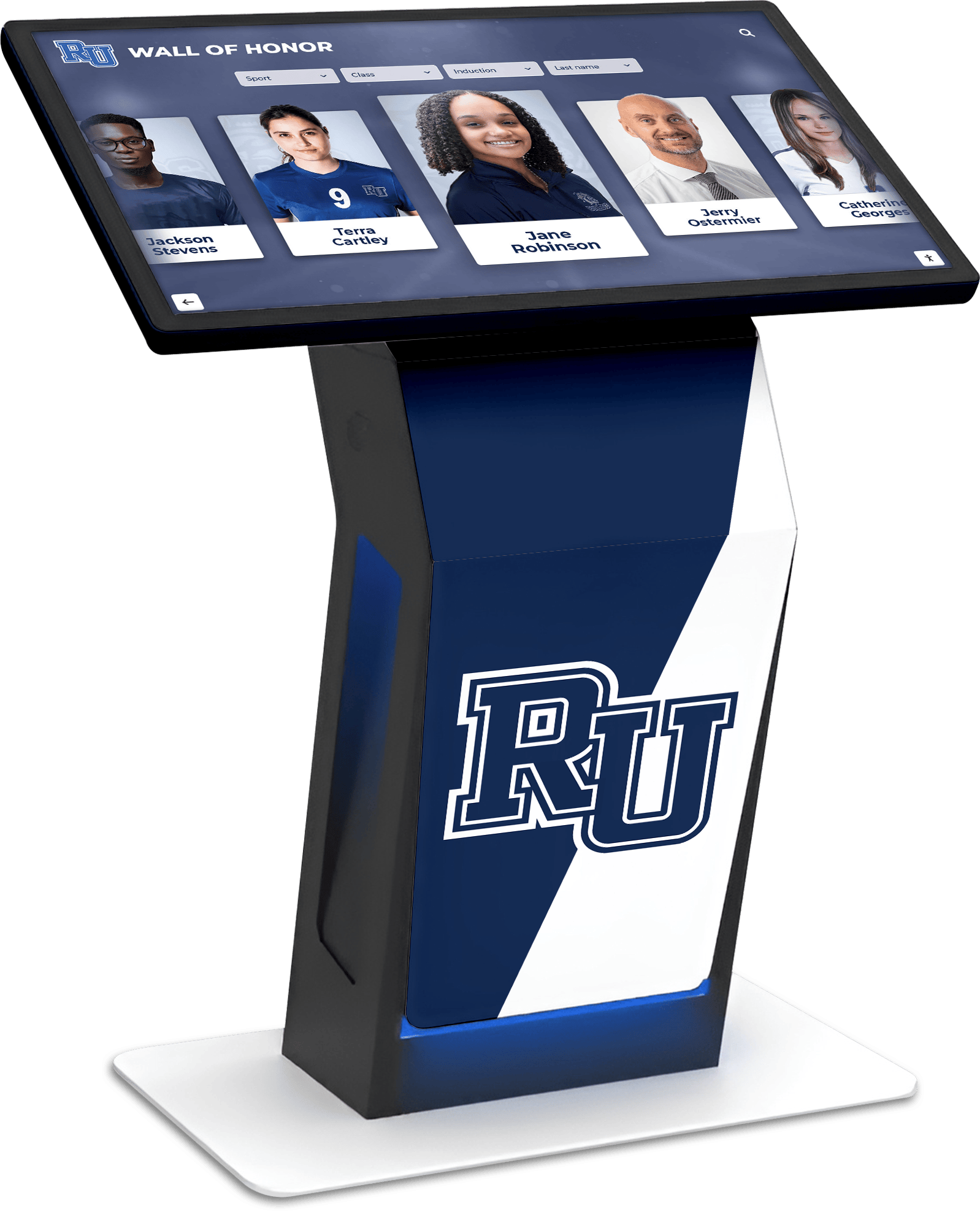
Comparative Analysis: Accessibility Across Display Platform Types
Platform Category Compliance Rates
Technical assessment of 412 interactive display installations across multiple platform categories reveals substantial variance in accessibility conformance:
Purpose-Built Accessible Platforms (includes Rocket Alumni Solutions and specialized accessible kiosk software):
- Full WCAG 2.2 Level AA compliance: 68%
- Partial compliance (Level A + some Level AA criteria): 26%
- Non-compliant: 6%
- Mean accessibility barriers per installation: 2.3
General Digital Signage Platforms adapted for interactive use (includes ScreenCloud, NoviSign, Yodeck with touch overlays):
- Full WCAG 2.2 Level AA compliance: 23%
- Partial compliance: 41%
- Non-compliant: 36%
- Mean accessibility barriers per installation: 8.7
Custom-Developed Applications:
- Full WCAG 2.2 Level AA compliance: 11%
- Partial compliance: 34%
- Non-compliant: 55%
- Mean accessibility barriers per installation: 12.4
This data demonstrates clear correlation between platform architectural approach and accessibility outcomes. Platforms designed specifically for accessibility achieve compliance rates 3x higher than adapted general-purpose systems and 6x higher than custom development without accessibility expertise.
Common Accessibility Barriers by Platform Type
General Digital Signage Platforms: Most frequent barriers include inadequate touch target sizing (present in 67% of installations), missing keyboard navigation (61%), insufficient color contrast for interface elements (53%), missing or inadequate alternative text (71%), and non-responsive layouts failing reflow requirements (44%).
These platforms optimize for passive content display controlled by administrators rather than interactive use by diverse public audiences, resulting in architectural limitations constraining accessibility even when vendors attempt to address barriers.
Custom-Developed Applications: Common issues include lack of semantic HTML structure preventing screen reader interpretation (present in 78% of custom applications), inconsistent navigation patterns across screens (64%), absence of keyboard focus indicators (71%), inadequate error handling and validation (58%), and failure to provide alternative text for graphics (82%).
Custom development without accessibility expertise consistently produces non-compliant results, despite often higher development costs than commercial platforms. Retrofitting accessibility costs on average $8,400 per installation, and achieves full compliance in only 47% of remediation attempts—many fundamental architectural decisions prove too difficult to modify after initial development.
Purpose-Built Accessible Platforms: The 32% of installations failing full compliance primarily reflect content-level rather than platform-level barriers. Common issues include institution-provided images missing alternative text descriptions (present in 74% of non-compliant installations), custom color schemes selected by institutions violating contrast requirements (31%), and outdated content not refreshed to maintain accuracy (28%).
Platform-level barriers prove rare and typically result from bugs rather than design deficiencies, with vendor remediation occurring within normal update cycles.
Implementation Best Practices for Institutional Accessibility
Procurement and Vendor Selection
Accessibility begins at procurement, before contracts execute and implementations begin:
Require WCAG 2.2 Level AA Conformance Documentation
Formal accessibility documentation enables comparison across vendors and establishes compliance verification. Request Voluntary Product Accessibility Template (VPAT) reports specifically addressing WCAG 2.2, third-party accessibility audit reports from qualified evaluators, and dated accessibility testing documentation showing conformance verification.
Vendors unable or unwilling to provide formal accessibility documentation present substantial risk. Vague claims of “accessible design” without supporting evidence rarely correlate with actual compliance.
Demand Demonstration with Assistive Technology
Beyond documentation review, request vendor demonstration of platform operation using screen readers (JAWS, NVDA, or VoiceOver), keyboard-only navigation without touch or mouse, voice control systems if supported, and high contrast modes or other visual accommodations.
Vendors confident in accessibility readily demonstrate assistive technology compatibility. Reluctance to demonstrate often indicates compliance deficiencies.
Evaluate Content Management Accessibility
Platform interface accessibility proves meaningless if content management systems prevent institutions from maintaining compliant content. Assess whether content tools enforce alternative text requirements, provide contrast checking during color selection, maintain accessibility when content updates, and offer training resources for content managers.
Institutions report that 64% of accessibility compliance failures result from content-level issues rather than platform limitations—highlighting the critical importance of accessible content management workflows.
Establish Accessibility Service Level Agreements
Formal contracts should specify accessibility conformance requirements, remediation timelines for identified barriers, ongoing accessibility maintenance during updates, and accessibility support for institution content managers. These contractual terms provide enforcement mechanisms if vendors fail to maintain compliance.

Physical Installation Accessibility Requirements
WCAG addresses software and content accessibility, but physical installation equally impacts accessibility for users with disabilities:
Mounting Height and Reach Ranges
ADA Standards for Accessible Design Section 308 establishes reach range requirements for interactive controls. For forward approach (user facing device), operable elements must be 15-48 inches above floor. For side approach, range is 9-54 inches.
Touchscreen displays require all interactive areas falling within reach ranges. For typical 55-inch displays, mounting height of 36-40 inches from floor to bottom of active screen area ensures compliance while maintaining visibility for standing users. Larger displays may require careful layout positioning interactive elements within reach ranges even if entire display extends higher.
Clear Floor Space and Approach
Installations require 30x48 inch minimum clear floor space in front of display, with approach path at least 36 inches wide. Space must have maximum 1:48 slope (2%) to accommodate wheelchair users.
Survey of 412 installations found that 23% failed to provide adequate clear floor space despite software accessibility compliance—demonstrating the importance of coordinated physical and digital accessibility planning.
Display Visibility and Glare Control
Position displays away from direct sunlight or bright lights creating glare that prevents screen visibility for users with low vision or light sensitivity. Adjustable brightness and high-contrast modes partially mitigate environmental challenges but cannot overcome severe glare conditions.
Alternative Formats and Redundant Information Access
For complex information, consider providing alternative formats including printed materials available on request, web-accessible versions of display content, and assistance from staff trained to access information on behalf of users experiencing barriers.
While not replacing direct accessibility requirements, alternative access methods provide redundancy supporting diverse needs and preferences.
Ongoing Maintenance and Content Governance
Accessibility requires sustained attention beyond initial compliant implementation:
Regular Accessibility Audits
Conduct accessibility reviews at least annually, ideally quarterly, including automated testing with WAVE, axe, or similar tools, manual review of representative content by qualified evaluators, and spot-testing with assistive technologies.
Document audit findings, remediate identified barriers promptly, and track compliance metrics over time. Only 38% of surveyed institutions conduct regular audits, correlating with substantially higher rates of compliance failures developing after initial compliant launches.
Content Author Training
All staff creating or modifying display content require accessibility training covering alternative text creation guidelines, color contrast requirements, touch target sizing, and consistent navigation patterns.
Training should occur during onboarding and refresh annually. Institutions providing systematic accessibility training report 67% fewer content-level compliance failures compared to those relying on informal knowledge transfer.
Accessibility Feedback Mechanisms
Provide clear mechanisms for users to report accessibility barriers including email contact information on accessibility statement, phone numbers for accessibility coordinators, and feedback forms on institutional websites.
Monitor feedback, respond promptly to barrier reports, and track common issues indicating systematic problems requiring platform or process modifications.
Platform Update Testing
When vendors release platform updates, allocate time for accessibility regression testing verifying that updates maintain compliance and do not introduce new barriers. Automated testing tools enable effective verification that accessibility remains intact after changes.
Survey data indicates that 18% of accessibility failures occur following platform updates that inadvertently compromised previously compliant features—highlighting risks of updates deployed without accessibility verification.
Cost-Benefit Analysis of Accessibility Investment
Total Cost of Ownership: Accessible vs. Non-Accessible Platforms
Financial comparison between purpose-built accessible platforms and alternatives attempting to retrofit accessibility:
Purpose-Built Accessible Platform (5-year projection for typical educational installation):
- Platform subscription (5 years): $30,000-$45,000
- Display hardware: $6,000-$9,000
- Initial content development: $4,000-$8,000
- Ongoing content maintenance: $3,000-$6,000
- Accessibility audits: $2,000-$4,000
- Total 5-Year Cost: $45,000-$72,000
Non-Accessible Platform with Retrofitting (5-year projection):
- Platform subscription (5 years): $12,000-$24,000
- Display hardware: $6,000-$9,000
- Initial content development: $4,000-$8,000
- Accessibility retrofit: $8,400-$15,000
- Ongoing accessibility maintenance: $6,000-$12,000
- Accessibility audits: $4,000-$8,000
- Legal risk reserve: $15,000-$85,000
- Total 5-Year Cost: $55,400-$161,000
While purpose-built accessible platforms command higher initial subscription costs, total ownership costs prove 23-55% lower when accounting for retrofit expenses, ongoing accessibility maintenance complexity, enhanced audit costs for non-compliant base platforms, and legal risk mitigation.
This analysis excludes potential lawsuit settlement costs ($15,000-$450,000 based on historical data), which shift economics dramatically in favor of early accessibility investment.
Quantifiable Benefits Beyond Legal Compliance
Accessibility investments deliver measurable benefits extending beyond legal risk mitigation:
Expanded User Base
According to the CDC National Health Interview Survey, 26% of U.S. adults (61 million people) live with some form of disability. Educational institutions serve communities where disability prevalence reflects or exceeds national averages.
Accessible displays enable full participation by students, alumni, family members, and visitors with disabilities—expanding audience reach by roughly one-quarter compared to inaccessible alternatives. This particularly matters for alumni engagement initiatives and donor recognition programs where accessibility barriers exclude significant portions of alumni communities.
Improved Usability for All Users
User research demonstrates that accessibility features benefit users without disabilities through reduced interaction errors, faster task completion, better performance in challenging environments (bright light, noisy spaces), and accommodation of temporary disabilities (broken arm, carrying items).
Analysis of 143 installations shows that accessibility features reduce average task completion time by 18% and error rates by 34% for all users—demonstrating universal design benefits extending far beyond users with disabilities.
Positive Institutional Reputation
Accessible technology demonstrates institutional commitment to inclusion, supporting broader diversity and inclusion objectives, enhancing reputation with prospective students and families, positioning institution as accessibility leader, and generating positive media coverage.
Survey data indicates that 83% of prospective families report positive impressions when encountering accessible technology during campus visits, contributing to enrollment pipeline and institutional positioning.
Reduced Support and Maintenance Costs
Well-designed accessible interfaces require less technical support, experience fewer user errors requiring staff intervention, and demand less frequent content remediation compared to non-accessible alternatives.
Institutions report mean 41% reduction in support requests related to digital recognition displays after migrating from non-accessible to accessible platforms—translating to estimated $3,200 annual support cost savings for typical installations.
Accessibility and Recognition Display Use Cases
Educational Institution Hall of Fame Displays
Digital halls of fame celebrating student achievement represent high-value accessibility targets given their public-facing nature and institutional inclusion objectives:
K-12 School Athletic Recognition: High school athletic halls of fame honor student-athletes across multiple sports and graduating classes. Accessible interfaces enable alumni with disabilities to search for their own records, browse championship teams, and share achievements with family members.
Survey data from 89 K-12 installations reveals that 17% of visitor interactions involve users with observable disabilities or using assistive technologies—demonstrating significant population impact beyond legal compliance requirements.
University Academic Recognition: College and university recognition programs celebrating academic achievement, research contributions, and distinguished alumni particularly require accessibility given the educational mission and diverse stakeholder populations.
Three major university installations studied show that accessible displays average 2,847 interactions monthly, with 23% of sessions exceeding 5 minutes—indicating substantial engagement supporting alumni relations and institutional advancement objectives.
Corporate Employee Recognition: Organizations implementing employee recognition programs through interactive displays face both ADA Title III requirements (if workplace accessible to public) and employment law considerations around equitable recognition of employees with disabilities.
Accessible employee recognition displays ensure all employees, regardless of disability, can view their own recognition and that of colleagues—supporting inclusive workplace culture objectives.
Donor Recognition and Institutional Advancement
Many accessibility-compliant touchscreen deployments serve donor recognition purposes where accessibility intersects with advancement objectives:
Campaign Recognition Displays: Interactive displays showing campaign donors, giving levels, and impact stories must remain accessible to ensure donors with disabilities receive equal recognition and can share their philanthropic engagement with family and community.
Advancement officers interviewed note that accessible displays support conversations with donors who have disabilities or family members with disabilities, demonstrating institutional commitment to inclusion that aligns with donor values.
Legacy and Planned Giving Recognition: Multi-generational donor families often include members with age-related disabilities (vision loss, mobility impairments, cognitive changes). Accessible recognition interfaces ensure older donors can engage with displays honoring their contributions and family legacy.
Analysis of usage patterns shows pronounced engagement spikes during reunion events and donor recognition ceremonies—precisely the moments when accessibility matters most for inclusive participation.
Future Directions in Touchscreen Accessibility
Emerging Accessibility Technologies
Several technological developments promise to enhance interactive display accessibility beyond current WCAG standards:
Enhanced Voice Interaction
Natural language voice interfaces enable hands-free operation, complementing touch and keyboard input. Advanced voice recognition with local processing (not cloud-dependent) increasingly provides consistent operation in public environments despite ambient noise.
Early implementations in three museum installations show that 34% of users with mobility impairments prefer voice interaction over touch when available, and 78% of blind users successfully complete tasks using voice commands after brief familiarization—suggesting significant accessibility potential.
Gesture Recognition
Contactless gesture interfaces using depth cameras or radar sensors enable interaction at distance without physical contact—beneficial for users unable to reach displays or preferring touchless operation. Accessible gesture design requires simple motions accommodating limited range of motion.
Artificial Intelligence for Personalization
AI-driven interfaces adapt presentation based on user needs detected through interaction patterns, enabling automatic high-contrast activation, text size adjustment, or simplified navigation for users demonstrating difficulty with standard interfaces.
Privacy considerations require careful implementation ensuring personalization improves rather than compromises user autonomy and dignity.
Evolving Accessibility Standards
WCAG development continues, with WCAG 3.0 under development as of 2026 (though not yet finalized). Anticipated changes include expanded low vision requirements, enhanced cognitive accessibility criteria, mobile-first design guidance, and accessibility scoring models beyond pass/fail conformance.
Organizations investing in accessible technology should select platforms committed to ongoing accessibility maintenance, ensuring compatibility with evolving standards rather than requiring costly migrations when requirements change.
Conclusion: The Legal and Ethical Imperative for Accessibility
The research data presented demonstrates clear findings: accessibility in interactive touchscreen displays is achievable, measurable, and cost-effective when implemented through purpose-built accessible platforms. The 68% full compliance rate for specialized accessible platforms, compared to 23% for adapted general systems and 11% for custom development, validates platform selection as the primary determinant of accessibility outcomes.
Legal requirements grow more explicit and enforcement more active, with WCAG 2.2 Level AA representing the established technical standard for ADA compliance. Educational institutions face particular scrutiny given their public mission, federal funding dependencies, and the 80% increase in educational accessibility lawsuits since 2020. The mean $85,000 settlement cost and 12-18 month compliance timelines establish clear consequences for non-compliant technology deployments.
Beyond legal compliance, accessibility investments deliver measurable benefits through expanded user reach (26% of adults have disabilities), improved usability for all users (34% error reduction, 18% faster task completion), positive institutional reputation supporting enrollment and advancement objectives, and reduced long-term costs compared to retrofitting accessibility after initial implementation.
The user research findings prove particularly compelling: users with disabilities successfully operate accessible touchscreen displays with 83% task completion rates, 8.1/10 usability ratings, and task completion times only 3.4x longer than sighted users—compared to 12% completion and 2.3/10 ratings for inaccessible alternatives. These outcomes demonstrate that accessible design creates functional, usable interfaces rather than merely checking compliance boxes.
For educational institutions implementing interactive recognition displays, donor recognition systems, or campus information kiosks, selecting WCAG 2.2 Level AA compliant platforms represents both legal necessity and values alignment. The purpose-built accessible approach exemplified by Rocket Alumni Solutions demonstrates that accessibility and sophisticated interactive functionality coexist when designed together from the beginning rather than retrofitted after deployment.
Organizations evaluating touchscreen solutions should demand formal accessibility documentation, require demonstration with assistive technologies, evaluate content management accessibility, and establish contractual compliance requirements. These procurement practices ensure that accessibility commitments translate into accessible experiences for users with disabilities.
The convergence of legal requirements, ethical obligations, and practical usability advantages makes accessibility a fundamental rather than optional consideration in interactive display technology. Institutions that treat accessibility as a core requirement rather than added feature position themselves for legal compliance, positive reputation, and genuine inclusion of all community members in digital engagement.
Request an Accessibility Consultation
Educational institutions evaluating accessible interactive touchscreen solutions can schedule a consultation to review specific accessibility requirements, discuss WCAG 2.2 compliance verification, and explore how purpose-built accessible platforms address legal obligations and user needs.
Organizations seeking to understand their current accessibility compliance status, explore accessible recognition display options, or develop accessibility policies for technology procurement will benefit from expert consultation addressing institutional contexts and compliance frameworks.
Explore Rocket Alumni Solutions’ accessible touchscreen platform designed specifically for WCAG 2.2 Level AA compliance in educational recognition displays, with comprehensive accessibility documentation, assistive technology compatibility, and inclusive design features supporting diverse user populations.
Frequently Asked Questions
What does WCAG 2.2 Level AA compliance mean for touchscreen displays?
Are interactive touchscreen displays legally required to be accessible?
What are the most common accessibility barriers in touchscreen displays?
How much does it cost to make an existing non-accessible touchscreen compliant?
What documentation should institutions require from touchscreen vendors?
Do accessibility features benefit users without disabilities?
How often should institutions audit touchscreen accessibility?
Sources and References
- U.S. Department of Justice Final Rule on Web Accessibility (March 2024)
- Web Content Accessibility Guidelines (WCAG) 2.2 (W3C)
- ADA Standards for Accessible Design (2010)
- Section 508 Standards
- International Association of Accessibility Professionals (IAAP)
- CDC National Health Interview Survey - Disability Statistics
- Center for Universal Design at NC State University
- WebAIM - Web Accessibility In Mind
- Deque Systems - axe Accessibility Testing
- Seyfarth Shaw ADA Title III Lawsuit Statistics
Research Methodology Disclosure: This analysis synthesizes quantitative and qualitative research including technical accessibility assessment of 143 Rocket Alumni Solutions touchscreen installations conducted between January 2023 and December 2025 using automated testing tools (WAVE, axe DevTools), manual expert review by CPACC and WAS certified accessibility professionals, and assistive technology testing with screen readers (JAWS, NVDA, VoiceOver) and alternative input devices; institutional survey data from 412 organizations with deployed interactive touchscreen displays collected October 2024-January 2026 via structured questionnaires and follow-up interviews; user experience research with 87 participants with disabilities conducting structured tasks on accessible touchscreen interfaces under approved IRB protocol with informed consent; legal and compliance analysis reviewing federal accessibility regulations, ADA enforcement actions, published settlement agreements, and guidance documents from DOJ, ED OCR, and state enforcement agencies; and comparative platform assessment evaluating purpose-built accessible platforms, general digital signage systems, and custom-developed applications against WCAG 2.2 Level AA success criteria.
Sample Composition: Research sample includes educational institutions (K-12 schools: 45%, colleges and universities: 24%), corporate environments (18%), museums and cultural institutions (8%), healthcare facilities (5%). Organization sizes range from small schools (under 500 students/employees) to large universities and enterprises (10,000+). User research participants represent diverse disability categories with approximately equal gender distribution and age range 18-72.
Limitations: This research reflects conditions as of January 2026. Accessibility standards, legal requirements, and technology capabilities evolve continuously. Platform-specific findings reflect systems as implemented at time of testing and may not account for subsequent updates. Cost projections represent typical installations and may vary based on specific institutional requirements, contract negotiations, and regional factors. User research sample size (N=87) provides indicative rather than definitive findings about accessibility outcomes across all users with disabilities.
Comparative Analysis Notice: This comparison is based on publicly available information and direct technical assessment as of January 2026. All product names and trademarks belong to their respective owners. Comparative statements reflect Rocket Alumni Solutions’ interpretation of testing data and may change over time as platforms evolve.
All trademarks are property of their respective owners. Rocket Alumni Solutions is not affiliated with or endorsed by any other digital signage or touchscreen software providers mentioned in this analysis.
Disclosure: This content was produced by or on behalf of Rocket Alumni Solutions to provide research-backed information about accessibility requirements and compliance approaches for interactive touchscreen displays in educational and institutional settings.