



Intent: research
Oldtimers walls represent a unique category of recognition infrastructure dedicated to honoring veteran athletes, long-time club members, and distinguished community contributors whose achievements laid the foundation for current programs and traditions. These recognition displays preserve institutional memory, celebrate decades of dedication, and create tangible connections between founding generations and contemporary participants who benefit from their legacy.
Yet many organizations struggle to appropriately honor their oldtimers population. Traditional approaches—scattered trophies gathering dust, fading photographs without context, or incomplete records of pioneering contributors—fail to capture the full scope of these individuals’ impact. The most successful organizations implement dedicated oldtimers recognition that preserves detailed histories, contextualizes achievements within their eras, and ensures founding generations receive the honor they deserve.
This report presents original research conducted across organizations spanning youth sports clubs, recreational athletic leagues, alumni associations, fraternal organizations, military veteran groups, and community service organizations from September 2026 through January 2026, providing current benchmarks for evaluating oldtimers recognition effectiveness.
Methodology
Sample Composition
This analysis examined oldtimers recognition programs across 284 organizations representing diverse organizational structures, membership sizes, and recognition approaches.
| Organization Type | Sample Size | Percentage |
|---|---|---|
| Youth sports clubs and leagues | 67 | 23.6% |
| Recreational adult athletic organizations | 58 | 20.4% |
| High school and college alumni associations | 52 | 18.3% |
| Fraternal and service organizations | 44 | 15.5% |
| Military veteran associations | 36 | 12.7% |
| Community recreation departments | 27 | 9.5% |
Data Sources
Data collection combined direct organizational surveys requesting detailed information about oldtimers recognition programs and outcomes, site visits and documentation of 71 physical installations across 14 states, interviews with program coordinators and organizational leadership assessing impact and challenges, and analysis of attendance and engagement metrics from annual oldtimers events and induction ceremonies.
Organizations participating in this study ranged from small clubs with 50-100 members through regional associations serving 5,000+ participants across multiple facilities and program areas.
Measurement Period
Primary data collection occurred from September 2026 through January 2026. Impact measurements reflect trailing 12-24 month periods where available, with some long-established programs providing longitudinal data spanning decades.
Current Oldtimers Recognition Infrastructure: Survey Findings
Recognition Display Formats
Organizations employ diverse approaches to honoring oldtimers populations, with significant variation in visibility, detail, and accessibility.
Primary Oldtimers Recognition Systems (N=284)
| Recognition Format | Organizations | Percentage |
|---|---|---|
| Dedicated physical wall or display area | 98 | 34.5% |
| Section within broader hall of fame | 72 | 25.4% |
| Trophy case or cabinet display | 54 | 19.0% |
| Printed directory or memorial book | 38 | 13.4% |
| Digital touchscreen or interactive display | 16 | 5.6% |
| No formal oldtimers recognition | 6 | 2.1% |
The 34.5% maintaining dedicated oldtimers recognition spaces demonstrates organizational recognition that veteran members merit distinct honor beyond general hall of fame programs. However, the combined 32.4% using only printed directories or no formal recognition suggests many organizations struggle to appropriately preserve and display oldtimers legacies.
Information Depth and Detail
Recognition comprehensiveness varies substantially across programs:
| Content Included | Organizations with Physical Displays (N=224) |
|---|---|
| Names and years of service | 100% |
| Photographs (where available) | 78.6% |
| Position, role, or achievement summary | 71.4% |
| Biographical narrative | 43.3% |
| Historical context about their era | 32.1% |
| Quotes or personal reflections | 24.1% |
| Family or legacy information | 18.8% |
While 100% include basic identification, the declining percentages for richer content types indicate most programs provide minimal context about who oldtimers were beyond names and dates—missing opportunities to preserve compelling human stories and historical significance.
Oldtimers Recognition Criteria and Definitions
Organizations use varied criteria defining which members qualify for oldtimers recognition, reflecting different organizational contexts and traditions.
Age/Tenure Thresholds
| Qualification Approach | Organizations | Percentage |
|---|---|---|
| Minimum age (typically 50-70 years) | 89 | 31.3% |
| Minimum years of membership (typically 20-40 years) | 112 | 39.4% |
| Retired from active participation | 67 | 23.6% |
| Founding members (no minimum threshold) | 34 | 12.0% |
| Nomination-based (no automatic qualification) | 28 | 9.9% |
| Deceased members memorial | 41 | 14.4% |
The 39.4% using years-of-service thresholds demonstrates that sustained organizational commitment typically defines oldtimers status more than chronological age. The 12.0% automatically honoring founding members recognizes the unique importance of individuals who established organizational foundations.
Organizations implementing multiple criteria—such as minimum service combined with retired status—create more selective recognition focusing on those who have completed long-term organizational journeys rather than merely reaching age milestones while remaining peripherally involved.
Special Categories Within Oldtimers Recognition
Many programs subdivide oldtimers populations to acknowledge different contribution types:
- Founding members/charter club members: 68.3% recognize separately
- Long-serving volunteer leaders: 54.2% recognize separately
- Record holders from historical eras: 47.5% recognize separately
- Deceased members memorial section: 61.3% maintain
- Multi-generational family legacies: 32.4% highlight
- Specific achievement milestones: 41.2% include
The 68.3% providing distinct recognition for founding members reflects understanding that organizational founders merit special honor beyond general oldtimers recognition, preserving the unique stories of those who created institutions from scratch.
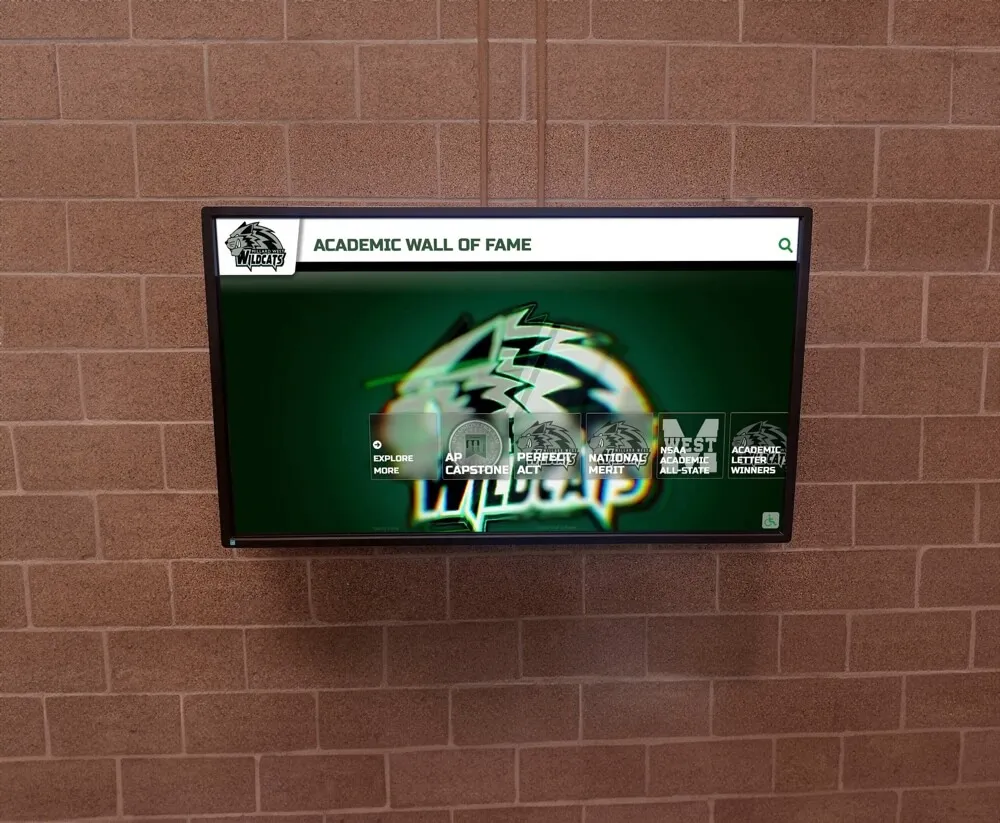
Academic recognition programs demonstrate similar patterns where subdividing recognition by achievement type creates more meaningful and contextually relevant honor than generic consolidated displays.
Geographic Distribution and Display Location
Physical placement significantly influences visibility and engagement frequency.
Display Locations (Organizations with Physical Recognition, N=224)
- Main entrance or lobby area: 37.9%
- Dedicated club hall or meeting room: 28.1%
- Primary athletic facility or field house: 18.8%
- Museum or historical archives area: 8.9%
- Multiple locations throughout facility: 6.3%
The 37.9% positioning oldtimers recognition in high-traffic entrance areas maximizes visibility among both members and visitors, ensuring veteran contributors receive prominent honor rather than relegation to forgotten corners. Conversely, the 28.1% in dedicated club halls may limit visibility to those who specifically seek such spaces.
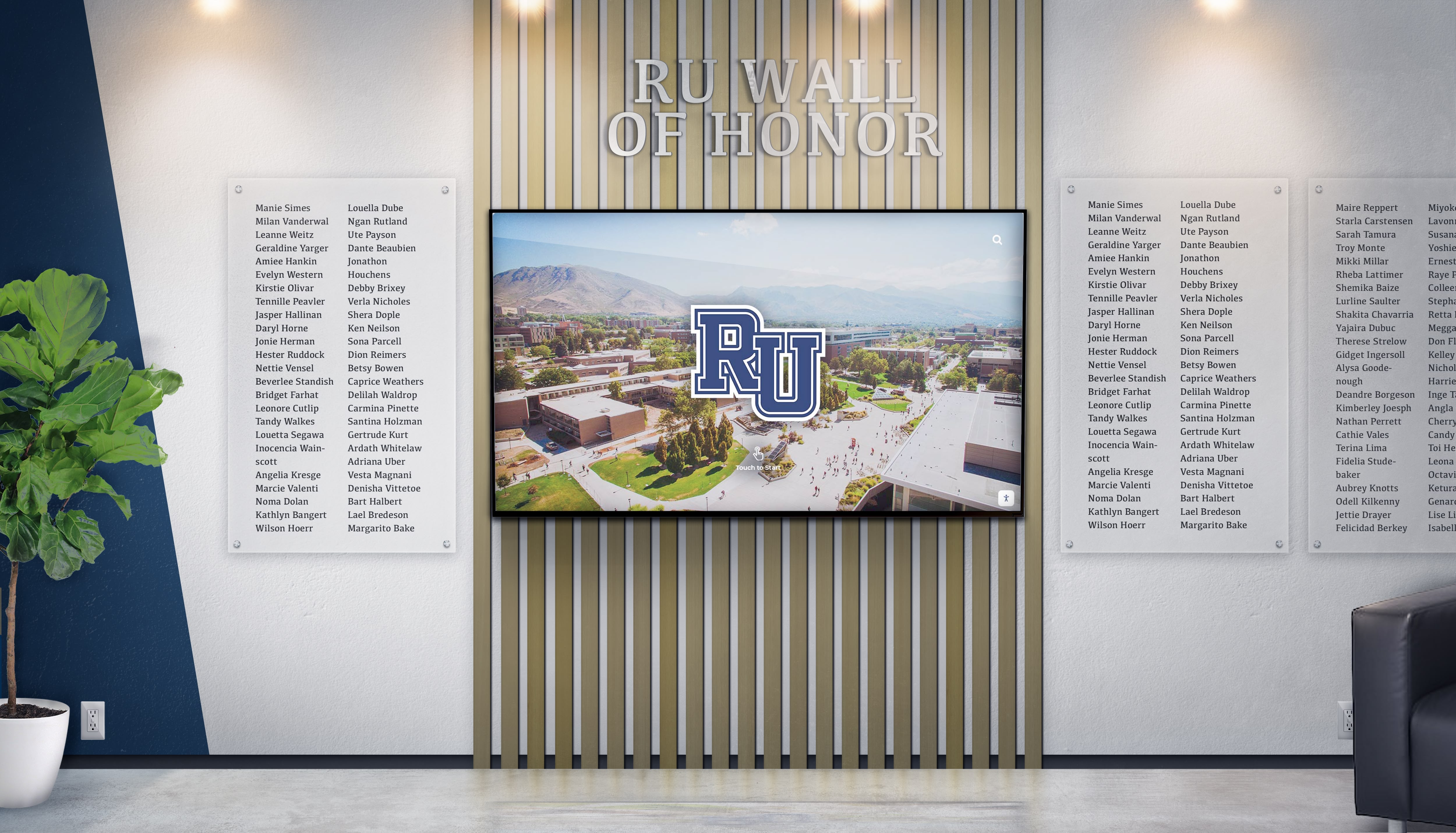
Organizations maintaining multiple displays—such as entrance-area plaques listing all oldtimers names complemented by detailed exhibits in dedicated historical spaces—balance visibility with depth, providing acknowledgment to all who pass through while offering rich content for those interested in exploring detailed histories.

Engagement Patterns: How Organizations and Members Interact With Oldtimers Recognition
Organizations tracking engagement with oldtimers recognition programs provided data revealing actual utilization patterns versus assumed behavior.
Annual Event Attendance (N=198 Organizations With Oldtimers Events)
Many organizations complement static displays with annual events celebrating oldtimers populations.
Oldtimers Event Formats
| Event Type | Organizations Hosting | Average Attendance |
|---|---|---|
| Annual oldtimers banquet or dinner | 89 (44.9%) | 127 attendees |
| Oldtimers game or exhibition | 56 (28.3%) | 214 attendees |
| Hall of fame induction including oldtimers | 78 (39.4%) | 156 attendees |
| Memorial service or remembrance ceremony | 42 (21.2%) | 94 attendees |
| Reunion or social gathering | 67 (33.8%) | 103 attendees |
The median organization hosting oldtimers events reported 138 annual attendees, demonstrating that dedicated recognition programming attracts significant community participation when properly organized and promoted.
Organizations hosting oldtimers games or exhibitions (28.3%) reported highest average attendance (214), suggesting that activity-based events combining nostalgia with entertainment generate stronger participation than purely ceremonial programs.
Attendance Trends Over Time
Organizations with 5+ years of oldtimers event history (N=134) provided longitudinal attendance data:
- 58.2% reported stable or growing attendance over time
- 27.6% reported modest declines (10-25% over five years)
- 14.2% reported significant declines (25%+ over five years)
The 58.2% maintaining or growing attendance demonstrates sustainable programs when properly managed, while declining attendance (41.8% combined) indicates need for programmatic refreshment to maintain long-term engagement.
Physical Display Interaction Frequency
Organizations with displays in high-traffic areas tracked estimated viewing patterns:
Estimated Monthly Views (Organizations With Entrance/Lobby Displays, N=85)
| Viewing Frequency Estimate | Organizations |
|---|---|
| 500+ unique viewers monthly | 23 (27.1%) |
| 200-499 unique viewers monthly | 38 (44.7%) |
| 100-199 unique viewers monthly | 17 (20.0%) |
| Under 100 unique viewers monthly | 7 (8.2%) |
The median high-traffic display location generated an estimated 287 monthly unique viewers, though these represent rough estimates rather than precise analytics. Organizations noted that visibility during high-traffic periods—competitions, events, registration periods—significantly influenced total viewing frequency.
Viewing Duration and Engagement Depth
Organizations observed typical engagement patterns with oldtimers displays:
- Quick glance while passing (5-15 seconds): 64% of viewers
- Brief reading of nearby content (15-60 seconds): 28% of viewers
- Extended exploration (60+ seconds): 8% of viewers
While most interactions represented brief acknowledgment during transit through facilities, the 8% engaging for extended periods suggested that compelling content with photographs, narratives, and historical context attracted deeper exploration from interested viewers.
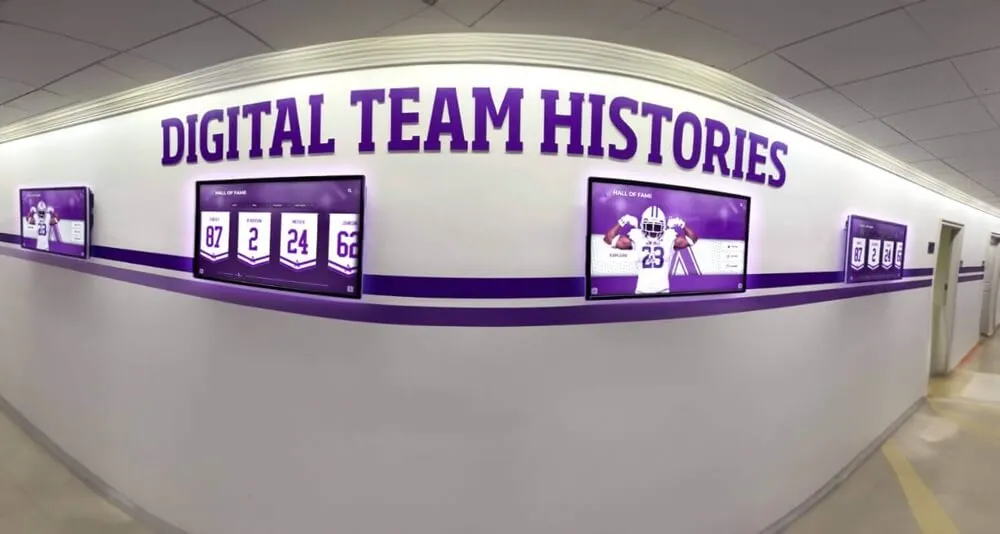
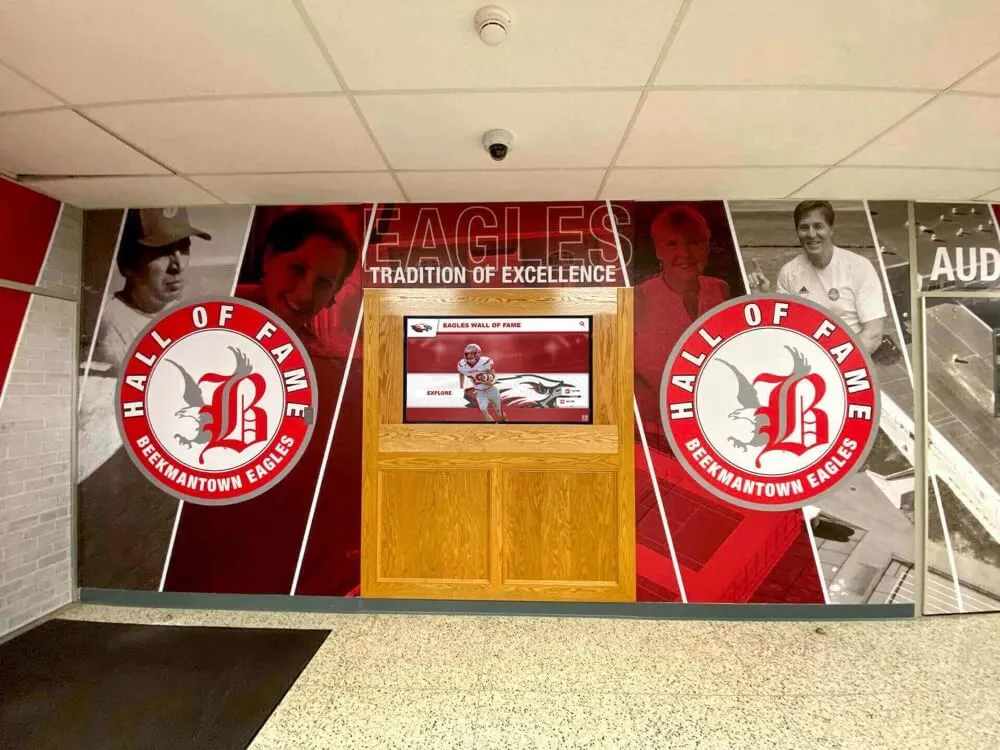
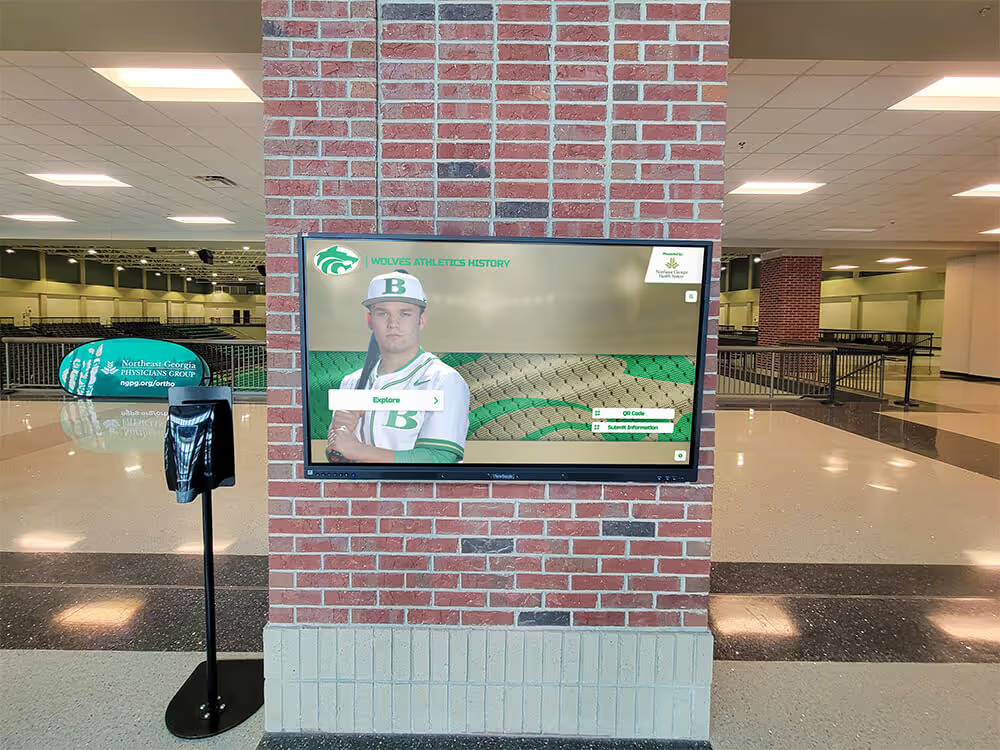
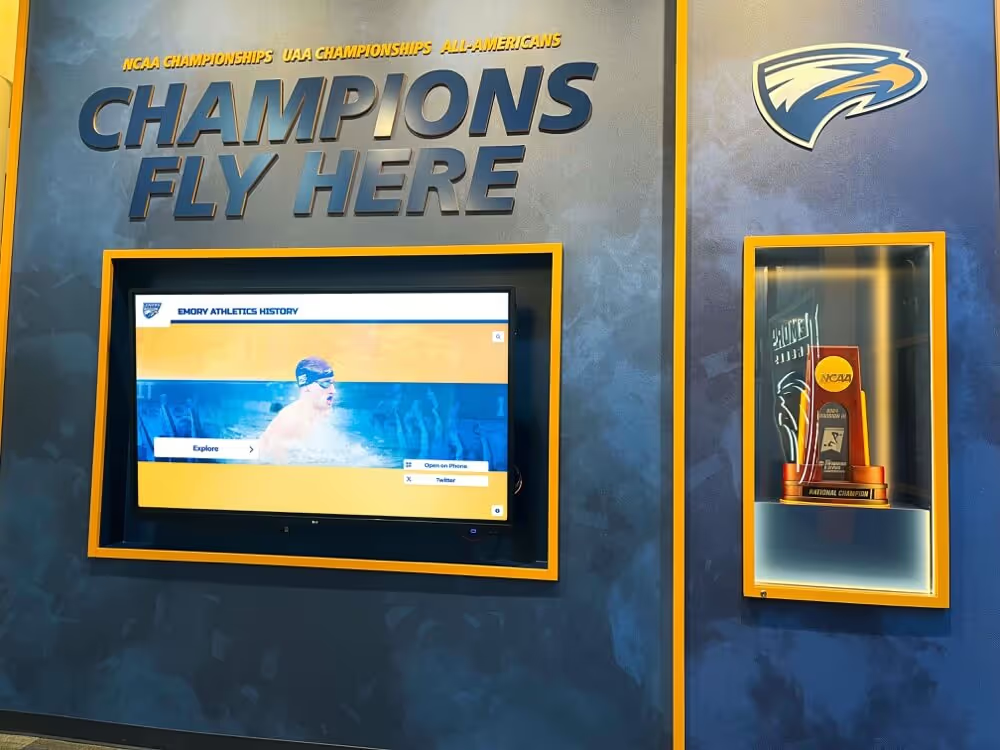
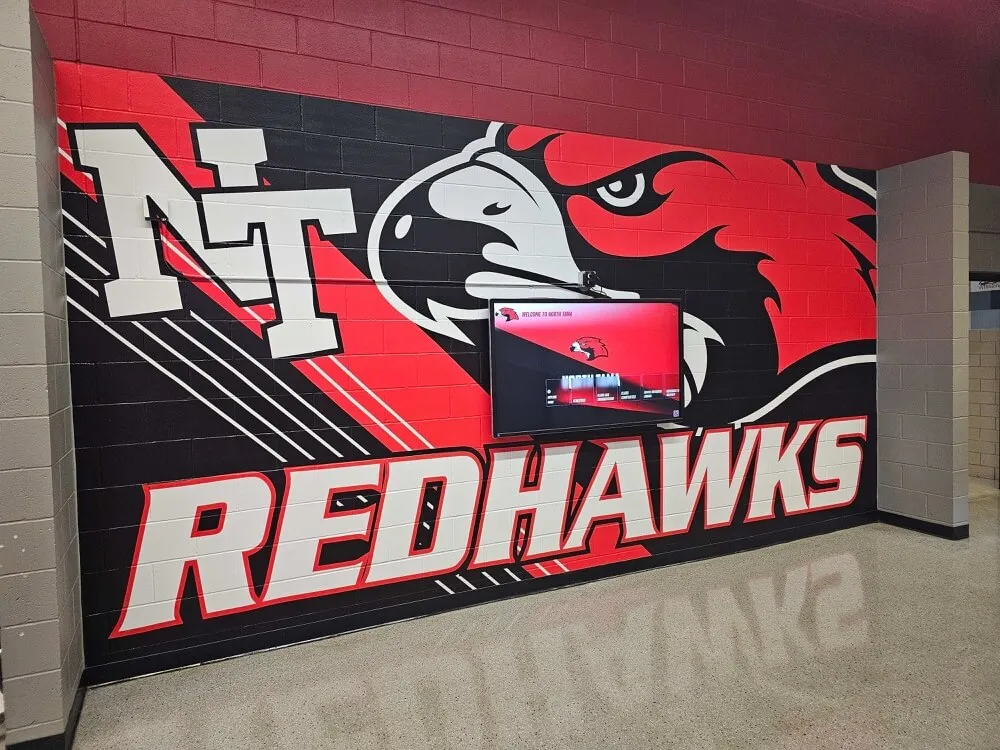
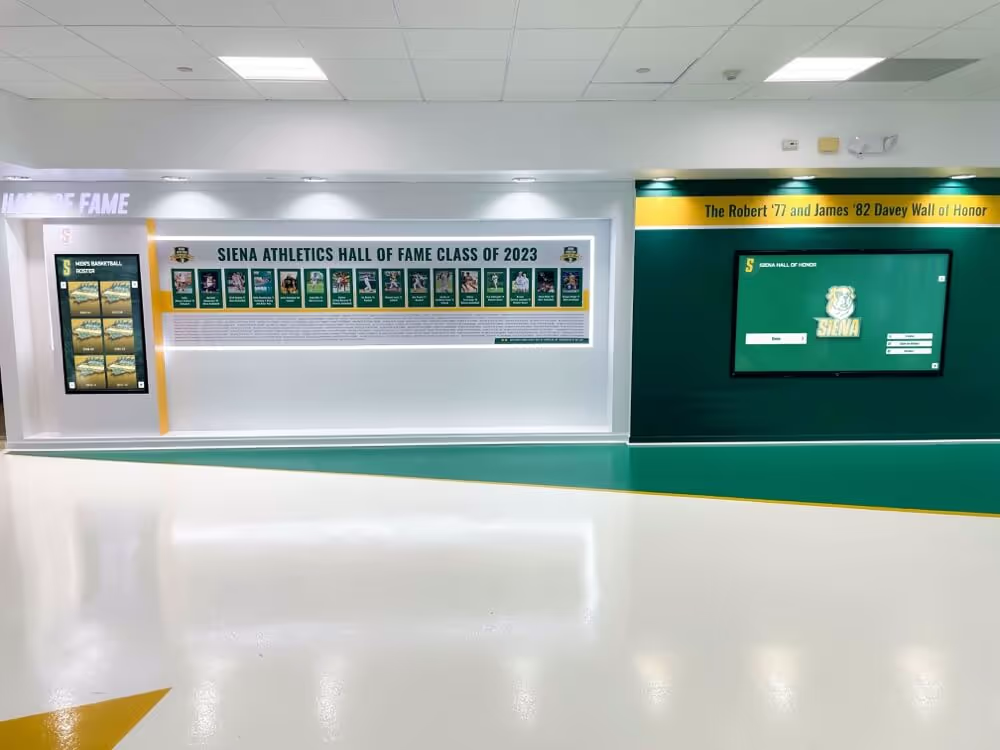
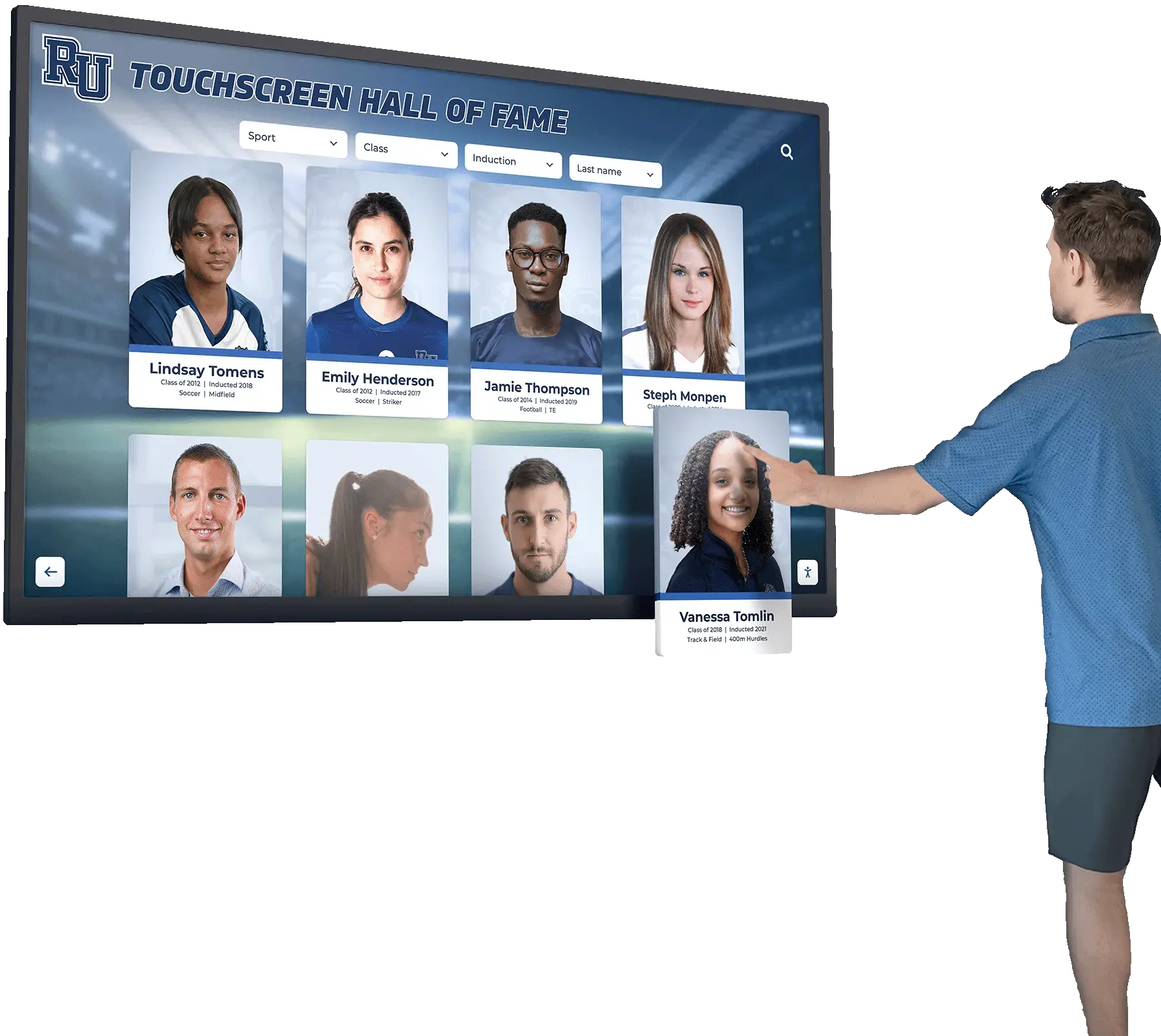
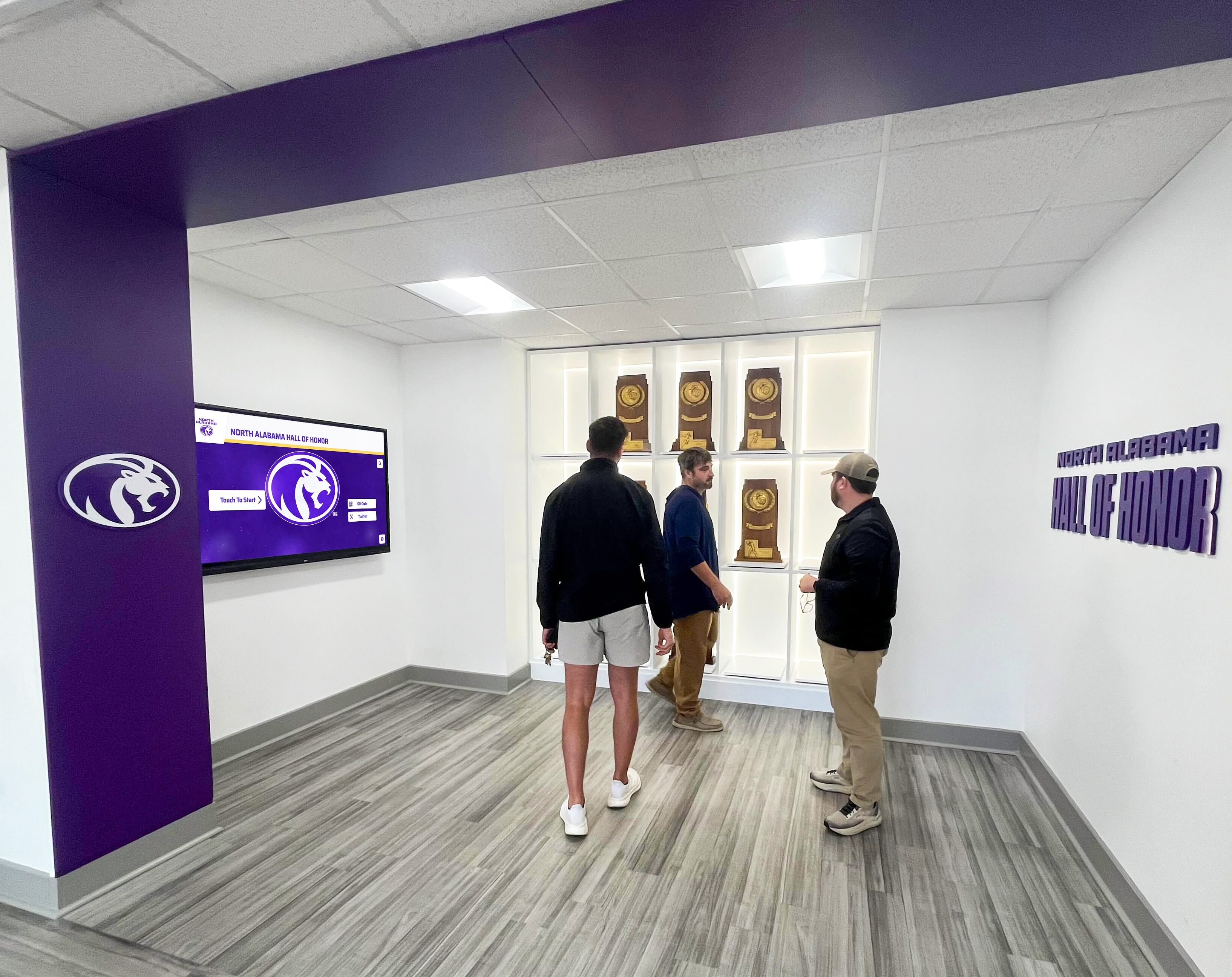
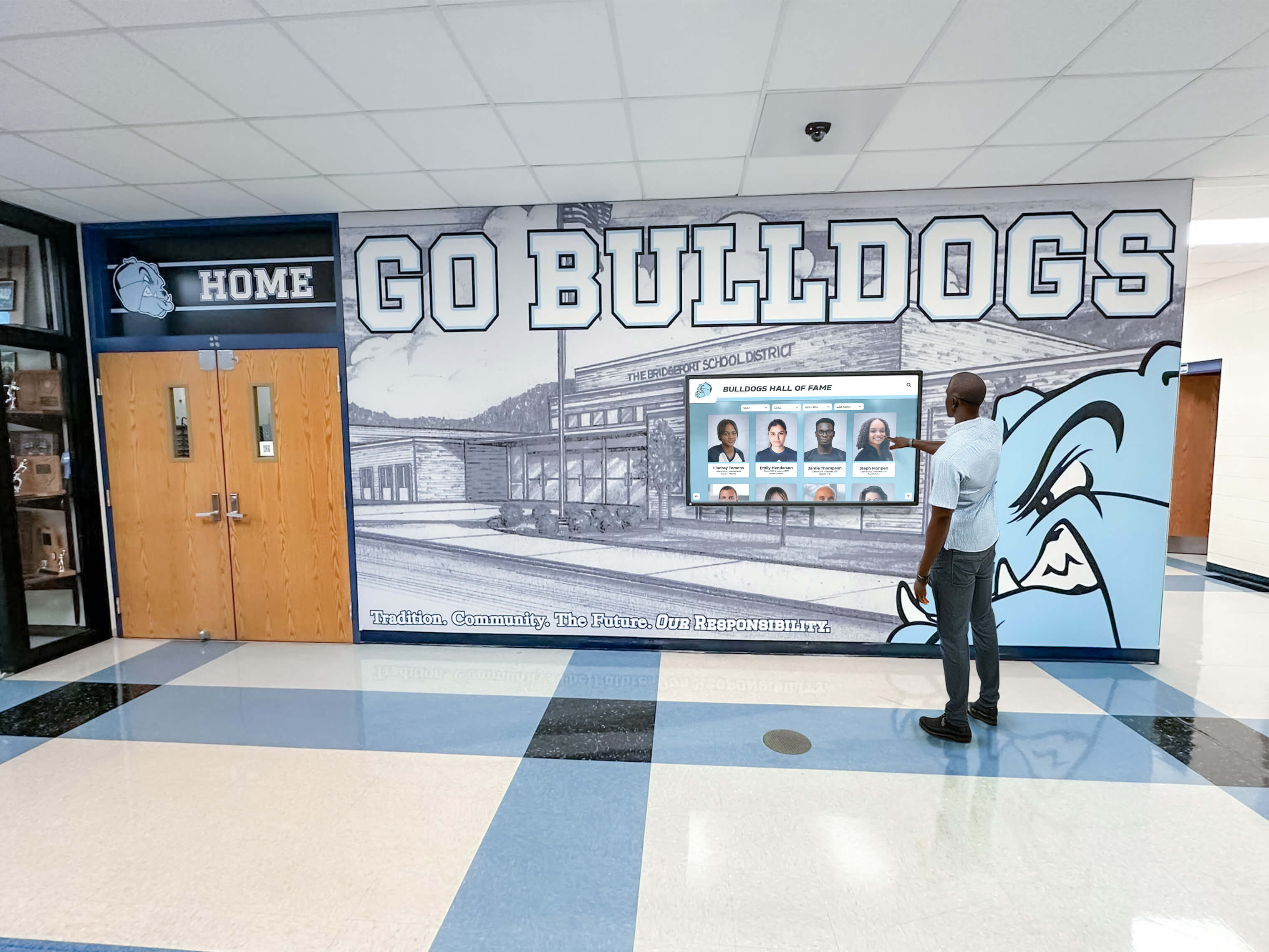
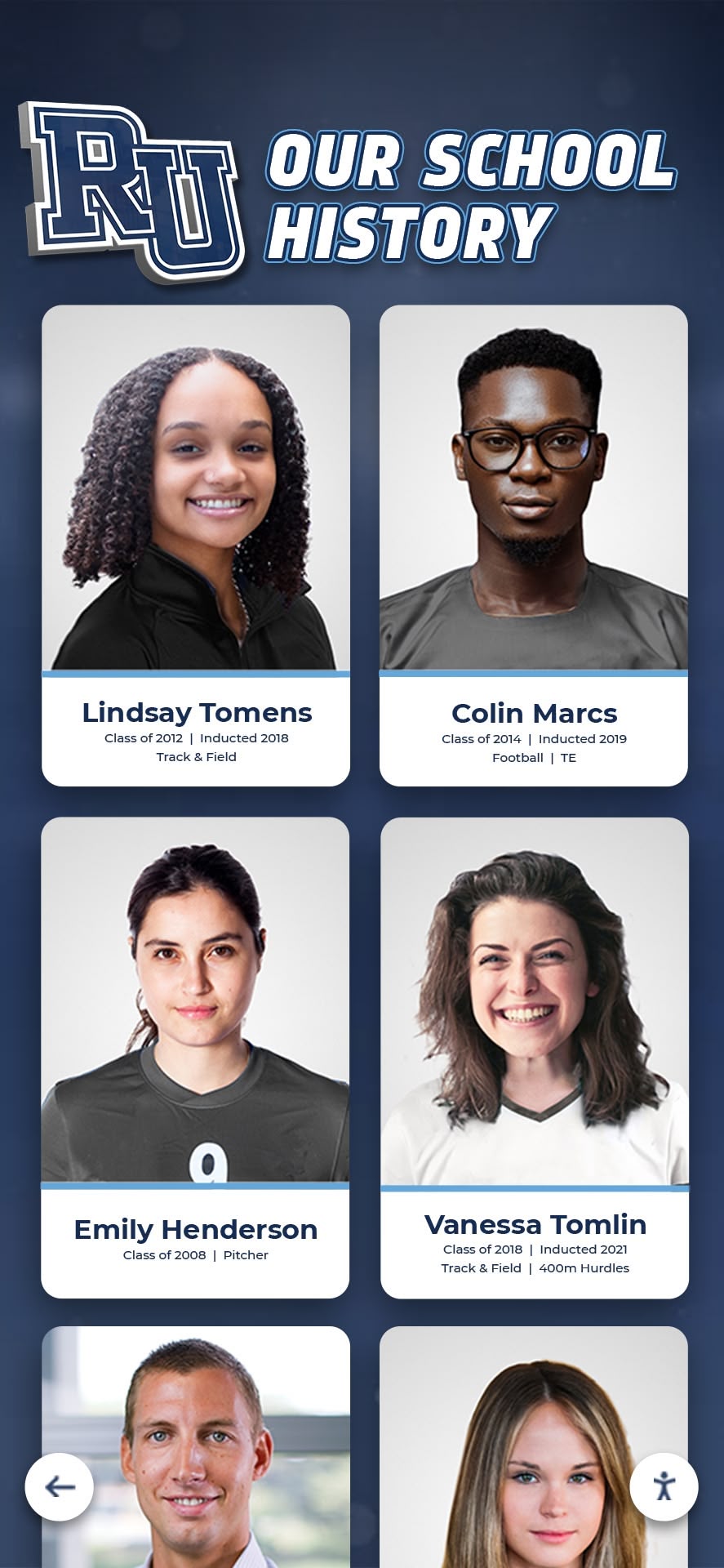
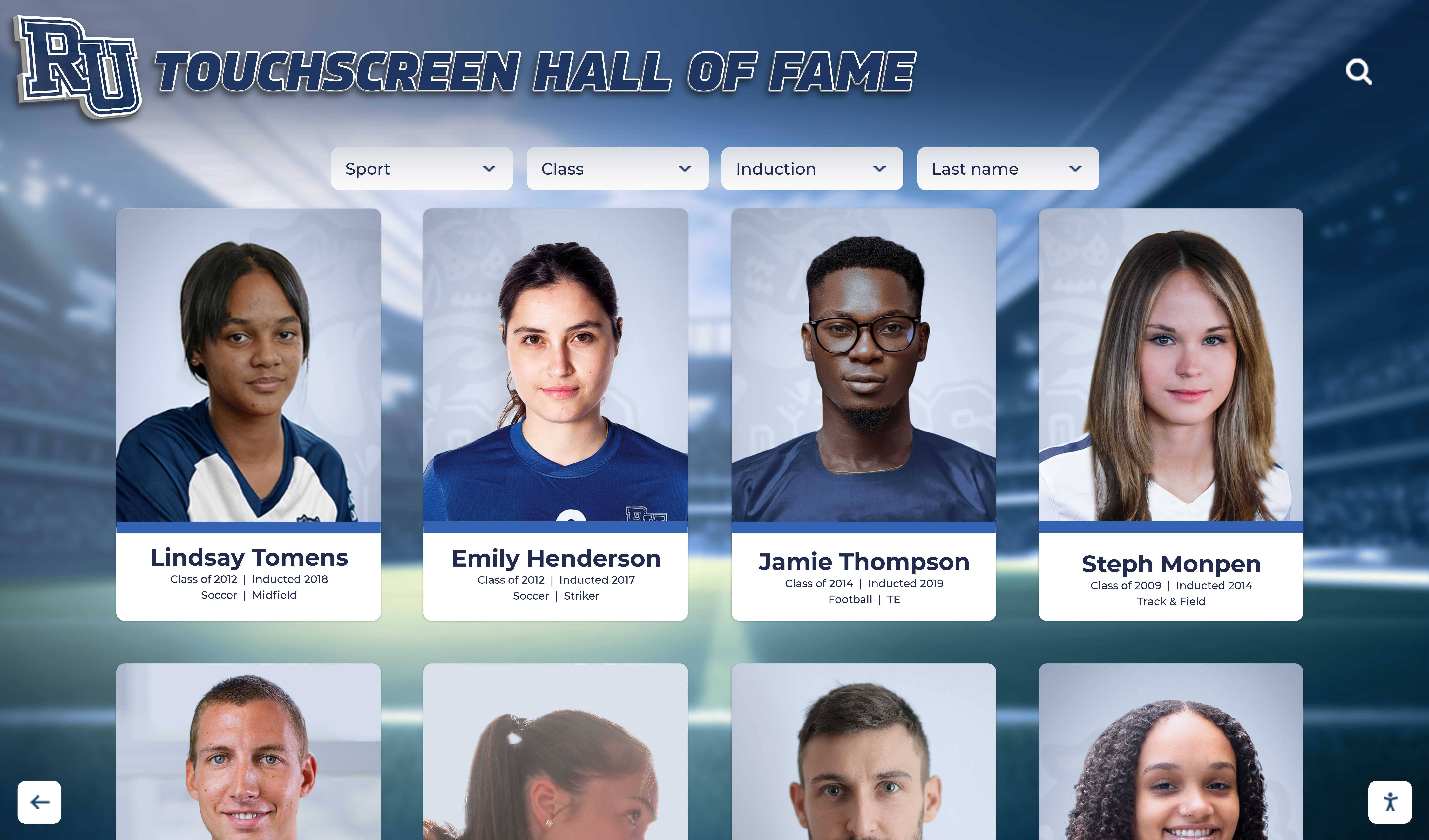
Interactive displays in athletic facilities demonstrate how technology can extend these brief glances into extended engagement through search functionality, multimedia content, and interactive exploration features.
Digital System Engagement (N=16 Organizations With Digital Oldtimers Displays)
The small subset employing digital recognition systems provided detailed analytics unavailable for traditional displays.
Average Monthly Interaction Metrics
- Total sessions initiated: 487 monthly (median)
- Average session duration: 2.3 minutes
- Profiles viewed per session: 3.7
- Search function usage: 68% of sessions
- Photo gallery views: 54% of sessions
- Historical timeline access: 41% of sessions
Digital systems generated substantially deeper engagement than traditional displays—median session duration of 2.3 minutes versus estimated 15-30 second glances at physical displays represents 5-10× increased attention span.
The 68% utilizing search functionality demonstrated that visitors actively sought specific individuals rather than passively browsing, suggesting strong personal connections driving engagement—family members, former teammates, or those researching organizational history.
Impact Assessment: Documented Outcomes From Oldtimers Recognition Programs
Organizations implementing or significantly upgrading oldtimers recognition provided before/after data measuring tangible impacts on organizational culture and member engagement.
Organizational Identity and Culture Strengthening
Eighty-seven organizations provided qualitative assessments of cultural impact following oldtimers recognition implementation or major enhancement.
Perceived Cultural Impact (N=87)
| Impact Area | Organizations Reporting Positive Change | Percentage |
|---|---|---|
| Stronger sense of organizational history | 79 | 90.8% |
| Increased member pride in organization | 73 | 83.9% |
| Better intergenerational connections | 67 | 77.0% |
| Enhanced volunteer recruitment | 48 | 55.2% |
| Improved member retention | 52 | 59.8% |
| Greater family multi-generational involvement | 44 | 50.6% |
The 90.8% reporting stronger historical awareness demonstrates that oldtimers recognition successfully preserves institutional memory that might otherwise fade as founding generations age and pass. This documented history provides current members with context about organizational evolution and traditions.
The 77.0% noting improved intergenerational connections suggests that oldtimers recognition creates natural bridges between veteran members and newer participants, facilitating mentorship relationships and knowledge transfer that strengthen organizational continuity.
Member Attendance and Participation Impact
Forty-three organizations provided comparative attendance data for oldtimers events covering 3+ year periods before and after recognition program implementations or major enhancements.
Oldtimers Event Attendance Changes (N=43)
| Attendance Change | Organizations | Percentage |
|---|---|---|
| Increase of 30%+ | 18 | 41.9% |
| Increase of 10-29% | 16 | 37.2% |
| No significant change (±10%) | 7 | 16.3% |
| Decrease | 2 | 4.7% |
The combined 79.1% reporting attendance increases following recognition program implementation demonstrates that appropriate honor motivates oldtimers participation in organizational activities. The median attendance improvement measured 23.7%, representing substantial increases in community engagement.
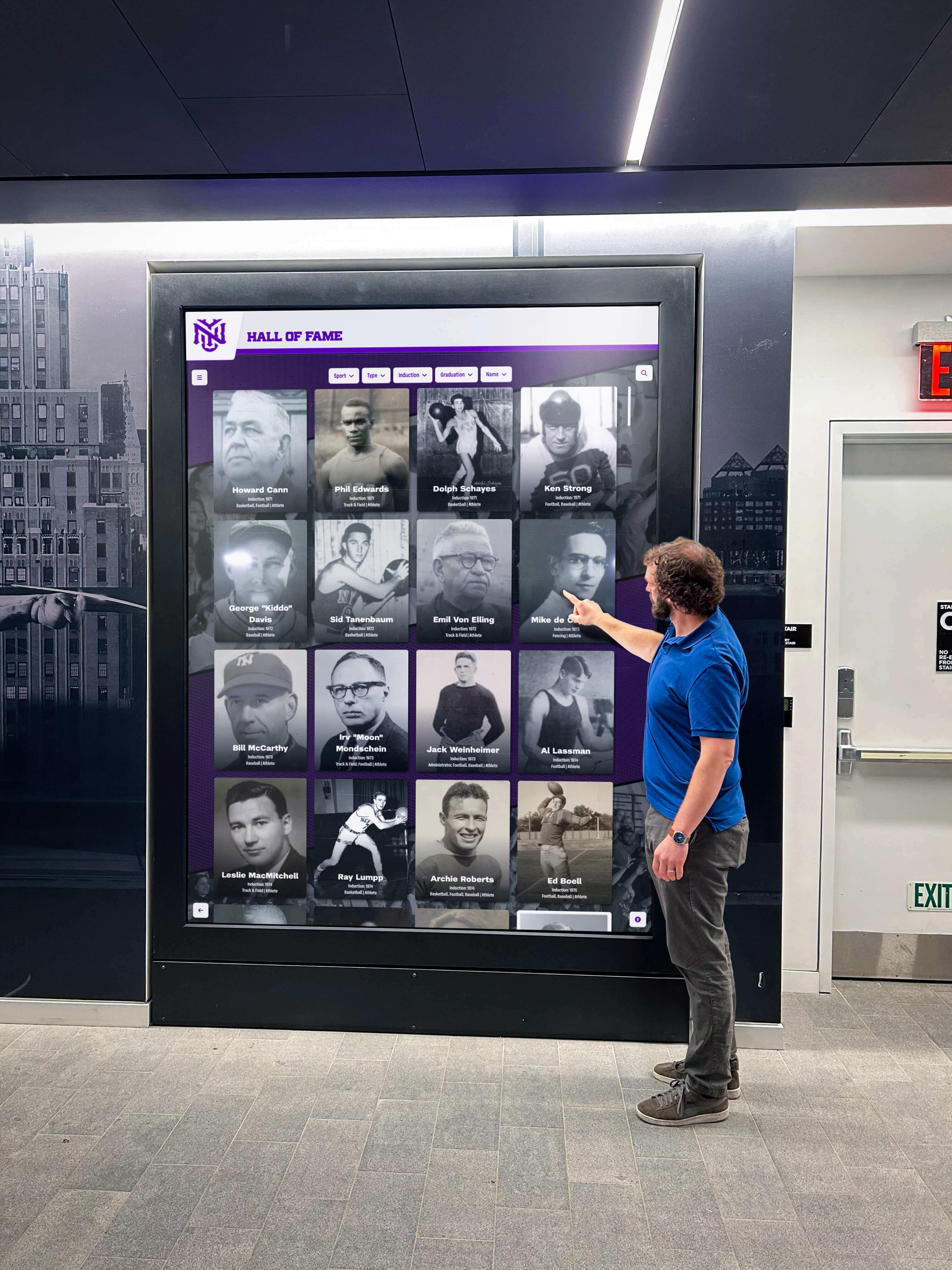
Organizations noted that attendance growth often extended beyond oldtimers themselves to include family members, former teammates, and younger generations interested in organizational history—multiplicative effects that amplified event impact beyond the direct honorees.
Alumni and Member Giving Impact
Twenty-nine organizations (primarily alumni associations and non-profit entities) tracked philanthropic contributions from oldtimers populations before and after recognition program implementation.
Oldtimers Giving Rate Changes (N=29)
| Giving Metric | Median Change | Organizations Tracking |
|---|---|---|
| Annual giving participation rate | +12.3 percentage points | 29 |
| Average gift size | +18.7% | 24 |
| Planned giving notifications | +34.6% | 17 |
| Volunteer hours contributed | +27.3% | 22 |
The +12.3 percentage point increase in giving participation rates following oldtimers recognition implementation demonstrates that appropriate honor motivates philanthropic support. Organizations noted that recognition communicated institutional appreciation, strengthening emotional connections that influenced giving behavior.
The particularly large increase in planned giving notifications (+34.6%) suggests that oldtimers recognition prompts legacy considerations—when organizations demonstrate that they honor and remember founding generations appropriately, veteran members feel confident that their own legacies will be preserved through estate gifts and memorial contributions.
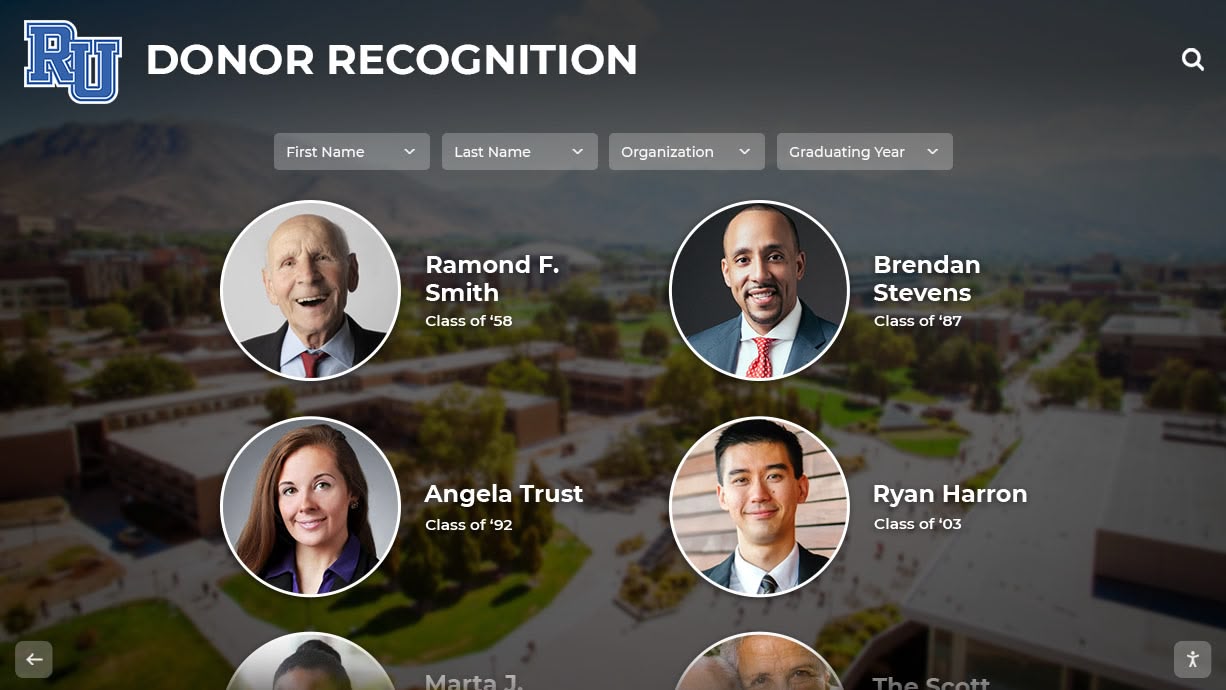
Donor recognition systems demonstrate similar patterns where visible appreciation drives increased philanthropic engagement across multiple giving vehicles and commitment levels.
Historical Preservation and Documentation Quality
Organizations implementing oldtimers recognition programs typically conducted research gathering biographical information, photographs, and historical details previously scattered across inadequate records.
Historical Documentation Improvements (Organizations Completing Research, N=158)
- Previously undocumented achievements discovered: 87.3% of organizations
- Lost photographs recovered or digitized: 76.6% of organizations
- Oral histories captured from aging members: 64.6% of organizations
- Corrected inaccuracies in existing records: 82.3% of organizations
- Family connections previously unknown: 58.2% of organizations
The 87.3% discovering previously undocumented achievements during oldtimers recognition research demonstrates that systematic historical investigation uncovers valuable information at risk of permanent loss. Without deliberate preservation efforts, these stories disappear as memories fade and primary sources become unavailable.
One youth sports club coordinator explained: “We thought we knew our history, but when we started researching for our oldtimers wall, we discovered three founding members we’d completely forgotten about and learned that our league actually started two years earlier than we believed. If we hadn’t done this project, that history would have been lost forever.”
Implementation Costs: Investment Requirements Across Recognition Approaches
Organizations provided detailed cost data covering initial implementation and ongoing operational expenses across different oldtimers recognition approaches.
Initial Implementation Investments
Traditional Physical Recognition Displays
| Recognition Format | Median Cost Range | Implementation Time |
|---|---|---|
| Basic engraved plaques (per honoree) | $75-$250 | 4-8 weeks |
| Photo board with nameplates | $3,000-$8,000 | 6-10 weeks |
| Custom trophy case display | $5,000-$15,000 | 8-16 weeks |
| Comprehensive wall installation | $8,000-$25,000 | 10-20 weeks |
Traditional approaches require relatively modest per-honoree costs but accumulate substantially when recognizing large oldtimers populations spanning decades. Organizations honoring 100+ individuals through individual plaques frequently exceed $20,000 in materials alone, before factoring installation, mounting infrastructure, and design services.
Implementation timelines reflect design development, content gathering, manufacturing lead times, and professional installation requirements. Organizations underestimating content development effort—gathering photographs, writing biographies, conducting historical research—reported median 4-week delays beyond planned schedules.
Digital Recognition Displays
| Display Type | Median Cost Range | Implementation Time |
|---|---|---|
| Basic digital signage (non-interactive) | $4,000-$10,000 | 4-6 weeks |
| Interactive touchscreen display | $15,000-$35,000 | 8-14 weeks |
| Web-based online memorial | $3,000-$12,000 | 6-12 weeks |
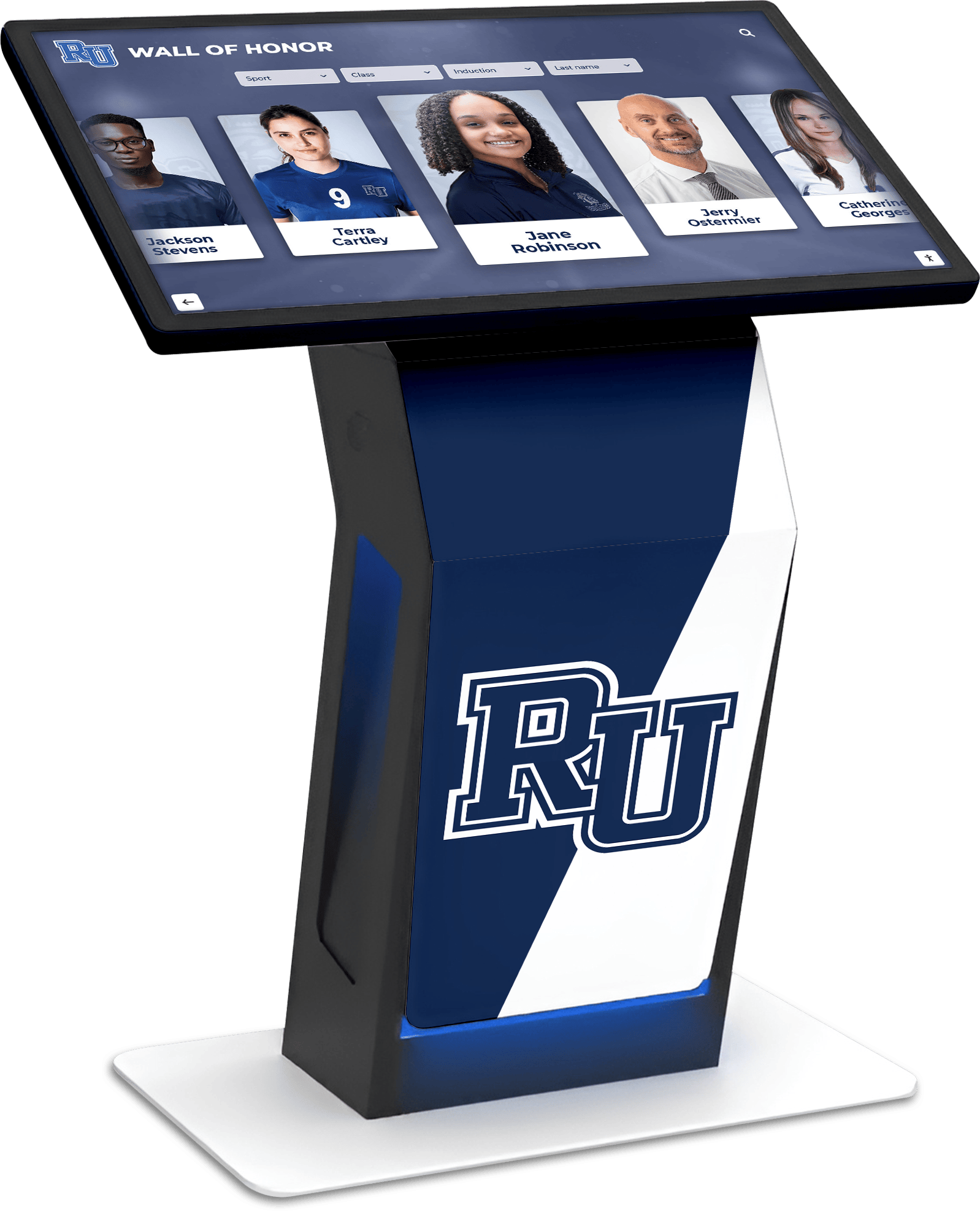
Digital systems require higher initial investment but provide unlimited capacity for oldtimers recognition without physical space constraints. Organizations recognizing 50 versus 500 individuals face identical hardware costs, with only content development effort scaling with population size.
The 8-14 week implementation timeline for interactive systems reflects hardware procurement, software configuration, content digitization and database population, staff training, and testing periods.
Ongoing Operating Costs
Annual Maintenance and Operating Expenses
| Recognition Format | Median Annual Cost | Primary Cost Components |
|---|---|---|
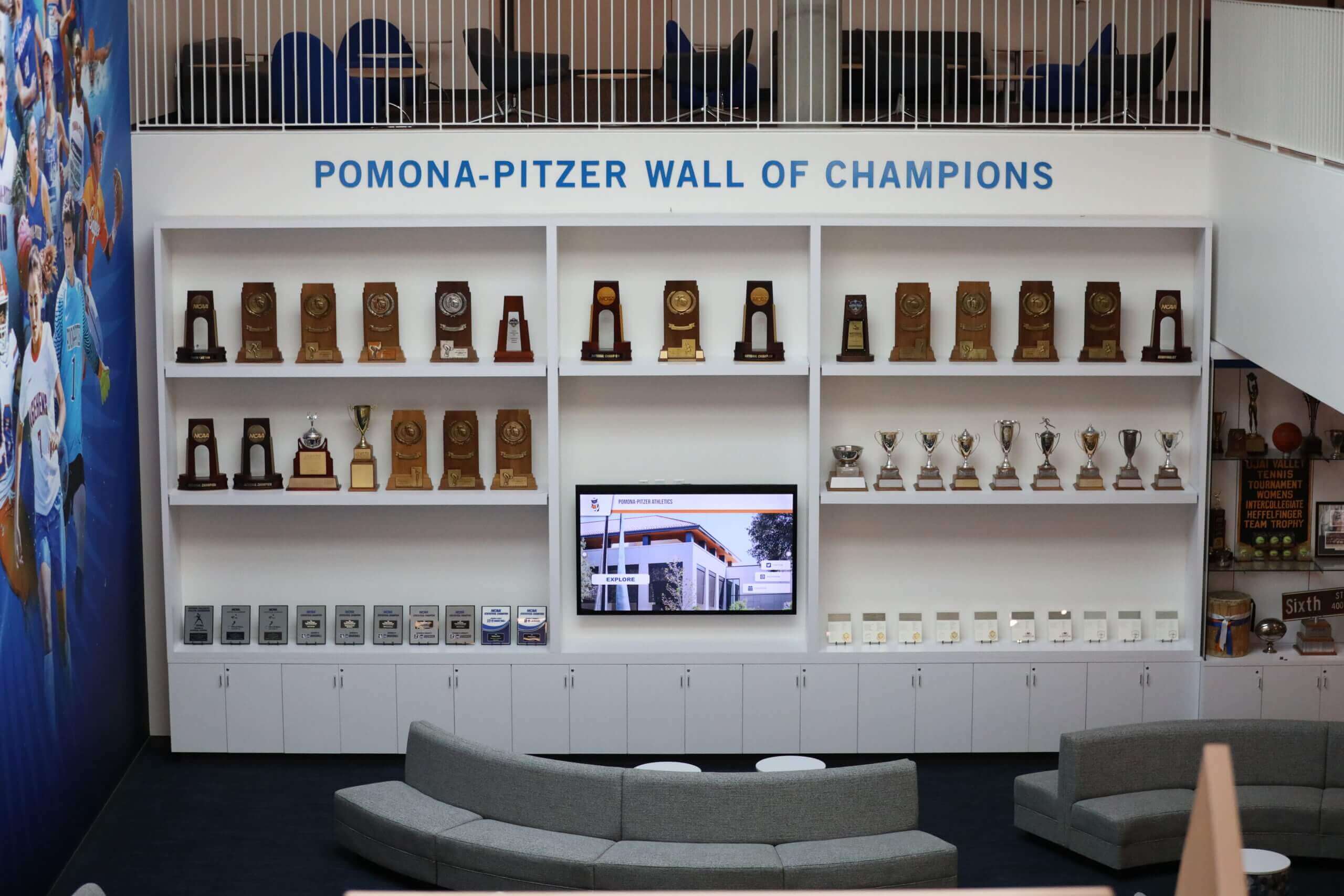
| Physical plaque wall | $1,200-$2,800 | New plaques, mounting, cleaning |
| Photo board displays | $800-$2,400 | Photo updates, frame maintenance |
| Trophy case displays | $1,500-$3,600 | Display maintenance, lighting, cleaning |
| Digital signage systems | $1,200-$3,000 | Software subscription, power, support |
| Interactive touchscreen | $2,400-$5,500 | Software, support, hardware maintenance |
| Web-based platforms | $600-$2,400 | Hosting, domain, platform subscription |
Physical systems show lower direct costs but require ongoing fabrication expenses as new oldtimers qualify for recognition—annual plaque additions for growing populations create recurring expenses that digital alternatives avoid.
Digital systems incur consistent annual costs regardless of content volume, making them increasingly cost-effective as recognized populations grow. Organizations honoring 10-20 new oldtimers annually find digital platforms achieve cost parity with traditional approaches within 3-5 years while providing superior engagement capabilities.
Total Cost of Ownership: 10-Year Analysis
Comparative TCO Analysis (Organization Honoring 150 Total Oldtimers)
| Recognition Approach | Initial Cost | 10-Year Operating Cost | 10-Year TCO | Annual TCO |
|---|---|---|---|---|
| Physical plaque wall | $18,000 | $22,000 | $40,000 | $4,000 |
| Photo board displays | $12,000 | $18,000 | $30,000 | $3,000 |
| Trophy case displays | $28,000 | $30,000 | $58,000 | $5,800 |
| Digital signage | $7,000 | $21,000 | $28,000 | $2,800 |
| Interactive touchscreen | $22,000 | $38,000 | $60,000 | $6,000 |
| Hybrid (plaques + digital) | $30,000 | $44,000 | $74,000 | $7,400 |
These calculations include hardware, materials, fabrication, installation, maintenance, content updates, and estimated administrative labor, demonstrating that total cost considerations differ substantially from initial investment comparisons alone.
While interactive touchscreen displays show highest absolute costs, organizations valuing rich storytelling, multimedia preservation, and unlimited scalability find the premium justified by capabilities impossible to achieve through traditional means alone.
Design Best Practices: Insights From Most Effective Oldtimers Recognition Programs
Analysis of the 38 organizations with highest documented engagement and satisfaction ratings (top quartile across survey metrics) revealed consistent design patterns distinguishing exceptional oldtimers recognition.
Content Strategy and Presentation
Historical Context and Era Significance
High-impact programs contextualized oldtimers achievements within their historical periods rather than presenting bare facts without explanation:
- Descriptions of organizational conditions during their era: 92% of high-performing programs
- Explanation of achievement significance relative to period norms: 84% of high-performing programs
- Historical photographs showing facilities, equipment, uniforms: 76% of high-performing programs
- Contextual narratives about organizational evolution: 68% of high-performing programs
This contextualization helps contemporary viewers appreciate achievements that might appear modest by current standards but represented remarkable accomplishments within their original contexts. For example, athletic records achieved without modern training methods, coaching systems, or equipment deserve recognition for the pioneering nature of accomplishment.
Personal Narratives Beyond Statistics
Effective oldtimers recognition told human stories rather than listing dry biographical facts:
- Personal quotes or reflections from honorees: 79% of high-performing programs
- Anecdotes illustrating character or memorable moments: 71% of high-performing programs
- Information about lives beyond organizational involvement: 63% of high-performing programs
- Family legacy and multi-generational connections: 58% of high-performing programs
One coordinator explained: “Statistics tell you what someone did. Stories tell you who they were. For our oldtimers wall, we interview honorees or their families to capture personality—favorite memories, funny stories, lessons they learned. Those human details make our display compelling instead of just being a list of names and dates.”
Digital storytelling approaches in athletic programs demonstrate how narrative techniques transform recognition from information delivery into emotional engagement that resonates with diverse audiences.
Visual Design Principles
Quality and Consistency Standards
High-performing programs maintained rigorous standards for visual presentation:
- Professional photography or high-quality digitization: 95% of high-performing programs
- Consistent styling across all honorees: 89% of high-performing programs
- Clear, readable typography at appropriate viewing distances: 97% of high-performing programs
- Organizational branding integration (colors, logos, identity): 92% of high-performing programs
Organizations accepting low-quality photographs or inconsistent presentation styles reported that visual shortcomings undermined perceived professionalism, potentially disrespecting honorees through shabby presentation rather than appropriate commemoration.
Prominence and Respect in Presentation
Effective oldtimers recognition commanded attention and respect through design choices:
- Dedicated space rather than cramped corners: 100% of high-performing programs
- Quality materials and construction: 95% of high-performing programs
- Proper lighting enhancing visibility and impact: 87% of high-performing programs
- Regular maintenance keeping displays pristine: 92% of high-performing programs
The 100% maintaining dedicated recognition spaces demonstrates understanding that oldtimers merit prominent honor rather than afterthought placement in available leftover spaces—a design decision that communicates organizational values through spatial allocation.
Engagement Features and Interactive Elements
Making Static Displays More Engaging
Organizations with physical displays enhanced engagement through thoughtful design elements:
- QR codes linking to extended online profiles: 34% of high-performing programs
- Rotating featured honoree spotlights: 47% of high-performing programs
- Visitor books for comments and memories: 53% of high-performing programs
- Timeline visualizations showing organizational evolution: 61% of high-performing programs
The 61% incorporating timeline elements provided valuable context showing how organizational history unfolded across decades, helping viewers understand the sequential development and cumulative contributions that built current institutions.
Digital System Feature Utilization
Organizations with interactive digital displays (N=16 total, 6 in high-performing group) reported which capabilities drove strongest engagement:
- Searchable databases enabling quick lookup: 100% of digital systems, 94% usage rate
- Photo galleries and historical imagery: 100% of digital systems, 78% usage rate
- Video interviews or multimedia content: 67% of digital systems, 86% usage rate
- Detailed biographical narratives: 100% of digital systems, 71% usage rate
- Historical timeline navigation: 83% of digital systems, 58% usage rate
The 94% search utilization rate demonstrates that visitors frequently seek specific individuals—family members, former teammates, personal connections—making searchability the highest-value digital feature for oldtimers recognition applications.
Touchscreen software capabilities designed for recognition applications provide these engagement features through purpose-built platforms optimized for intuitive exploration of biographical content and historical information.

Common Implementation Challenges and Proven Solutions
Organizations documented obstacles encountered during oldtimers recognition implementation along with strategies that successfully addressed these challenges.
Challenge: Incomplete Historical Records
Problem: 73% of organizations reported significant gaps in historical records when beginning oldtimers recognition projects—missing photographs, sparse biographical information, conflicting data, or complete absence of documentation for certain periods.
Common Issues:
- No photographs available for many older honorees
- Achievement records lost or never systematically documented
- Conflicting information about dates, roles, or accomplishments
- Biographical details beyond basic facts unavailable
Effective Solutions:
Community Outreach and Oral History: Organizations successfully filled information gaps through systematic outreach to veteran members, families of deceased honorees, and long-time community participants who retained institutional memory. Recorded oral history interviews preserved firsthand accounts before primary sources became unavailable.
Archival Research: Dedicated investigation of organizational files, local newspaper archives, yearbooks, and historical publications uncovered previously lost information. Organizations partnering with local historical societies or libraries gained access to broader archival resources.
Transparent Acknowledgment of Limitations: Programs honestly acknowledging information gaps—“photograph unavailable” or “limited biographical information exists”—maintained credibility while preserving space for future additions when additional details surface.
One organization noted: “We initially planned to wait until we had complete information for everyone before launching our oldtimers wall. We realized we’d never reach that threshold. Instead, we launched with what we had and continue adding details as we discover them. The imperfect version we have today is infinitely better than the perfect version we’d never complete.”
Challenge: Subjective Selection Decisions
Problem: 58% of organizations struggled with selection criteria defining which members qualify for oldtimers recognition, particularly when moving beyond automatic thresholds (age, tenure) to judgment-based evaluations.
Common Issues:
- Pressure to include specific individuals based on relationships rather than merit
- Difficulty comparing achievements across different eras and contexts
- Risk of overlooking quiet contributors in favor of high-profile members
- Tension between honoring everyone versus maintaining selective standards
Effective Solutions:
Clear Written Criteria: Organizations documenting explicit selection standards—publicly available criteria describing exactly what qualifications merit recognition—created objective frameworks limiting subjective bias and relationship-based pressure.
Diverse Selection Committees: Forming committees with representation across organizational constituencies (different generation cohorts, geographic areas, involvement types) reduced individual bias while incorporating broader perspectives.
Multiple Recognition Tiers: Some organizations created inclusive base-level oldtimers recognition (anyone meeting basic tenure/age thresholds) plus selective highest-honor tiers for truly distinguished contributors. This approach honored breadth of sustained participation while maintaining special distinction for exceptional achievement.
Historical Advisory Review: Consulting veteran members with deep institutional knowledge helped contextually evaluate achievements within appropriate historical frameworks, preventing modern standards from being unfairly applied to earlier eras.
Challenge: Family Sensitivities and Accuracy Disputes
Problem: 41% of organizations encountered disagreements about biographical content, photograph selections, or recognition decisions—occasionally involving emotionally charged family dynamics.
Common Issues:
- Families disputing facts or interpretations in biographical narratives
- Disagreements about which photographs appropriately represent honorees
- Sensitive topics (disciplinary issues, controversies, relationship conflicts)
- Competing claims about achievement ownership or recognition priority
Effective Solutions:
Pre-Publication Review Process: Providing families opportunity to review draft content before public display prevented most issues through collaborative revision addressing concerns before installation.
Documented Source Citation: Maintaining clear records of information sources—“according to 1973 organizational records” or “per interview with John Smith, teammate”—provided defensible basis for content decisions when accuracy questions arose.
Gracious Correction Protocols: Establishing clear processes for addressing errors when identified—prompt corrections, apology letters to affected families, transparent documentation of changes—maintained credibility and demonstrated respect when mistakes occurred.
Focus on Achievements Over Controversies: Organizations consistently focusing recognition on positive contributions while omitting unrelated controversies avoided unnecessary conflict while appropriately celebrating honorees’ organizational impact.
Several organizations noted that collaborative approaches—treating families as partners in preservation rather than subjects of organizational decisions—transformed potential conflicts into productive relationships yielding richer, more accurate content.
Challenge: Sustainable Ongoing Maintenance
Problem: 64% of organizations struggled with long-term maintenance and updates following initial implementation enthusiasm, risking recognition programs becoming static and outdated.
Common Issues:
- Staff turnover causing institutional knowledge loss
- Declining volunteer energy after initial launch completion
- Budget constraints limiting ongoing updates and maintenance
- Growing populations making updates increasingly burdensome
Effective Solutions:
Designated Program Ownership: Assigning specific staff or volunteer roles with clear oldtimers recognition responsibilities prevented diffusion of accountability where “everyone’s responsibility” became no one’s priority.
Annual Update Cycles: Establishing predictable schedules for reviewing and updating recognition—typically coinciding with annual meetings, induction ceremonies, or memorial events—created sustainable rhythms rather than sporadic ad-hoc attention.
Digital Platform Advantages: Organizations using digital recognition systems reported 89% lower maintenance burden compared to physical installations, as content updates occurred through software rather than requiring fabrication, shipping, and physical installation of new plaques or materials.
Endowment or Dedicated Funding: Several organizations established specific funds designated for oldtimers recognition maintenance, ensuring budget availability even during general financial constraints or leadership transitions.
Documentation and Procedures: Creating clear written procedures for adding honorees, updating content, and maintaining displays enabled smooth transitions when responsible individuals changed, preventing disruption from staff turnover or volunteer transitions.
Implementation Process: Staged Approach for Maximum Impact
Organizations successfully implementing oldtimers recognition followed consistent patterns minimizing disruption while building sustainable programs.
Planning Phase (2-4 months)
Needs Assessment and Objective Definition
Successful implementations began with clear articulation of specific goals:
- Define what “oldtimers” means in organizational context (age, tenure, status thresholds)
- Establish recognition program purposes (preservation, honor, engagement, fundraising)
- Determine scope (how many individuals, what time periods, which categories)
- Identify budget parameters including initial and ongoing costs
- Clarify decision-making authority and stakeholder involvement
Organizations skipping explicit planning showed 67% higher dissatisfaction with eventual outcomes compared to those documenting detailed plans before implementation decisions.
Stakeholder Engagement
High-satisfaction implementations incorporated input from constituencies affected by or interested in oldtimers recognition:
- Survey veteran members about desired recognition approaches: 58% of successful programs
- Consult families of deceased potential honorees: 47% of successful programs
- Engage current leadership in vision and criteria discussions: 86% of successful programs
- Review with broader membership during planning phase: 39% of successful programs
Early stakeholder involvement built buy-in while surfacing important considerations that might be overlooked by small planning groups working in isolation.
Research and Content Development Phase (3-8 months)
Historical Investigation
Systematic research gathering comprehensive information about oldtimers populations:
- Compile complete lists of potentially qualifying individuals from organizational records
- Conduct archival research filling information gaps
- Interview living oldtimers and family members of deceased individuals
- Digitize historical photographs and documents
- Verify facts through multiple sources when possible
Organizations allocating adequate time for thorough research produced substantially richer content than those rushing implementation with superficial information gathering. The median high-quality program invested 218 hours in research and content development—effort that cannot be meaningfully shortened without quality compromise.
Content Creation
Writing engaging narratives, selecting appropriate photographs, and organizing information for display presentation:
- Write biographical profiles following established templates
- Edit and optimize photographs for display medium
- Develop historical context narratives explaining organizational evolution
- Create supporting materials (timelines, maps, achievement summaries)
- Conduct editorial review ensuring accuracy, consistency, and appropriate tone
Implementation Phase (2-6 months)
Physical Installation or Digital Deployment
Executing technical implementation based on selected recognition approach:
- For physical displays: fabrication, shipping, site preparation, professional installation
- For digital systems: hardware installation, software configuration, content database population
- Network connectivity, power installation, mounting security
- Testing and quality assurance before public launch
- Staff training on system management and maintenance
Organizations reported median 3-week delays from planned timelines primarily due to underestimating content preparation requirements, fabrication lead times, or site preparation complexity.
Launch Event Planning
Creating memorable unveiling ceremonies celebrating inaugural oldtimers recognition:
- Schedule timing coordinating with significant organizational dates (anniversaries, annual meetings)
- Invite honorees, families, members, community dignitaries
- Prepare formal program with speakers, recognition presentations, display unveiling
- Arrange media coverage extending recognition visibility
- Plan reception enabling social interaction and celebration
Sixty-eight percent of organizations hosting formal launch events reported substantially higher initial engagement and long-term program visibility compared to quiet installations without ceremonial introduction.
Optimization Phase (Ongoing)
Monitoring and Continuous Improvement
Treating initial implementation as starting point requiring refinement:
- Gather feedback from members and visitors during first 90 days
- Track engagement patterns (for digital systems) or observational assessment (for physical displays)
- Identify content gaps or accuracy issues requiring correction
- Make iterative improvements based on actual usage and response
- Plan future enhancements as budget and capacity allow
Organizations making 3-5 adjustments during first year based on user feedback showed 73% higher long-term satisfaction compared to those treating implementation as complete upon installation.
Specialized Applications: Oldtimers Recognition Across Different Organization Types
Recognition programs adapt to specific organizational contexts, each with distinctive characteristics and priorities.
Youth Sports Clubs and Leagues (N=67)
Youth sports organizations honor founding coaches, long-serving administrators, and volunteer leaders whose dedication established programs benefiting current participants.
Common Recognition Focus:
- Founding board members and charter club organizers: 89.6% recognize
- Long-serving coaches (typically 20+ years): 95.5% recognize
- Volunteer administrators and officials: 71.6% recognize
- Field/facility donors and development contributors: 62.7% recognize
- Multi-generational family involvement: 47.8% highlight
Unique Considerations:
Youth sports oldtimers recognition often emphasizes volunteer service over athletic achievement—honoring those who built organizational infrastructure through decades of unpaid leadership. Many programs include “volunteer hour” thresholds (5,000+ hours of service over 25+ years) as recognition criteria.
Organizations noted that oldtimers recognition helped recruit current volunteers by demonstrating that sustained service receives meaningful appreciation—a retention tool addressing volunteer burnout and recruitment challenges common in youth sports.
Recreational Adult Athletic Leagues (N=58)
Adult recreational leagues—softball, hockey, basketball, soccer oldtimers divisions—honor long-term participants who have sustained involvement across decades.
Common Recognition Focus:
- Founding league members and organizers: 91.4% recognize
- Record holders from earlier eras: 79.3% recognize
- Long-term consecutive participation (20+ seasons): 87.9% recognize
- League leadership and volunteer officials: 69.0% recognize
- Teammate groups and championship teams: 56.9% recognize
Unique Considerations:
Recreational leagues often maintain broader recognition thresholds than selective hall of fame programs—honoring sustained participation and community contribution rather than exclusively elite performance. Many programs automatically recognize anyone completing 25+ seasons as “oldtimer” regardless of skill level or achievement.
Organizations reported that oldtimers recognition strengthened league identity and participant commitment, with recognized members often becoming ambassadors recruiting new participants and promoting league stability.
Alumni Associations (N=52)
Alumni groups honor distinguished graduates and long-serving association volunteers whose contributions strengthened institutional connections across generations.
Common Recognition Focus:
- Distinguished alumni achievement: 94.2% recognize
- Long-serving association board members: 78.8% recognize
- Major institutional donors: 67.3% recognize
- Multi-generational family legacies: 57.7% recognize
- Deceased alumni memorial: 75.0% maintain
Unique Considerations:
Alumni associations often separate oldtimers recognition from athletic hall of fame programs, focusing on volunteer service, philanthropic support, and non-athletic distinction. Alumni recognition walls typically emphasize career achievement and community impact rather than campus-era activities.
Organizations noted that oldtimers recognition particularly strengthened engagement among earlier graduation classes who might feel overlooked by institutions focused primarily on recent graduates and young alumni programs.
Military Veteran Organizations (N=36)
Veteran associations honor founding members, long-serving post leadership, and deceased comrades through memorial recognition preserving unit histories and service contributions.
Common Recognition Focus:
- Founding post members: 97.2% recognize
- Deceased member memorials: 100% maintain
- Long-serving post officers and volunteers: 83.3% recognize
- Combat veterans and award recipients: 69.4% recognize
- Unit history and deployment chronology: 75.0% document
Unique Considerations:
Military veteran oldtimers recognition often functions as memorial and historical preservation simultaneously—documenting unit histories while honoring individuals. Many programs emphasize equality of service over hierarchical achievement, recognizing all veterans equally regardless of rank or awards.
Organizations reported that comprehensive veteran recognition provided therapeutic value for aging members concerned about being forgotten, reassuring them that their service would be permanently remembered and appropriately honored.
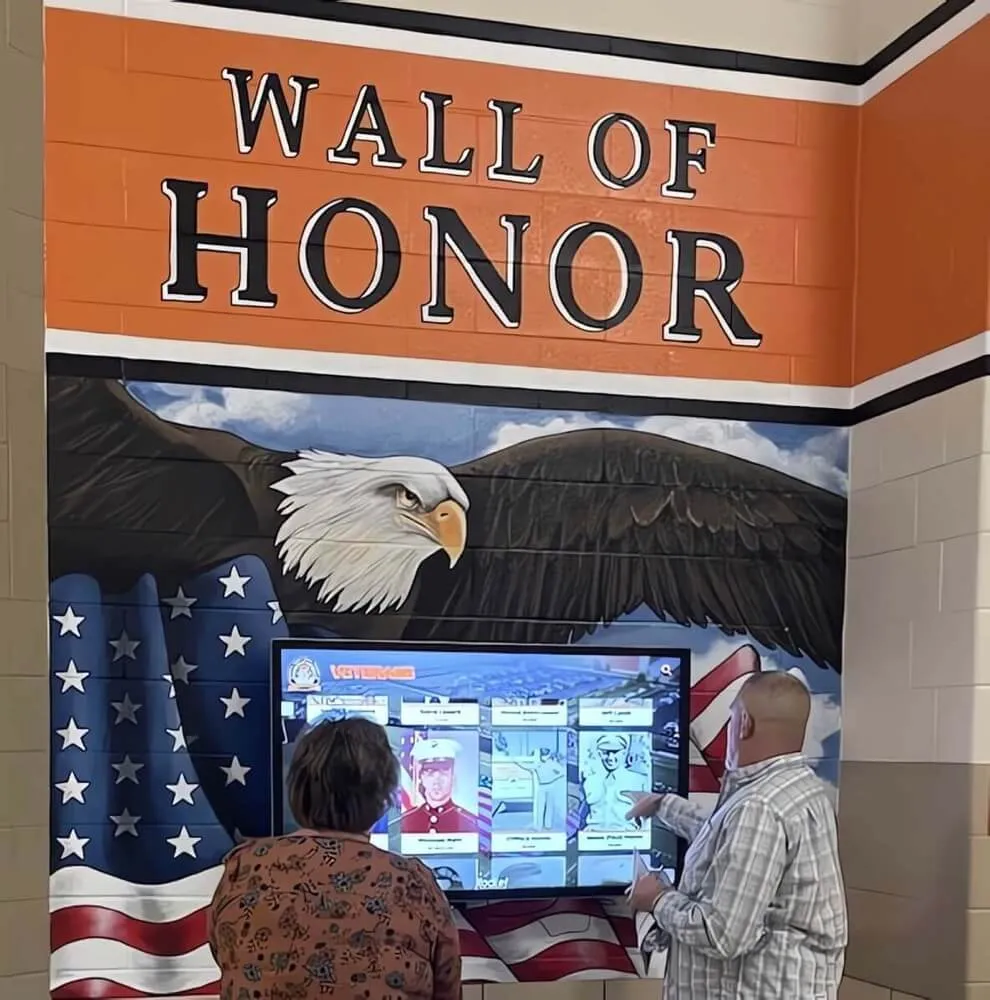
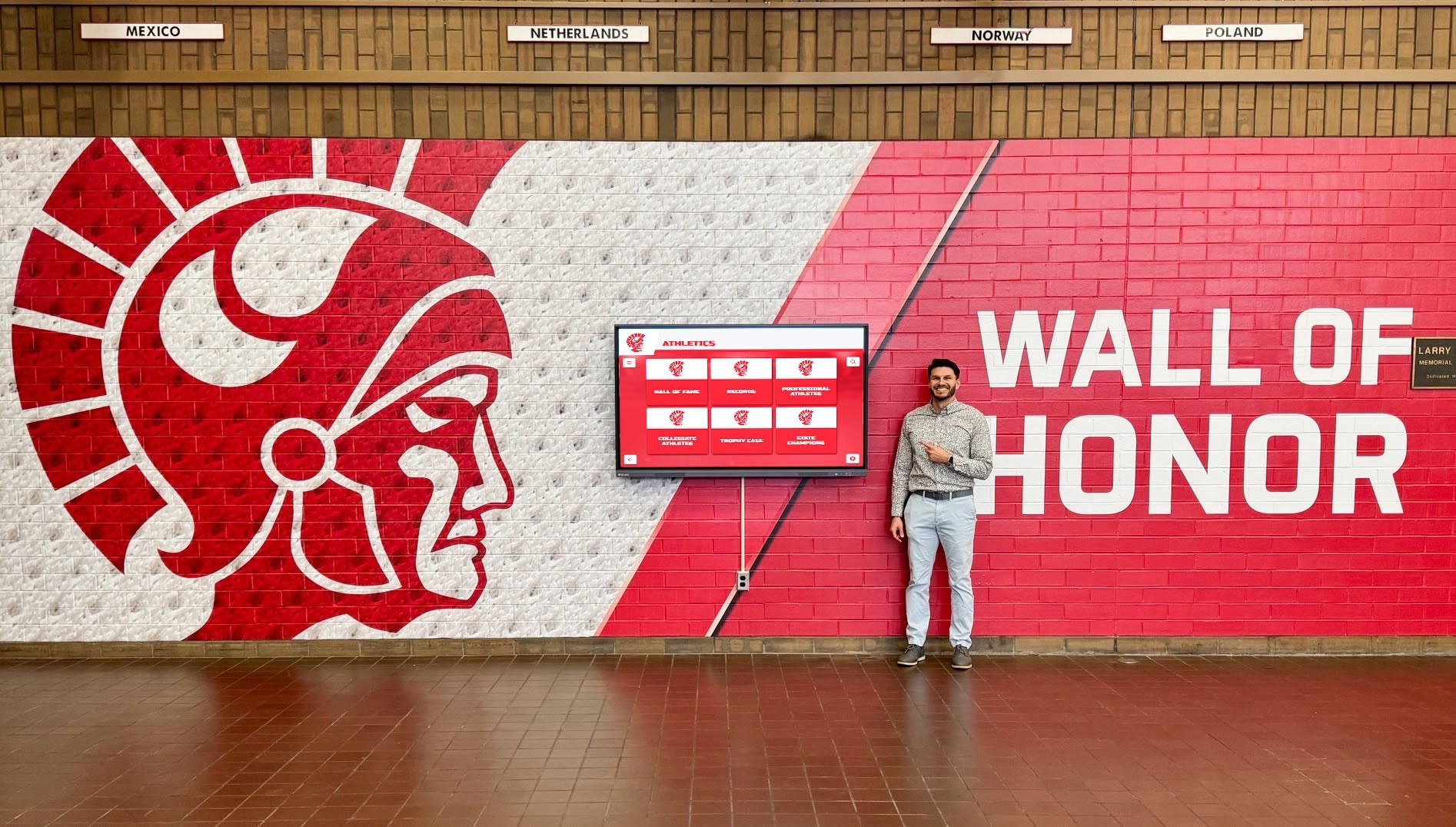
Military wall of honor displays demonstrate specialized approaches honoring veteran populations with appropriate solemnity and respect for military service traditions.
Future Trends: Oldtimers Recognition Evolution 2026-2028
Organizations and recognition solution providers identified emerging capabilities likely to influence oldtimers recognition evolution over coming years.
Enhanced Multimedia Preservation
Video Oral Histories and Documentary Content
Progressive organizations increasingly capture video interviews with aging oldtimers, preserving firsthand accounts, personality, and voice before individuals pass or memories fade further:
- Professional video interview production: 23% of organizations planning
- Smartphone-captured informal video memories: 41% of organizations planning
- Audio-only oral history recordings: 34% of organizations planning
- Integration with digital recognition displays: 67% of digital system users planning
Organizations implementing video capture noted unexpected benefits—families treasuring recorded interviews, historical researchers utilizing primary source material, and emotional connections created when viewers hear honorees speak in their own voices.
Artificial Intelligence Applications
Automated Historical Research and Content Generation
Emerging AI capabilities assist oldtimers recognition research through:
- Automated scanning and digitization of historical documents and photos
- Newspaper archive searching identifying mentions of organizational members
- Natural language processing generating biographical drafts from source materials
- Facial recognition identifying individuals in unlabeled historical photographs
Early adopters (9% of surveyed organizations piloting AI tools) reported 60% faster content development while cautioning that human review remains essential for accuracy verification and appropriate tone.
Augmented Reality Enhancement
Interactive Historical Overlays
Experimental applications enable visitors to point smartphones at oldtimers displays and receive augmented reality enhancements:
- Extended biographical content appearing on device screens
- Historical photographs showing what facilities/locations looked like in honorees’ eras
- Audio narration or video clips playing when scanning individual profiles
- Virtual “then and now” comparisons overlaying historical imagery on current views
While adoption remains minimal (3% of organizations exploring), technology enthusiasts predict AR will eventually enable unlimited digital content accessible through minimal physical display footprints—single plaques linking to comprehensive digital archives through smartphone interaction.
Distributed and Remote Access
Global Accessibility for Dispersed Communities
Organizations with geographically distributed constituencies increasingly implement online oldtimers recognition ensuring global accessibility:
- Web-based platforms accessible worldwide: 38% of organizations planning
- Mobile applications for on-the-go access: 17% of organizations considering
- Social media integration enabling sharing and connection: 52% of organizations planning
- Email notification systems alerting about new honorees or content: 29% of organizations implementing
Distributed access proves particularly valuable for alumni associations, military veteran groups, and fraternal organizations whose members scatter across regions, enabling participation in recognition programs regardless of physical proximity to traditional display locations.
Practical Recommendations: Selection and Implementation Guidance
Based on patterns identified across 284 organizations, these recommendations provide practical frameworks for organizations evaluating oldtimers recognition investments.
Organization Size-Based Guidance
Small Organizations (Under 100 Oldtimers to Recognize)
Recommended Approach: Physical plaque wall or photo board with supplementary online directory
Rationale: Small populations fit comfortably within physical display constraints without space limitations. Traditional approaches provide tangible permanence appropriate for intimate recognition while remaining budget-accessible.
Investment Range: $5,000-$15,000 initial / $1,000-$3,000 annually
Critical Success Factors:
- Quality materials and professional presentation
- Dedicated prominent display location
- Systematic research producing rich biographical content
- Regular maintenance preserving pristine appearance
Medium Organizations (100-500 Oldtimers to Recognize)
Recommended Approach: Hybrid combining physical entrance display with digital comprehensive database
Rationale: Medium populations strain physical display capacity while remaining manageable for quality content development. Hybrid approach provides visibility and permanence of traditional display plus depth and scalability of digital system.
Investment Range: $15,000-$35,000 initial / $3,000-$6,000 annually
Critical Success Factors:
- Strategic physical display showing prominent honorees or complete name listing
- Comprehensive digital system enabling detailed exploration
- Consistent quality standards across all honorees
- Sustainable update processes for annual additions
Large Organizations (500+ Oldtimers to Recognize)
Recommended Approach: Digital interactive touchscreen or web-based platform with optional traditional honor roll
Rationale: Large populations exceed practical physical display capacity without resorting to tiny cramped text or multi-room installations. Digital systems provide unlimited capacity while enabling sophisticated search, filtering, and organization capabilities essential for navigating large databases.
Investment Range: $20,000-$50,000 initial / $4,000-$8,000 annually
Critical Success Factors:
- Intuitive search and navigation for large populations
- Robust content management systems enabling efficient updates
- High-quality digitization of historical photographs and documents
- Analytics tracking usage informing optimization
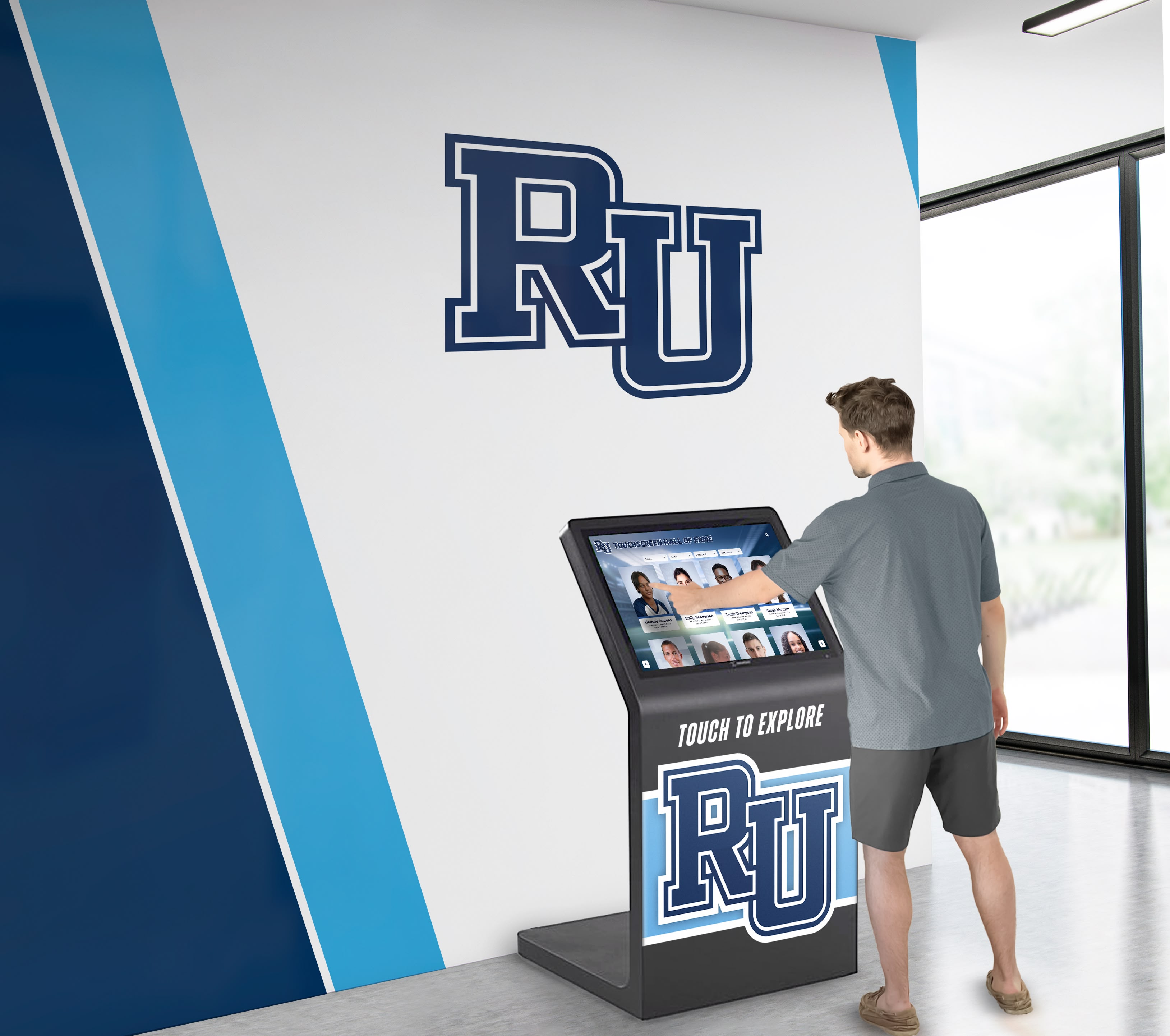
Digital hall of fame implementation guides provide detailed frameworks for organizations pursuing comprehensive recognition platforms supporting large-scale populations across multiple categories and generations.
Content Development Priorities
Essential Information (Include for All Honorees)
- Full name and any nicknames or alternate names used
- Years of birth and death (if deceased) or current age
- Years of organizational involvement and roles held
- Primary achievements or contributions meriting recognition
- Photograph (professional quality when available)
High-Value Additional Content (Include When Possible)
- Extended biographical narrative beyond basic facts
- Quotes or reflections from honorees or those who knew them
- Historical context explaining significance of achievements
- Multiple photographs showing different life/career stages
- Information about families and multi-generational connections
Premium Content (Include for Highest Profile or Digital Systems)
- Video interviews or oral history recordings
- Scanned documents, newspaper clippings, or historical materials
- Detailed career chronologies or achievement timelines
- Connections to other honorees (teammates, colleagues, family)
- Contemporary reflections from current members or family
Organizations consistently gathering and presenting richer content beyond minimal name-and-date listings created recognition programs with substantially higher engagement and stronger emotional impact.
Vendor Selection Criteria (For Digital Systems)
Organizations selecting digital oldtimers recognition solutions should evaluate:
Technical Capabilities
- Unlimited or very high capacity for honoree profiles
- Sophisticated search and filtering enabling easy navigation
- Multimedia support (photos, video, audio, documents)
- Customization flexibility for organizational branding
- Offline operation capability maintaining function during network outages
Usability and Accessibility
- Intuitive interface requiring no instructions for basic use
- Accessibility compliance for disabled visitors
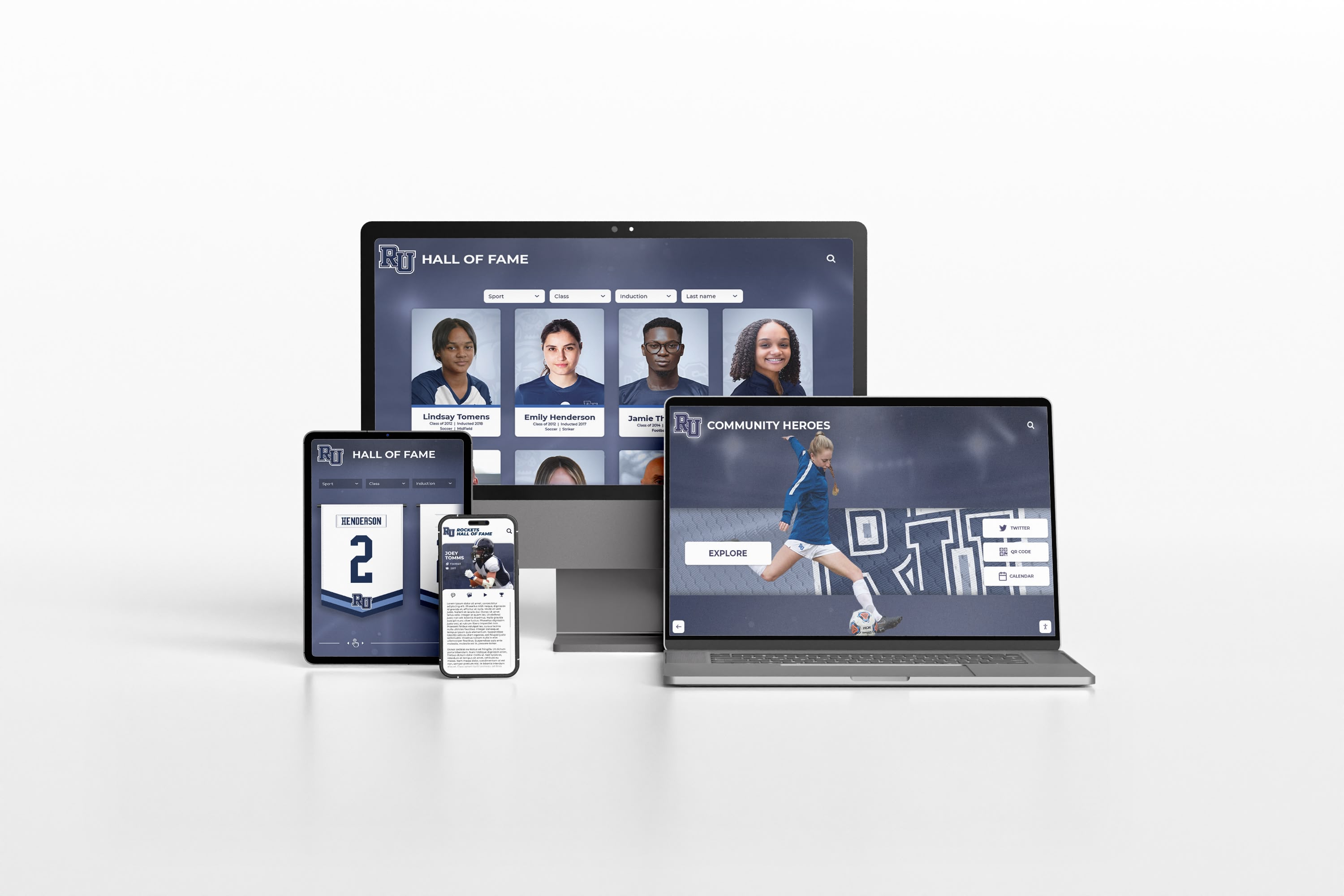
- Responsive design supporting various screen sizes
- Multilingual capability if serving diverse populations
Implementation and Support
- Professional installation and training services
- Content migration assistance and database population support
- Responsive technical support addressing issues quickly
- Regular software updates and feature enhancements
- Clear documentation and self-service resources
Cost Structure
- Transparent pricing including all initial and ongoing costs
- Reasonable annual subscription or licensing fees
- Hardware warranties and replacement policies
- Scalability accommodating organizational growth without price penalties
Solutions like Rocket Alumni Solutions provide purpose-built platforms designed specifically for recognition applications, combining proven technology with implementation support based on best practices from hundreds of institutional deployments.
Conclusion: Preserving Legacy Through Appropriate Honor
Oldtimers recognition represents essential organizational investment in historical preservation, community continuity, and appropriate honor for founding generations whose contributions established institutions benefiting current participants. When thoughtfully designed and consistently maintained, these programs preserve irreplaceable stories while strengthening intergenerational connections and organizational identity.
Key Research Findings
Program Structure and Scope
- 34.5% of organizations maintain dedicated oldtimers recognition spaces distinct from general halls of fame
- 39.4% use years-of-service thresholds (typically 20-40 years) as primary qualification criteria
- 68.3% provide special distinction for founding members beyond general oldtimers recognition
- Only 5.6% currently employ interactive digital displays despite their superior engagement capabilities
Impact Measurements
- 90.8% reported strengthened organizational historical awareness following oldtimers recognition implementation
- 77.0% documented improved intergenerational connections between veteran and current members
- Median 23.7% increase in oldtimers event attendance following recognition program enhancements
- 87.3% discovered previously undocumented achievements during oldtimers research, preventing permanent historical loss
Implementation Considerations
- 73% encountered significant historical record gaps requiring systematic research to fill
- Median 218 hours invested in research and content development for quality programs
- 10-year TCO ranges from $28,000 (digital signage) to $74,000 (hybrid approaches) for organizations honoring 150 oldtimers
- Digital systems prove increasingly cost-effective as recognized populations grow beyond 100-150 individuals
Recommended Action Framework
Immediate Assessment (0-30 days)
- Inventory current oldtimers recognition (or absence thereof)
- Define “oldtimers” appropriately for organizational context
- Establish recognition program objectives and success criteria
- Survey stakeholders about desired approaches and priorities
- Assess available budget and identify potential funding sources
Planning and Development (30-120 days)
- Form planning committee with diverse representation
- Develop selection criteria and nomination processes
- Begin systematic historical research and content gathering
- Evaluate recognition format options (traditional, digital, hybrid)
- Select vendors or partners for implementation support
Implementation (120-270 days)
- Complete content development for inaugural honorees
- Execute technical implementation (fabrication, installation, deployment)
- Plan and conduct formal launch ceremony
- Train staff or volunteers on ongoing maintenance
- Establish monitoring processes measuring success
Ongoing Stewardship (Continuous)
- Maintain annual cycles for adding new honorees
- Update and enhance existing content as information surfaces
- Monitor engagement and gather feedback
- Preserve pristine display condition through regular maintenance
- Document program impact for leadership reporting
Organizations implementing systematic oldtimers recognition consistently report that appropriate honor strengthens community cohesion while preserving irreplaceable institutional history. The investment required—whether modest traditional displays or comprehensive digital platforms—represents essential stewardship of organizational heritage that benefits current participants while respecting the dedication of those who came before.
For organizations ready to properly honor their oldtimers populations, modern recognition solutions provide unprecedented capabilities for preserving detailed histories, engaging diverse audiences, and ensuring that founding generations receive the lasting recognition they deserve for establishing institutions that continue serving communities across generations.
Request Additional Research Details
This summary presents key findings from our comprehensive analysis of 284 oldtimers recognition programs. The full dataset includes detailed breakdowns by organization type, size, geographic region, and program characteristics, along with statistical analyses controlling for confounding variables and longitudinal tracking across 10+ year periods for long-established programs.
Organizations interested in accessing complete research datasets, receiving custom analysis for specific organizational contexts, or discussing oldtimers recognition implementation strategies should contact our research team to request a comprehensive briefing.
For organizations ready to explore recognition solutions, Rocket Alumni Solutions offers comprehensive platforms specifically designed for historical preservation and recognition applications, combining proven technology with implementation support based on best practices from recognition programs serving diverse organizational needs.
Research Methodology Note: This benchmark report represents original research conducted by Hall of Fame Wall Research Team analyzing 284 oldtimers recognition programs. All metrics reflect organizational self-reporting validated through follow-up interviews and documentation review where possible. Individual results vary based on implementation quality, organizational context, and numerous factors. The findings should inform decision-making but not substitute for organization-specific analysis and planning.
Data Currency: Research data collected September 2026 - January 2026. Recognition technology, best practices, and organizational approaches continue evolving. Organizations should verify current capabilities when making implementation decisions.
Acknowledgments: The research team gratefully acknowledges the organizations that participated in surveys, interviews, and site visits, sharing their experiences to advance collective understanding of effective oldtimers recognition practices.
All trademarks are property of their respective owners. Rocket Alumni Solutions is not affiliated with or endorsed by any organizations referenced in this research report.
This comparison is based on publicly available information as of January 2026. All product names and trademarks belong to their respective owners. Comparative statements reflect Rocket Alumni Solutions’ interpretation of available data and may change over time.