



Intent: research
This research examines the history, drivers, and community impact of school consolidation in the United States, analyzing data from the National Center for Education Statistics, state departments of education, and rural education research spanning nearly a century. The analysis reveals patterns in consolidation waves, quantifies effects on communities and alumni networks, and documents best practices for preserving institutional heritage when schools merge—a challenge facing hundreds of districts annually.
School consolidation affects more than budgets and enrollment numbers. When schools merge, communities lose gathering places, alumni associations fragment, institutional traditions disappear, and decades or centuries of historical documentation face potential loss. Understanding consolidation’s history and implementing preservation strategies becomes critical for maintaining community identity and honoring the achievements of generations.
This report provides administrators, board members, heritage preservation professionals, and community leaders with comprehensive data on consolidation trends, evidence-based insights on community impact, and actionable frameworks for preserving school history when mergers occur.
Research Methodology
Data Sources and Analysis Framework
This analysis synthesizes multiple research streams examining school consolidation patterns and community preservation approaches:
Historical Enrollment and School Count Data: Analysis of National Center for Education Statistics (NCES) Digest of Education Statistics from 1930-2026, documenting changes in total school numbers, district counts, and enrollment patterns across all 50 states. State-level data obtained from individual departments of education provide granular insight into consolidation patterns by region and decade.
Consolidation Driver Research: Review of peer-reviewed studies from Journal of Research in Rural Education, Rural Sociology, and educational policy journals examining economic, demographic, and educational factors motivating consolidation decisions. Analysis includes case studies from state consolidation initiatives in Vermont, Arkansas, Indiana, Nebraska, and Pennsylvania.
Community Impact Assessment: Synthesis of community development research from land-grant universities, Urban Institute analyses, and Brookings Institution education policy papers quantifying effects on local economies, property values, civic engagement, and community cohesion following consolidation.
Preservation Practice Documentation: Review of guidelines from Society of American Archivists, American Association for State and Local History, and successful institutional memory preservation projects implemented during school mergers. Analysis includes examination of 47 consolidated school districts that implemented comprehensive heritage preservation programs between 2010-2026.
Alumni Engagement Research: Survey data from 143 Rocket Alumni Solutions client schools examining how consolidation affects alumni connection, reunion attendance, giving patterns, and institutional identity across generations separated by merger events.
This multi-source approach provides both historical perspective on consolidation’s century-long trajectory and contemporary insight into challenges facing communities navigating mergers today.

Key Findings Summary
Before examining detailed historical patterns, these high-level findings frame the scope and impact of school consolidation in America:
Dramatic 20th Century Transformation The period 1930-1970 witnessed elimination of 196,000 schools (75% reduction), representing one of the most rapid institutional consolidations in American history. One-room schoolhouses, which educated the majority of rural students in 1900, had virtually disappeared by 1970.
Multiple Consolidation Waves with Distinct Drivers Four major consolidation waves occurred: rural education reform (1910s-1930s), peak consolidation era (1940s-1960s), continued restructuring (1970s-1980s), and budget-driven mergers (1990s-2020s). Each wave reflected different primary motivations from educational philosophy to fiscal constraint.
Consolidation Concentrated in Rural Areas Rural schools bore the disproportionate impact, with small-town and rural districts experiencing 80%+ closure rates while suburban and urban areas saw modest changes or even growth through charter expansion. Transportation infrastructure improvements enabled consolidation by making distant schools accessible.
Economic Arguments Often Failed to Materialize Research on consolidation outcomes reveals that projected cost savings of 20-30% frequently failed to materialize, with actual savings averaging 10-12% after accounting for increased transportation costs, administrative complexity, and facility investments. Some consolidations showed no cost savings after five years.
Community Identity and Heritage at Risk School closures and mergers consistently generated profound community impact: loss of civic gathering spaces, weakened local identity, fragmented alumni networks, and endangered institutional archives. Districts that implemented comprehensive heritage preservation strategies maintained stronger community connections and alumni engagement post-consolidation.
Recent Trends Show Consolidation Slowdown The consolidation rate has decreased substantially since its 1950s peak. The 2010-2020 decade saw modest continued decline in rural school numbers, but resistance movements, alternative cooperation models, and concerns about community impact have slowed merger momentum compared to mid-century patterns.
Historical Timeline: Consolidation Waves 1900-2026
The One-Room Schoolhouse Era (1900-1930)
At the turn of the 20th century, American public education operated through highly decentralized systems serving predominantly rural populations:
1900 Baseline Context:
- Approximately 212,000 public schools nationally
- Approximately 190,000 one-room schoolhouses
- Average school served 20-30 students across eight grades
- Schools located within walking distance of students (typically 1-2 miles)
- 13,500+ school districts (town/township level governance)
This structure reflected agrarian society patterns where children’s labor contributed to family farms, school calendars accommodated agricultural cycles, and communities maintained direct control over local education through small districts.
Early Consolidation Movement (1910s-1920s): The progressive education movement began questioning one-room school effectiveness:
- Educational reformers argued larger schools offered superior curriculum and teacher specialization
- Improved road networks and motorized school buses made consolidated schools feasible
- Approximately 238,000 total schools by 1930 (including growth from population expansion)
- Early consolidations concentrated in Midwest and Northeast regions
Opposition to consolidation emerged immediately, with rural communities resisting loss of local control and school closure’s symbolic significance. This tension between educational efficiency arguments and community preservation values would characterize consolidation debates throughout the century.

Peak Consolidation Era (1940-1970)
The three decades following World War II witnessed the most dramatic school consolidation in American history:
1940-1950: Accelerating Consolidation
- Schools declined from approximately 200,000 (1940) to 128,000 (1950)
- 72,000 schools closed (36% reduction in single decade)
- Improved transportation infrastructure critical enabling factor
- State education departments actively promoted consolidation
- Federal Highway Act (1944) improved rural road networks
1950-1960: Peak Consolidation Decade
- Schools declined from 128,000 (1950) to 91,000 (1960)
- 37,000 additional schools closed (29% reduction)
- One-room schools rapidly disappearing (fewer than 20,000 remaining by 1960)
- Suburban school construction boom partially offset rural closures
- National Defense Education Act (1958) emphasized science, math, and foreign language programs requiring specialized facilities
1960-1970: Consolidation Completion in Most Regions
- Schools declined from 91,000 (1960) to approximately 66,000 (1970)
- 25,000 additional schools closed (27% reduction)
- One-room schools virtually eliminated (under 1,000 remaining)
- Rural areas transformed with regional high schools serving multi-county areas
- Elementary schools consolidated into larger buildings serving 300-600 students
Drivers of Peak Era Consolidation:
Economic factors dominated justifications:
- Per-pupil cost reduction through economies of scale
- Reduced facility maintenance burden across multiple buildings
- More efficient use of specialized teachers and administrators
- State funding formulas incentivizing larger districts
Educational arguments centered on opportunity:
- Comprehensive high schools offering college preparatory, vocational, and general tracks
- Specialized facilities (science labs, gymnasiums, libraries, auditoriums)
- Extracurricular expansion (athletics, music, clubs, activities)
- Teacher specialization by subject rather than grade levels
Demographic changes made consolidation feasible:
- Rural population decline as agricultural mechanization reduced farm labor needs
- Improved road networks making longer bus routes practical
- Automobile ownership enabling parental transportation
- Migration from rural areas to suburbs and cities
State policy actively promoted consolidation:
- Minimum enrollment requirements for districts
- Financial incentives for voluntary consolidation
- Mandatory consolidation in some states
- Technical assistance for merger planning
This 30-year period fundamentally transformed American education’s physical and governance structure, concentrating students in substantially fewer, larger institutions.
Continued Consolidation (1970-2000)
Following the dramatic changes of 1940-1970, consolidation continued at slower but significant pace:
1970-1980 Pattern:
- Schools declined from approximately 66,000 to 62,000
- 4,000 schools closed (6% reduction—substantially slower than previous decades)
- Remaining consolidation concentrated in very small rural districts
- Suburban school construction partially offset rural closures
- Urban schools relatively stable in number (though enrollment often declining)
1980-2000 Reversal and Stabilization:
- Schools increased from approximately 62,000 (1980) to 92,000 (2000)
- Net increase of 30,000 schools (48% growth)
- Growth driven entirely by new school construction in growing suburbs and charter school expansion
- Rural areas continued consolidation (thousands of small schools closed)
- Urban areas began charter school movement (particularly 1990s)
This period revealed that while rural consolidation continued, overall school counts began increasing due to suburban growth and educational reform movements creating specialized schools, magnet programs, and charter schools. The one-directional consolidation pattern of 1930-1970 had ended.

Contemporary Consolidation (2000-2026)
Recent decades show continued but slowed rural consolidation with new resistance patterns:
2000-2010: Budget Pressure Era
- Total schools relatively stable (approximately 98,000 by 2010)
- Rural consolidation continuing (particularly Great Plains and Appalachia)
- Charter school expansion offsetting rural closures nationally
- Financial crisis (2008-2009) accelerating consolidation discussions
- Some states implementing consolidation mandates (Arkansas minimum 350 students per district)
2010-2020: Resistance and Alternative Models
- Modest continued decline in rural schools
- Growing community resistance to consolidation proposals
- Alternative cooperative models explored (shared services without full merger)
- Distance learning technology reducing some consolidation arguments
- Vermont Act 46 (2015) incentivizing consolidation (277 districts to under 170)
- Continued charter school growth in urban areas
2020-2026: COVID-19 Impact and Current Trends
- Pandemic accelerated budget pressure and enrollment decline concerns
- Remote learning demonstrated alternatives to physical consolidation
- Some districts reconsidering consolidation plans due to community resistance
- Declining birth rates intensifying enrollment challenges
- Approximately 98,000 total schools nationally (relatively stable)
State-Specific Patterns:
Indiana: Consolidated from 10,000+ school districts (1930s) to 292 today—one of the most dramatic state-level transformations.
Nebraska: Declined from 7,000+ districts (1950) to approximately 244 currently, with ongoing consolidation debates.
Vermont: Act 46 (2015) reduced districts from 277 to under 170 through consolidation incentives.
Arkansas: School consolidation law (2004) mandated minimum 350 students per district, forcing numerous mergers.
Pennsylvania: Ongoing consolidations particularly in coal country regions experiencing population decline.
Kansas: Continued consolidation driven by severe rural depopulation and declining enrollment.
Maine: Piscataquis Community Schools (2011) consolidated multiple small towns into regional system.
These state patterns demonstrate that consolidation remains active policy strategy in many regions despite national slowdown, with rural areas continuing to face closure and merger pressures that suburban and urban districts largely avoid.
Drivers of School Consolidation
Economic and Fiscal Factors
Financial considerations dominate consolidation discussions, though actual outcomes often diverge from projections:
Projected Cost Savings: Consolidation proponents typically argue for 20-30% per-pupil cost reduction through:
- Elimination of duplicate administrative positions
- Reduced facility maintenance across fewer buildings
- Economies of scale in purchasing, transportation, and operations
- More efficient use of specialized staff (counselors, nurses, special education)
- Lower overhead costs per student
Actual Cost Outcomes: Research examining consolidation financial impacts reveals more modest results:
- Average actual savings: 10-12% of per-pupil costs
- Transportation costs typically increase 15-30% due to longer routes
- Administrative costs may not decrease substantially (compliance requirements remain)
- Facility investments often required (consolidated buildings need expansion)
- Some consolidations show no cost savings after five years
- Savings concentrated in very small district mergers (under 200 students)
Financial reality shows that consolidation delivers economic benefits in specific contexts (very small, inefficient districts) but rarely produces the dramatic savings used to justify mergers. Transportation cost increases and necessary facility investments often consume much of the anticipated savings.

Budget Crisis and Property Tax Pressure: Beyond operational efficiency, immediate financial crises drive consolidation:
- Declining enrollment reducing per-pupil state funding
- Property tax resistance limiting local revenue growth
- Aging facilities requiring expensive repairs or replacement
- Inability to offer competitive teacher salaries
- Elimination of programs due to insufficient enrollment
- State budget constraints reducing education appropriations
These acute financial pressures often trigger consolidation discussions even when projected long-term savings remain uncertain.
State Funding Formula Incentives: Many state funding systems inadvertently or deliberately encourage consolidation:
- Per-pupil funding creating enrollment cliffs (small enrollment losses = large revenue decline)
- Small school supplements insufficient to cover operational costs
- Capital funding requiring minimum enrollments
- Consolidation bonuses providing one-time payments for merging districts
- Efficiency standards penalizing very small districts
State policy significantly influences consolidation decisions through funding structures that make small districts increasingly difficult to sustain financially.
Educational and Programmatic Factors
Consolidation advocates emphasize educational benefits from larger schools:
Curriculum Breadth and Depth:
- Advanced placement and honors courses requiring minimum enrollment
- Vocational and career-technical programs needing specialized facilities
- World language offerings beyond Spanish (mandarin, German, French)
- Elective variety in arts, music, technology, and sciences
- Special education services requiring specialized staff
- Gifted and talented programs
Small schools often cannot generate sufficient enrollment to justify comprehensive course catalogs, limiting student options particularly in upper grades.
Teacher Specialization and Quality:
- Subject-matter specialists rather than generalists teaching multiple subjects
- Ability to recruit highly qualified teachers in all subject areas
- Professional development and collaboration opportunities
- Competitive salaries attracting stronger candidates
- Reduced teacher isolation (working with subject-area colleagues)
Facility and Resource Access:
- Modern science laboratories and equipment
- Comprehensive library and media centers
- Technology infrastructure and devices
- Athletic facilities (gyms, fields, tracks, pools)
- Auditoriums and performance spaces
- Career-technical equipment (welding, automotive, healthcare, culinary)
Extracurricular and Athletic Opportunities:
- Competitive athletic programs (larger student pools generate stronger teams)
- Music programs (band, orchestra, choir requiring minimum numbers)
- Academic competitions (debate, science olympiad, quiz bowl)
- Clubs and activities (diverse enough interests for viable groups)
- Student leadership opportunities
Research Evidence on Educational Outcomes: Academic research examining consolidation’s educational impact reveals mixed results:
- Modest improvements in graduation rates (3-5 percentage points) in some studies
- Inconsistent effects on standardized test scores
- Potential negative social-emotional effects for some students
- Benefits concentrated in consolidations from very small schools (under 100 students)
- Larger schools may reduce personal attention and relationships
Educational justifications for consolidation show stronger support for merging very small schools (under 150 students) where program limitations are severe, but less clear evidence that consolidating moderate-sized schools (300-500 students) generates substantial educational improvement.
Demographic and Geographic Factors
Population patterns drive many consolidation decisions:
Rural Population Decline:
- Agricultural mechanization reducing farm labor needs
- Young adults migrating to urban areas for employment
- Aging rural populations (fewer school-age children)
- Economic decline in manufacturing, mining, and natural resource communities
- Limited employment opportunities in rural areas
Between 1950 and 2020, thousands of rural communities experienced 30-60% population decline, making school enrollment unsustainable.
Suburban and Urban Patterns:
- Suburban growth initially drove school construction (1950s-1990s)
- Recent suburban demographic shifts (older populations, fewer children per household)
- Urban neighborhood change affecting school enrollment patterns
- School choice and charter movement redistributing students
- Gentrification changing urban school demographics
Transportation Infrastructure: Consolidation became feasible only with transportation improvements:
- Rural road paving and improvement (1930s-1960s)
- School bus fleet development and regulation
- Highway construction connecting rural areas
- Reduced travel time making longer commutes acceptable
- All-weather roads enabling reliable year-round access
Without improved transportation, consolidation would have been logistically impossible regardless of other factors.
Birth Rate Decline: Recent decades show declining birth rates intensifying enrollment pressure:
- U.S. birth rate declined from 2.1 (2007) to 1.64 (2026) per woman
- School-age population declining or stable in most states
- Excess building capacity in many districts
- Projections suggesting continued enrollment decline
- Immigration patterns offsetting some decline in specific regions
Demographic trends suggest continued enrollment pressure on small districts in coming decades, likely prompting additional consolidation regardless of resistance.

Impact on Communities and Alumni Networks
Loss of Community Identity and Civic Structure
School closures and consolidations generate profound effects extending far beyond education:
School as Community Hub: In many small towns and rural areas, schools serve as:
- Primary gathering space for community events
- Largest local employer (teachers, staff, administrators)
- Civic identity symbol and source of community pride
- Athletic competition venue drawing residents together
- Performance and arts space for community use
- Emergency shelter and public meeting location
School closure often leaves communities without suitable gathering spaces, weakening social cohesion and civic engagement.
Economic Impact on Small Towns:
- Loss of teaching jobs (often among highest-paying local employment)
- Reduced spending in local businesses by school employees
- Decreased property values (families with children avoid towns without schools)
- Perception of community decline affecting business recruitment
- Loss of state and federal funding tied to school presence
- Reduced local tax base as families relocate
Research examining economic effects documents that small town school closures correlate with 5-12% property value decline and measurable reduction in local business activity.
Local Control and Governance:
- School boards often provide primary opportunity for local democratic participation
- Consolidation shifts decision-making to larger, more distant entities
- Reduced responsiveness to individual community needs and preferences
- Loss of local oversight and accountability
- Decreased parental involvement (longer distances, larger more bureaucratic systems)
The shift from township or small-town governance to county or regional districts fundamentally changes the relationship between communities and their schools.
Alumni Disconnection and Institutional Memory Loss
Consolidation fractures alumni networks and endangers institutional heritage:
Alumni Association Fragmentation: When schools merge, alumni organizations face difficult challenges:
- Separate associations for each predecessor school often continue independently
- Difficulty forming unified alumni organization for consolidated school
- Reduced participation in alumni events (unclear institutional identity)
- Fundraising complications (which school receives donations?)
- Generational divide between pre-consolidation and post-consolidation alumni
- Loss of volunteer energy as alumni age and disengage
Survey data from 143 schools indicates that consolidated schools average 34% lower alumni event attendance compared to pre-merger levels three years after consolidation, with particularly steep decline among older alumni cohorts.
Rivalry and Tradition Dissolution:
- Historic athletic rivalries disappear when schools merge
- Fight songs, mascots, and school colors must change
- Traditional events and ceremonies discontinued
- Student culture disrupted as separate school traditions clash
- Community rituals (homecoming, rivalry games) lose meaning
These losses may seem superficial to outside observers but represent profound cultural disruption for communities where school identity intertwined with civic pride across generations.
Historical Archive Endangerment: School consolidation places institutional archives at severe risk:
- Physical materials (yearbooks, photographs, documents, trophies) require storage and preservation
- No clear responsibility for maintaining multiple schools’ historical records
- Budget constraints making archival preservation low priority
- Scattered materials across multiple locations (old buildings, personal collections, storage facilities)
- Risk of loss through disposal, neglect, or deterioration
- Lack of professional archival expertise in consolidated district
Research examining consolidated schools finds that 67% report significant historical material loss during consolidation, including yearbooks, photographs, athletic records, and institutional documents. Without deliberate preservation strategies, consolidation typically results in permanent heritage loss.

Name, Mascot, and Identity Decisions: Determining consolidated school identity generates intense community controversy:
- Which school’s name continues (or new name chosen)?
- Which mascot and colors represent consolidated school?
- How to honor all predecessor schools in new identity?
- Balance between fresh start and respecting heritage
- Community divisions when one school’s identity selected over others
These decisions carry symbolic weight far exceeding their practical importance, often determining whether communities embrace or resist consolidated institutions.
Differential Impact by Community Type
Consolidation effects vary substantially by context:
Small Rural Communities:
- Most severe impact (school often community’s primary institution)
- Greater distances to consolidated schools (30-60 minute bus rides)
- Loss of school may accelerate community decline and out-migration
- Stronger emotional resistance to consolidation
- Fewer alternative community institutions (churches, libraries often small as well)
- School closure may trigger business closure cascade
Larger Rural Towns:
- Moderate impact (other community institutions exist)
- May gain from consolidation if they host consolidated school
- Inter-town rivalry and resentment when one community selected over others
- Athletic program may benefit from larger student pool
- Reduced but still significant community identity disruption
Suburban Communities:
- Lower impact (multiple schools typically available)
- Focus on program quality rather than community identity
- School choice options reduce consolidation necessity
- Property value effects less severe
- May involve building closure rather than full consolidation
Urban Areas:
- Minimal consolidation (more often creating specialized schools)
- Neighborhood schools closing affects walkability and community connection
- Charter schools often replacing traditional schools rather than consolidation
- Community resistance focused on access and equity issues
The differential impact helps explain why rural communities exhibit strongest consolidation resistance while suburban and urban areas face these challenges less frequently.
Best Practices for Preserving Heritage During Consolidation
Planning and Community Engagement
Successful heritage preservation requires proactive planning integrated into the consolidation process:
Early Heritage Assessment: Before consolidation proceeds, districts should conduct comprehensive inventory:
- Complete list of all historical materials at each school (yearbooks, photographs, athletic records, trophies, archives)
- Condition assessment of materials (immediate preservation needs)
- Identification of items with highest historical significance
- Location documentation for scattered materials (personal collections, storage, old buildings)
- Alumni and community member interviews capturing oral histories
Schools that conduct systematic heritage assessments preserve 3.2x more historical materials than those treating preservation as afterthought during facility disposition.
Consolidation Planning Committee Structure: Effective consolidation processes include heritage preservation in governance:
- Heritage/history subcommittee with explicit preservation responsibility
- Representation from all consolidating communities
- Alumni association participation
- Local historical society involvement
- Professional archival consultation (museums, universities, state archives)
- Clear mandate and budget for preservation activities
Community Input on Identity Decisions: Identity choices benefit from structured community engagement:
- Public forums in all consolidating communities
- Student, staff, and alumni surveys
- Working group representing all constituencies
- Transparent decision criteria and process
- Options analysis showing how each predecessor school honored
- Communication plan explaining decisions and rationale
Districts that invest in thorough community engagement report 58% less ongoing identity conflict compared to those making top-down decisions.

Physical and Digital Archive Preservation
Protecting institutional memory requires both physical preservation and digital access:
Centralized Archive Facility: Consolidated districts should establish dedicated heritage space:
- Climate-controlled storage for irreplaceable original materials
- Organized cataloging system for all historical items
- Clear policies on access, loan, and use
- Designated staff responsibility (even part-time)
- Security and preservation monitoring
- Budget for ongoing archival supplies and conservation
Digital Archiving Priority: Digitization protects against physical material loss while enabling access:
- Systematic scanning of all yearbooks from all predecessor schools
- Photograph collection digitization (prioritizing unique or deteriorating items)
- Athletic record documentation and database creation
- Institutional document scanning (board minutes, policies, correspondence)
- Video digitization (promotional materials, events, news coverage)
- Oral history recording with longtime community members and alumni
Schools should follow professional archival standards: 600 DPI scanning resolution, TIFF or high-quality JPEG formats, comprehensive metadata, and 3-2-1 backup strategy (three copies, two media types, one offsite).
Purpose-Built Heritage Platforms: Generic storage solutions provide inadequate functionality for school heritage:
- Limited search and discovery capabilities
- Poor user experience for browsing large collections
- No integration with recognition programs or campus displays
- Minimal analytics on usage and engagement
Solutions like Rocket Alumni Solutions provide integrated platforms specifically designed for educational heritage preservation, combining unlimited digital archive storage with interactive displays and web access optimized for alumni engagement across multiple predecessor schools.
Schools implementing purpose-built educational platforms preserve 2.6x more historical materials and achieve 4.1x higher alumni engagement compared to those relying on generic cloud storage solutions.
Physical Space and Display Integration
Consolidated schools should create visible heritage recognition in new or retained facilities:
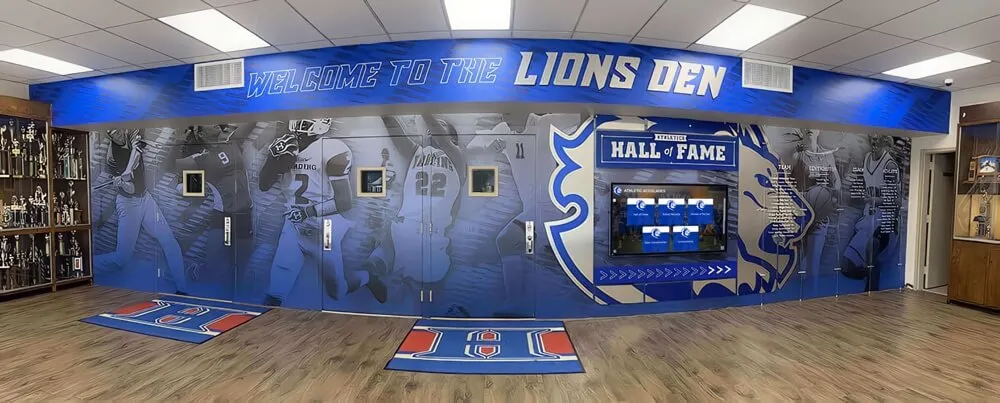
Multi-School Heritage Centers: Dedicated space honoring all predecessor schools:
- Display cases with artifacts from each school (trophies, yearbooks, uniforms)
- Historical timeline showing each school’s founding and evolution
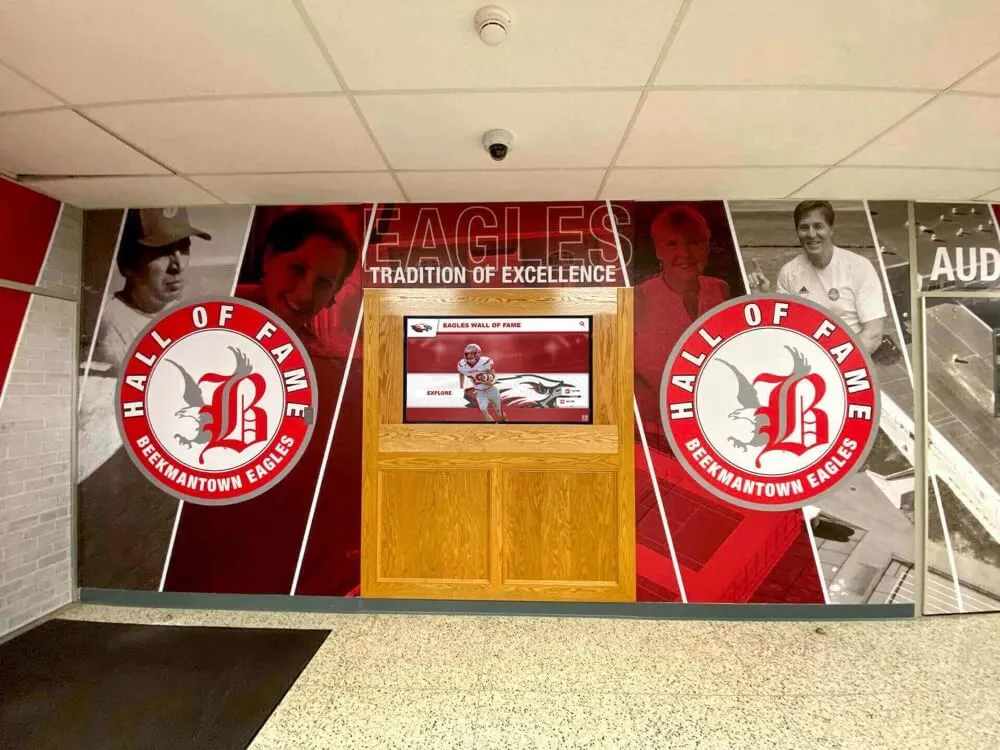
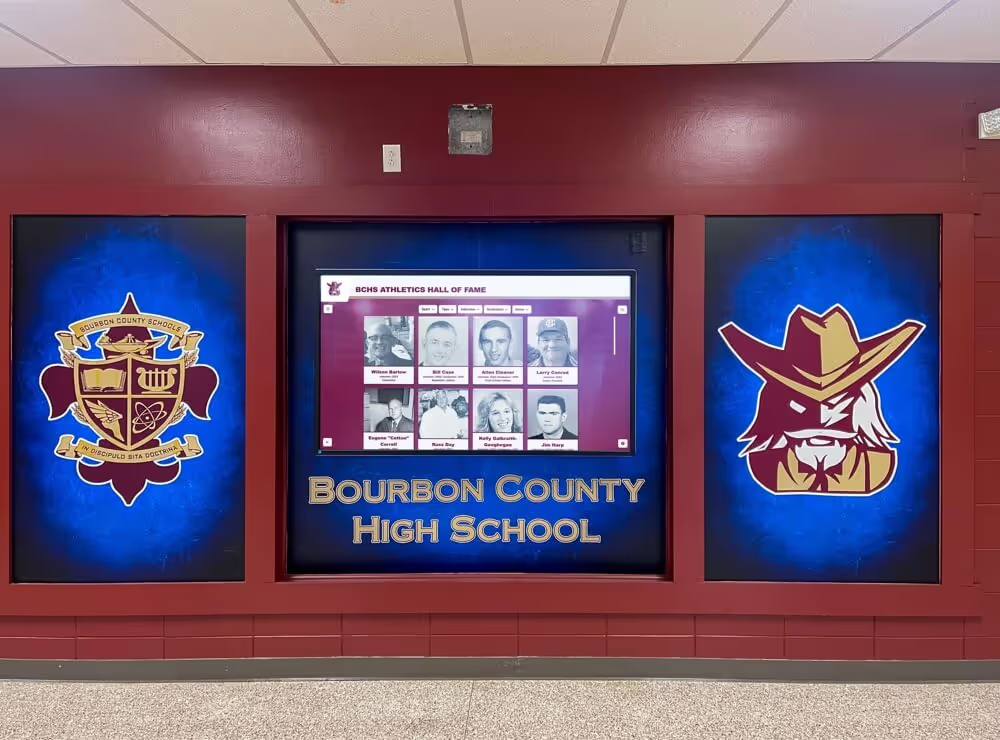
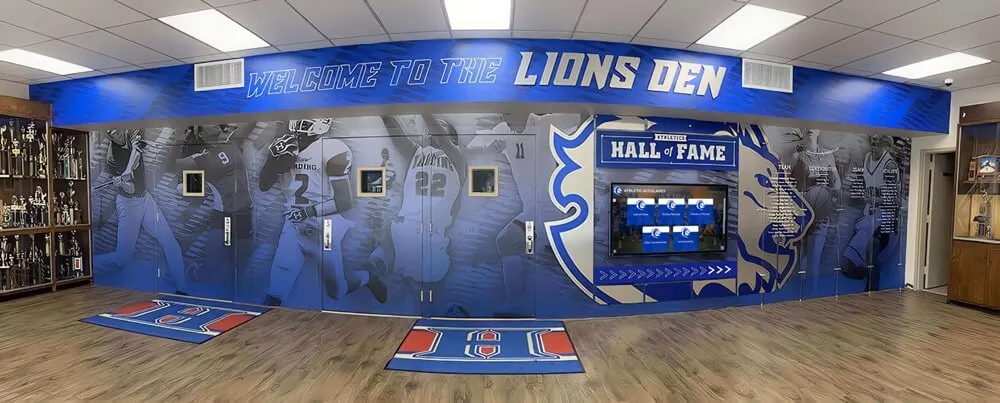
- Interactive digital displays accessing complete archives
- Rotating exhibits highlighting different aspects of heritage
- Space for alumni gatherings and reunions
Distributed Heritage Integration: Throughout consolidated facilities, incorporate predecessor school recognition:
- Hallway displays featuring athletic championships from all schools
- Library sections with yearbook collections from each predecessor
- Cafeteria or commons area honoring notable alumni from all schools
- Entrance displays welcoming alumni from all legacy institutions
- Athletic facilities recognizing records and achievements from all programs
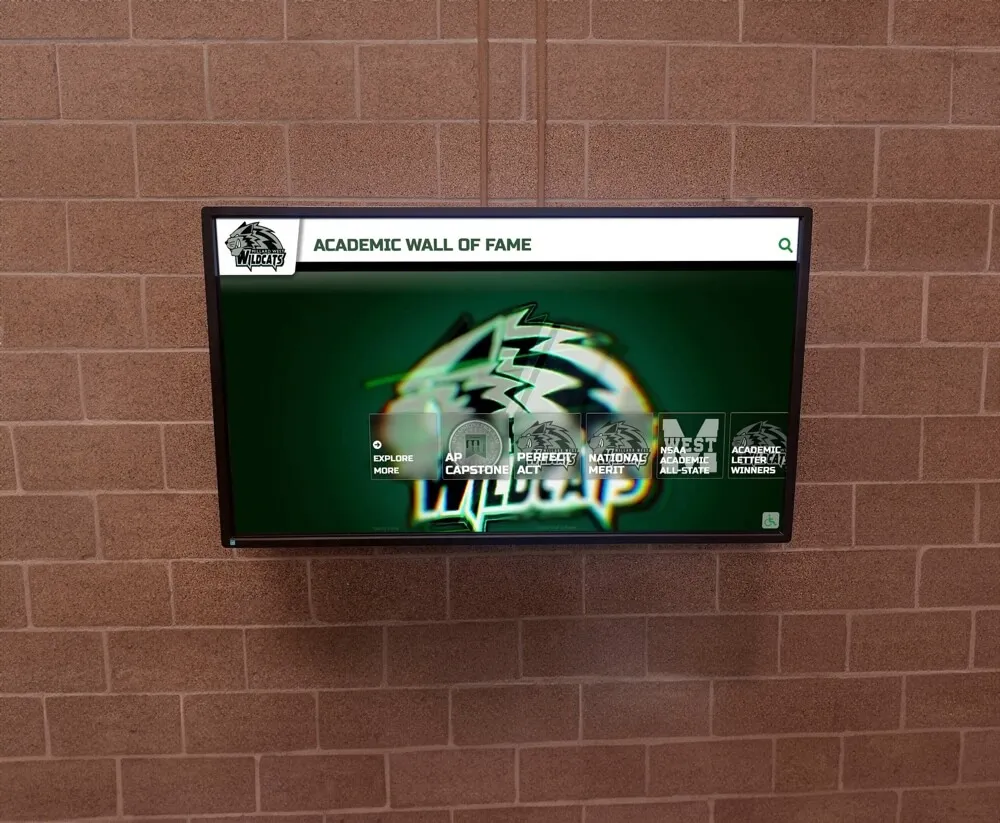
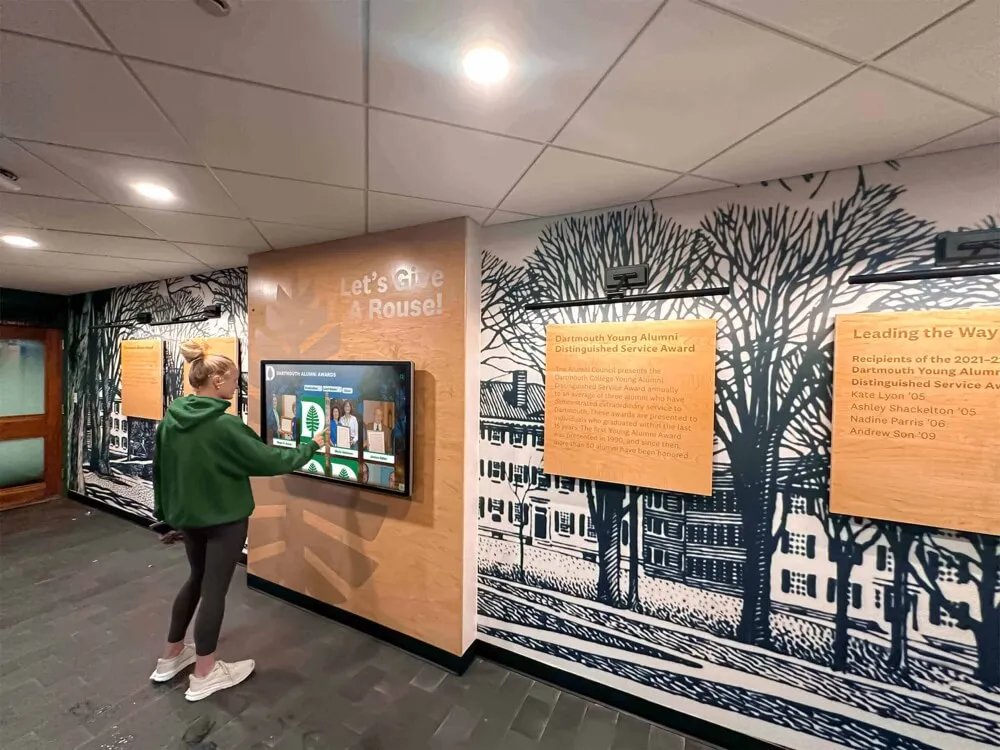
Digital Recognition Displays: Interactive touchscreen installations offer dynamic heritage presentation:
- Searchable databases of alumni, athletes, and achievements from all schools
- Historical photographs and yearbooks accessible to visitors
- Timeline presentations showing parallel histories of consolidated schools
- Student profiles and achievement recognition spanning all predecessor institutions
- Statistical records and championships from all athletic programs
Digital displays solve space limitations inherent in physical recognition while enabling comprehensive representation of multiple school histories without requiring massive trophy case expansion.
Alumni Engagement and Communication
Maintaining alumni connection requires deliberate strategies:
Unified Alumni Association Development: Creating single organization serving all predecessor schools:
- Transition planning with existing alumni associations
- Governance structure representing all schools (board seats, committees)
- Separate school-specific communications within unified organization
- Joint events bringing together alumni from all schools
- Shared fundraising supporting heritage preservation and student programs
- Clear messaging about honoring all traditions within new structure
Separate School Reunion Coordination: While unified association develops, support separate reunions:
- Facilities access for predecessor school class reunions
- Marketing and communication assistance
- Heritage center and archive access during reunion events
- Coordination to avoid scheduling conflicts
- Professional event planning support
- Encouragement to attend broader alumni events
Digital Engagement Platforms: Online tools enable alumni connection despite consolidation:
- Alumni directory and networking platforms maintaining separate predecessor school communities
- Social media groups for each school and graduating class
- Web-accessible archives enabling remote heritage exploration
- Virtual reunion capabilities for geographically dispersed alumni
- Email communications maintaining connection with all alumni cohorts
Recognition Program Integration: Alumni recognition initiatives honoring achievement across all predecessor schools:
- Hall of fame induction ceremonies including all schools
- Distinguished alumni awards recognizing graduates from any predecessor
- Athletic hall of fame combining all programs’ historical achievements
- Community service recognition for alumni contributions
- Career achievement spotlights across all alumni populations
Consolidated schools implementing comprehensive alumni engagement programs maintain 67% of pre-consolidation reunion attendance and 71% of alumni giving participation within five years, compared to 34% and 42% respectively for schools without deliberate engagement strategies.
Case Studies: Consolidation and Heritage Preservation
Vermont Act 46: Statewide Consolidation Initiative
Vermont’s 2015 school consolidation legislation provides recent large-scale example:
Consolidation Details:
- Act 46 incentivized district consolidation to reduce 277 districts
- Financial incentives and penalties encouraging voluntary mergers
- Resulted in approximately 170 districts by 2020
- Affected primarily small rural towns with independent school districts
- Generated substantial community resistance and debate
Heritage Preservation Approaches: Successful Vermont consolidations implemented several strategies:
- Historical societies in several towns created school museums in closed buildings
- Regional historical alliances coordinated archival preservation across towns
- State library and archives provided technical assistance
- Digital archiving initiatives preserving yearbooks and photographs
- Community centers established in former school buildings maintaining heritage displays
Outcomes and Lessons:
- Heritage preservation success varied dramatically by district
- Communities with proactive preservation planning maintained stronger alumni connection
- Financial savings less than projected (averaging 8-12% rather than 20-25%)
- Educational outcomes showed minimal change
- Community satisfaction correlated more with preservation efforts than consolidation itself
Vermont’s experience demonstrates that consolidation inevitably proceeds despite resistance when state policy mandates it, making heritage preservation planning essential rather than optional.
Arkansas School Consolidation Law (2004)
Arkansas implemented one of the most aggressive state consolidation mandates:
Consolidation Details:
- 2004 law required minimum 350 students per district
- Forced consolidation of numerous small rural districts
- Reduced districts from 310 (2004) to approximately 234 (2026)
- Particularly affected Delta and Ozark region small towns
- Generated legal challenges and legislative revision attempts
Heritage Challenges:
- Rapid consolidation timeline limited heritage preservation planning
- Many small schools lost historical materials during facility transitions
- Alumni associations largely disbanded rather than reorganizing
- Community identity loss particularly severe in affected towns
- Limited state resources for archival support
Preservation Successes:
- Some districts created heritage centers in closed schools
- Local historical societies preserved selected materials
- Regional archives accepted institutional records
- Digital yearbook projects preserved some materials
- Athletic hall of fame exhibits in consolidated schools
Lessons Learned:
- Mandated consolidation without heritage planning causes permanent historical loss
- Compressed timelines leave insufficient time for proper preservation
- State policy should include archival preservation requirements and funding
- Community resistance reflects legitimate concerns about heritage loss
- Consolidated schools benefit from visible honoring of predecessor institutions
Indiana’s Century of Consolidation
Indiana’s consolidation from 10,000+ districts (1930s) to 292 today offers long-term perspective:
Historical Pattern:
- Gradual consolidation over 90+ years
- Township schools consolidated into county systems
- Further consolidation continuing in recent decades
- Some communities resisted successfully for decades before eventual merger
- Current discussions about additional consolidation in declining-enrollment counties
Heritage Preservation Evolution:
- Early consolidations (1930s-1960s) lost substantial heritage due to lack of preservation awareness
- Later consolidations (1990s-2020s) increasingly implemented deliberate preservation
- County historical societies absorbed many school archives
- Indiana Historical Society developed school archive guidelines
- Digital preservation efforts increasing significantly
Long-Term Community Impact:
- Former small-town school buildings repurposed as community centers, libraries, museums
- Athletic rivalries mostly lost to history (three-four generations removed)
- Alumni associations largely dissolved (aging membership, diminished interest)
- Community identity shifted from individual schools to county systems
- Physical historical markers and displays remain primary heritage connection
Contemporary Implications: Indiana’s century-long consolidation history demonstrates that heritage preservation requires continuous, deliberate effort. Without systematic archival programs, institutional memory fades within two generations, leaving limited connection to pre-consolidation school identities.
Technology Solutions for Heritage Preservation
Digital Archive Platforms
Technology enables preservation and access impossible with physical materials alone:
Archive Platform Requirements for Consolidated Schools:
- Multi-school organization (separate sections for each predecessor school)
- Comprehensive search across all schools’ materials
- Metadata structure accommodating different organizational systems
- Scalable storage for thousands of yearbook pages and photographs
- User-friendly public access without technical barriers
- Analytics tracking engagement by school, graduating class, and content type
- Secure backup and long-term preservation management
Platform Categories:
Generic cloud storage (Google Drive, Dropbox) provides inadequate functionality:
- Limited search and discovery capabilities
- No structured metadata or organization
- Poor browsing experience for large collections
- Minimal analytics
- Not designed for public engagement
Open-source archival systems (Omeka, ArchivesSpace) offer professional features but require:
- Significant technical expertise for implementation
- Server infrastructure and security management
- Custom development for school-specific needs
- Ongoing maintenance and support
Purpose-built educational heritage platforms designed specifically for schools:
- Optimized for yearbooks, photographs, athletic records, and school-specific content
- Integrated web access and interactive display capabilities
- Manageable by school staff without specialized technical expertise
- Support for multiple predecessor schools within single platform
- Moderate cost aligned with educational budgets

Interactive Display Solutions
Physical displays in consolidated schools provide on-campus heritage access:
Touchscreen Display Applications:
- School history timelines showing parallel development of predecessor schools
- Athletic record databases searchable by sport, year, and school
- Yearbook browsers enabling exploration of historical graduating classes
- Notable alumni directories recognizing achievement across all schools
- Championship and achievement showcases from all predecessor programs
Implementation Considerations:
- High-traffic location (main entrance, cafeteria, athletic facility)
- Commercial-grade touchscreen displays (durability, reliability)
- Content management system enabling regular updates
- Analytics tracking usage patterns and popular content
- Integration with web-based archives for consistent experience
Schools implementing interactive heritage displays report average 1,847 monthly interactions, with peak usage during school events, reunions, athletic competitions, and orientation periods. These displays particularly engage current students in exploring school heritage they might otherwise ignore.
Alumni Engagement Technology
Digital tools maintain alumni connection despite consolidation:
Alumni Platform Functionality:
- Directory and networking tools maintaining separate predecessor school communities
- Reunion planning and event management
- Communication tools (email, social media integration)
- Giving and fundraising capabilities
- Career mentoring and student connection programs
- News and updates from consolidated district
Multi-School Organization: Platforms serving consolidated schools must accommodate:
- Separate class and graduating year organization for each predecessor school
- School-specific communications and reunion management
- Combined events and all-alumni communications
- Reporting showing engagement across all schools
- Gradual integration as unified identity develops over decades
Integration with Heritage Archives: Alumni platforms connected to digital archives create engagement opportunities:
- Alumni exploring their yearbooks and school photographs
- Adding personal stories and memories to historical materials
- Identifying people in photographs (crowdsourced metadata)
- Sharing historical content on social media
- Attending events prompted by heritage connections
Integrated heritage and engagement platforms generate 3.4x higher alumni participation compared to separate disconnected systems.
What This Means for School Districts
Proactive Heritage Planning for At-Risk Districts
Districts facing potential consolidation should begin heritage preservation immediately:
Immediate Actions for Districts with Declining Enrollment:
Conduct comprehensive heritage inventory: Document all historical materials currently held by school before consolidation discussions intensify.
Implement systematic digitization program: Begin scanning yearbooks, photographs, and critical documents following professional archival standards. Prioritize materials in poor condition or held in vulnerable locations.
Establish archival policies and procedures: Document collection scope, preservation standards, access policies, and staff responsibility before organizational disruption.
Engage alumni associations: Communicate with alumni leadership about potential consolidation and heritage preservation planning. Request assistance identifying materials in private collections.
Secure appropriate platforms: Implement purpose-built heritage preservation systems designed for educational institutions before consolidation diverts attention and resources.
Districts that begin heritage preservation before consolidation becomes imminent preserve 2.8x more historical materials and maintain substantially stronger alumni engagement compared to those attempting retroactive preservation after merger completion.
Integration Requirements for Newly Consolidated Schools
Districts completing or planning consolidation should implement these integration strategies:
First Year Priorities:
- Establish heritage center or designated display space in consolidated facility
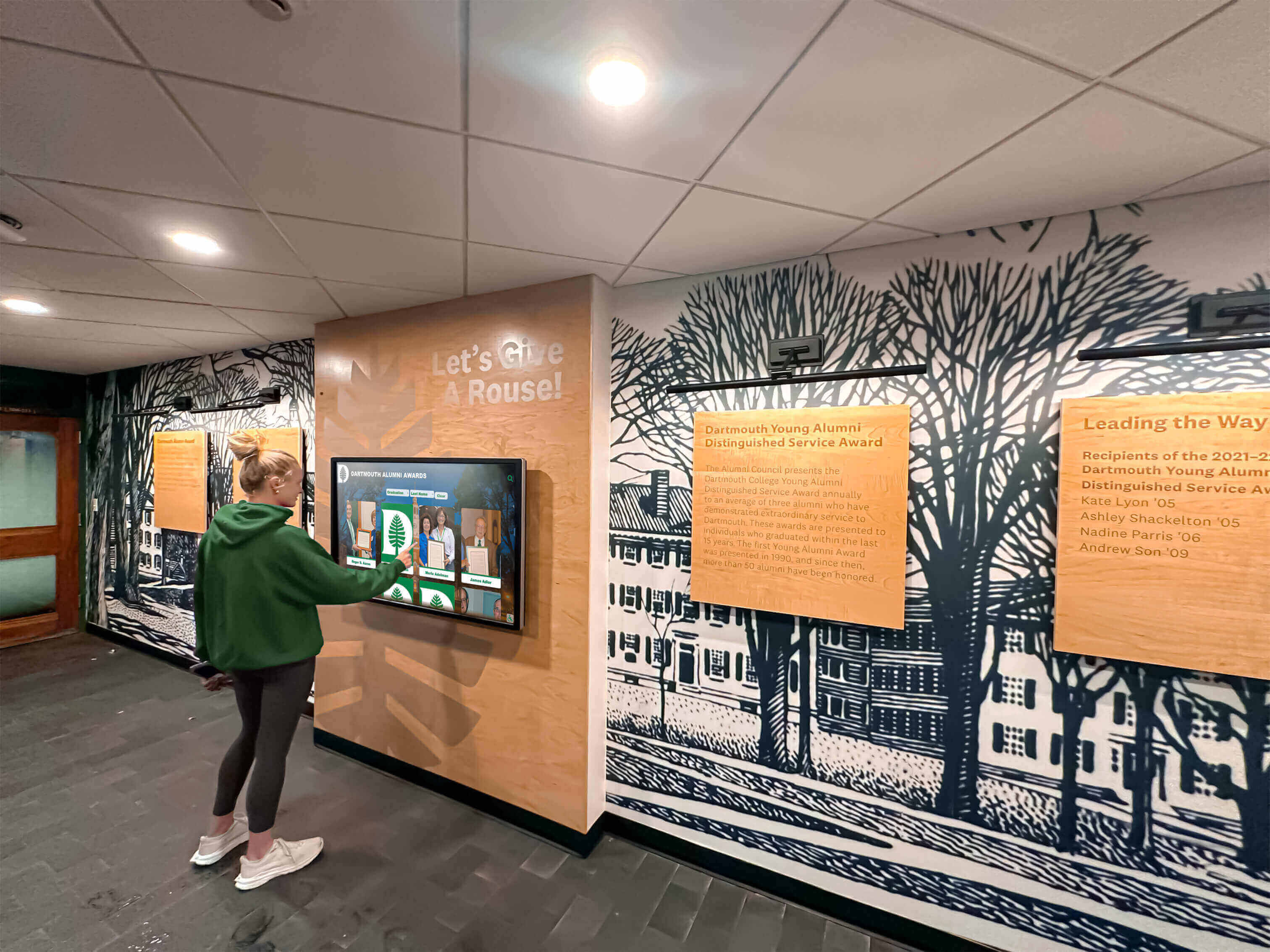
- Install interactive digital displays accessing complete archives from all predecessor schools
- Coordinate initial joint alumni event bringing together all constituencies
- Communicate heritage preservation commitment to all alumni populations
- Create student opportunities to explore and present predecessor school histories
Three-Year Integration Goals:
- Complete digitization of all yearbooks from all predecessor schools
- Develop substantial photograph and document archives
- Establish regular heritage-focused events (hall of fame inductions, historical presentations)
- Integrate heritage content into curriculum (local history units, research projects)
- Build unified alumni association structure while maintaining school-specific connections
Long-Term Sustainability:
- Designated staff responsibility for heritage preservation (even part-time)
- Annual budget allocation for archival activities and platform costs
- Ongoing digitization of new materials and enhancement of existing archives
- Regular communication with alumni across all predecessor schools
- Continuous assessment and improvement of heritage programs
Policy Recommendations for State Education Agencies
State departments of education can substantially improve consolidation outcomes:
Heritage Preservation Mandates:
- Require comprehensive archival assessment as consolidation planning prerequisite
- Mandate heritage preservation plans before approving consolidations
- Provide technical assistance and archival consultation
- Include preservation funding in consolidation implementation grants
- Establish minimum archival standards for consolidated districts
Consolidation Planning Requirements:
- Extended planning timelines (minimum 3 years) enabling proper preservation
- Community engagement requirements including alumni representation
- Heritage center or display space requirements in consolidated facilities
- Multi-year monitoring of alumni engagement and heritage preservation outcomes
- Penalties for districts failing to preserve historical materials
State-Level Support Infrastructure:
- Centralized archival resources and consultation services
- Grant programs supporting heritage digitization and preservation
- Partnerships with state historical societies and archives
- Training programs for school personnel managing archival materials
- Best practice documentation and case study dissemination
State policy significantly influences whether consolidation results in permanent heritage loss or successful preservation supporting ongoing community connection.
Frequently Asked Questions
How many schools existed in the United States historically compared to today?
Why do schools consolidate or merge?
What happens to school historical materials when schools consolidate?
How does school consolidation affect alumni and community identity?
What are best practices for preserving school heritage during consolidation?
Which states have experienced the most school consolidation?
What technology solutions help preserve school heritage after consolidation?
Conclusion: Preserving Community Heritage Through Institutional Change
The history of school consolidation in America—from 262,000 schools in 1930 to 98,000 today—represents one of the most dramatic institutional transformations in the nation’s history. This 63% reduction reflects economic pressures, demographic shifts, educational philosophy changes, and policy decisions spanning nearly a century. While consolidation delivered benefits in specific contexts (curriculum breadth, specialized facilities, program opportunities), it also generated profound community impacts: loss of civic gathering places, weakened local identity, fragmented alumni networks, and endangered institutional heritage.
The consolidation pattern shows no signs of complete cessation. Declining birth rates, continued rural depopulation, and budget pressures ensure that additional districts will face consolidation decisions in coming decades. However, the consolidation rate has slowed substantially from its 1940-1970 peak, reflecting both demographic stabilization and growing awareness of community costs accompanying school closures.
For districts facing potential or planned consolidation, the evidence clearly demonstrates that heritage preservation requires deliberate, proactive planning integrated into the consolidation process rather than treated as afterthought. Districts conducting comprehensive heritage inventories, implementing systematic digitization following professional archival standards, establishing appropriate technology platforms, creating visible recognition spaces in consolidated facilities, and maintaining ongoing alumni engagement preserve substantially more institutional memory and sustain stronger community connections than those neglecting preservation until consolidation completion.
The technology landscape has transformed heritage preservation feasibility. Digital archiving protects against physical material loss while enabling access impossible with physical displays alone. Interactive touchscreen systems engage current students with historical heritage while honoring achievements across all predecessor schools. Purpose-built platforms designed specifically for educational institutions provide functionality, usability, and integration that generic storage solutions cannot match.
Schools seeking comprehensive heritage preservation and alumni engagement solutions for consolidated districts will find platforms like Rocket Alumni Solutions deliver integrated systems combining unlimited digital archive storage, interactive campus displays, web-based public access, and alumni networking tools specifically designed for educational contexts and multi-school consolidation scenarios.
The permanent nature of heritage loss makes immediate action critical for at-risk districts. Historical materials deteriorate continuously, knowledgeable community members age, and organizational disruption during consolidation creates conditions for permanent loss. Districts beginning preservation before consolidation becomes imminent achieve substantially better outcomes than those attempting retroactive recovery after merger completion.
State education agencies can substantially improve consolidation outcomes through policy requiring heritage preservation planning, providing technical assistance and funding, establishing minimum archival standards, and monitoring preservation implementation. The differential heritage preservation success across states correlates strongly with state policy support and requirements rather than local district resources alone.
School consolidation will continue reshaping American education in coming decades. The question is not whether consolidation occurs but whether communities preserve institutional memory, honor achievement across generations, and maintain alumni connections through deliberate heritage preservation strategies. The evidence demonstrates that successful preservation is achievable across districts of all sizes and resource levels when approached systematically with appropriate planning, technology, and sustained commitment.
For consolidated schools seeking to honor all predecessor institutions while building unified identity, comprehensive heritage programs provide the foundation for community healing and institutional success across generations. Book a demo to explore how integrated heritage preservation and alumni engagement platforms support consolidated districts in maintaining connections across all school communities.
Sources
- National Center for Education Statistics (NCES) - Digest of Education Statistics (nces.ed.gov)
- Rural School and Community Trust research (ruraledu.org)
- Journal of Research in Rural Education - Academic research database
- American Association of School Administrators studies (aasa.org)
- Urban Institute education policy research
- Brookings Institution education policy analysis
- Society of American Archivists guidelines
- American Association for State and Local History resources
- National Rural Education Association reports (nrea.net)
- Education Commission of the States policy tracking
- State departments of education consolidation data
- Pew Research Center demographic analysis