Every year, athletic directors and administrators across the country face the same uncomfortable moment: a passionate booster insists a beloved alumnus deserves hall of fame recognition, a coaching legend’s family reaches out about nomination, or the selection committee quietly disagrees about whether this year’s class should have three inductees or seven. Without a formal hall of fame nomination form and documented selection criteria, those conversations default to gut feeling—and gut feeling, however well-intentioned, produces inconsistent classes and erodes the credibility of the honor itself.
Whether you are building a hall of fame program from scratch or overhauling an inconsistent legacy process, the steps below will help you create a nomination system that produces induction classes your entire community respects for generations.

Why the Nomination Form Comes Before Everything Else
Schools often start hall of fame planning by choosing a location for the display, selecting a plaque style, or scheduling an induction banquet. Those decisions matter, but they all depend on having inductees—and having inductees requires a process that the community trusts.
A nomination form is the public face of that process. It communicates what your school measures, how thoroughly nominees are evaluated, and who holds responsibility for decisions. When community members see a nomination form that asks substantive questions about a candidate’s specific accomplishments, their character, and their post-graduation contributions, they understand that selection is taken seriously. When they see a one-page form with three blanks, they assume the selection is based on whoever nominates the loudest.
The nomination form also creates your paper trail. Selection committees change over time; the coach who championed a particular nomination standard retires; institutional memory fades. A documented process with completed forms in the archive allows future committees to see exactly how past decisions were made and apply consistent standards even when the people change.
For programs that want to understand the broader ecosystem of recognition tools available, reviewing resources like the 10 best hall of fame tools for schools can help frame where the nomination process fits within the larger recognition infrastructure.
Core Required Fields for Every Nomination Form
Regardless of whether your school emphasizes athletics, academics, or community service, every hall of fame nomination form needs the same foundational information. These fields establish identity, context, and the basic claim for induction.
Nominee Information
Full legal name — Use the name the nominee went by at your school if different from their current legal name, and note any name changes for record-keeping purposes.
Graduation year — Essential for historical context and for enforcing waiting period rules (many programs require five to ten years between graduation and eligibility).
Sport(s) or program(s) — List every program the nominee participated in, not only the one driving the nomination. A three-sport athlete may be nominated primarily for football but deserves credit for the full scope of involvement.
Years of participation — Specific years (not just a single graduation year) help the committee verify records and understand the nominee’s era within program history.
Current contact information — Required for notifying living nominees and for gathering supplementary materials. Some programs contact nominees before formal selection; others make the notification a surprise. Either way, having accurate contact information prevents awkward situations.
Nominator information — Full name, relationship to nominee, contact information, and the date of submission. Anonymous nominations are difficult to follow up on and can undermine process integrity.
Achievement Documentation
This section is where most nomination forms fail to go deep enough. Vague phrases like “exceptional athlete” or “great leader” do not give the selection committee anything to evaluate. Strong nomination forms demand specificity.
Statistical record — Career statistics, season bests, personal records, and rankings. For athletes, this means points scored, wins, times, distances, or whatever measurable outcomes define excellence in the sport. For academic honorees, this might include GPA, standardized test scores, or specific academic distinctions.
Championships and team honors — Conference championships, state tournament appearances or titles, national qualifications. Distinguish between individual and team honors.
Individual awards received — All-state selections, All-American recognition, coach’s awards, academic honors. Require the nominator to list the awarding body and year for each honor, making verification straightforward.
School records held — List any school, conference, or regional records the nominee set, with documentation where available. Records establish a candidate’s achievement relative to the institution’s entire history, which is the most relevant context for a school hall of fame.
Comparative context — Where did this nominee’s performance rank relative to contemporaries, or relative to all-time program performance? The selection committee benefits from knowing whether a nominee was the best in program history at their event or one of five similarly outstanding performers in a given decade.

Character and Community Contributions
Hall of fame recognition is rarely meant to honor athletic statistics alone. Most programs explicitly or implicitly value character and contribution beyond competition. The nomination form should require concrete evidence, not general praise.
Sportsmanship and leadership — Ask nominators to describe specific instances, not to rate the nominee on a scale. “Captain for two seasons who organized the team’s community service project” is evaluable. “Great leader” is not.
Community service during enrollment — Activities, organizations, hours committed, and impact where quantifiable.
Post-graduation contributions — Mentorship of current athletes, coaching at youth or school levels, financial support of the program, public representation of the school’s values. For many programs, the post-graduation dimension distinguishes a very good athlete from a true hall of fame honoree.
Nominations or support from others — Some forms include a section for additional supporting letters from coaches, teammates, or community members. Limit these to two or three to keep the review process manageable, but require that letters address specific criteria rather than simply expressing enthusiasm.
Defining Your Selection Criteria
The nomination form collects information; the selection criteria define what the committee does with it. Without explicit criteria documented in writing, two committee members can read the same nomination packet and reach opposite conclusions, both believing they applied the program’s standards correctly.
Effective selection criteria answer three questions: What categories of achievement matter? How much weight does each category carry? What minimum threshold must a candidate clear to be eligible for induction?
Category 1: Athletic or Program Performance
For most school halls of fame, competitive performance in the nominee’s primary program area forms the largest share of the evaluation. This category typically accounts for 40–60 percent of total consideration.
Defining performance criteria requires acknowledging that raw statistics can be misleading across different eras and program contexts. A 2,000-yard rushing season in the 1980s may represent a different level of achievement than the same total in a modern spread offense against weaker competition—or it might represent even more, depending on the era. The selection criteria should direct committees to contextualize achievement, comparing nominees to the program’s historical record and to the competitive landscape of their era.
Performance criteria also need to address different levels of achievement consistently. Should a state runner-up who was arguably as talented as same-year state champions from neighboring districts receive the same consideration? Should a wrestler who went 40–2 but never qualified for the state tournament because of an injury receive equal credit to a 35–7 wrestler who finished third at state? These are judgment calls, but the selection criteria should acknowledge that such cases exist and direct committees on how to think through them.
Category 2: Academic Achievement
Schools are educational institutions first, and many programs include academic achievement as a formal category in hall of fame selection. For schools that want this to be more than lip service, the criteria should define what academic achievement means in measurable terms: minimum GPA, honor roll membership, academic all-state or all-conference recognition, scholarship achievement, or post-secondary academic accomplishment.
The weighting here depends on your program’s values and the community you serve. Some schools weight academics and athletics equally. Others treat academic achievement as a tie-breaker or as a bonus factor rather than a primary category. What matters is consistency: document the weighting explicitly so that every candidate is evaluated the same way.
Recognizing academic achievement alongside athletic accomplishment also supports important messaging for current students. When they see that the school’s hall of fame includes people who excelled in the classroom alongside those who excelled on the field, the institution communicates that it values the full student-athlete identity—a point worth making visible and permanent. For parallel recognition programs, the process of creating a student of the month certificate program can complement and feed into the longer-term hall of fame pipeline.
Category 3: Service and Character
Service and character are the hardest categories to evaluate objectively, which is exactly why having explicit criteria matters most here. Without written standards, this category tends to reflect whichever committee member feels most strongly rather than a principled assessment.
Useful service criteria include documented hours of community involvement during enrollment, sustained post-graduation contribution to the program or school (measured in years, not single events), and specific leadership roles that advanced the institution’s mission. Character criteria are harder to quantify, but nomination forms can ask nominators to document specific behaviors—recognition by peers, response to adversity, behavior toward opponents and officials—rather than general impressions.
Many programs also include a “negative conduct” clause in their selection criteria: nominees who were removed from their program for conduct violations, or who have engaged in conduct publicly inconsistent with the school’s values since graduation, may be ineligible or subject to additional review. This clause protects the institution and makes clear that the hall of fame is a reflection of values, not merely a statistical leaderboard.

Building a Weighted Scoring Rubric
Once categories are defined, the scoring rubric translates subjective evaluations into comparable numbers. A rubric does not eliminate judgment—it structures it. Committee members still read the nomination materials and form assessments, but they record those assessments using a consistent scale that produces comparable totals for all candidates.
Sample Four-Point Scale
A four-point scale is simple enough to apply consistently but nuanced enough to distinguish among candidates:
4 — Exceptional: Among the very best in program history; achievement would be recognizable as outstanding in any era of the program.
3 — Excellent: Clearly above average program performance; achievement would be recognized as significant by any knowledgeable observer of the program.
2 — Solid: Above-average performance with noteworthy accomplishments, but not at the highest tier of program history.
1 — Good: Positive contribution to the program that does not reach the threshold for hall of fame recognition on its own.
0 — Insufficient information: The committee does not have enough documentation to evaluate this criterion; the nomination packet should be returned to the nominator for supplementation before the next review cycle.
The “0 — Insufficient information” rating is important. It removes the pressure on committee members to invent assessments for criteria where documentation was not provided, and it creates accountability for nominators to submit complete packets.
Weighted Scoring Template
The following weighting structure represents one defensible approach. Programs should adjust percentages to reflect their institutional values.
| Criterion | Maximum Points | Weight | Weighted Maximum |
|---|---|---|---|
| Athletic/Program Performance | 4 | 40% | 1.6 |
| Historical Significance | 4 | 15% | 0.6 |
| Academic Achievement | 4 | 20% | 0.8 |
| Community Service (during enrollment) | 4 | 10% | 0.4 |
| Post-Graduation Contribution | 4 | 10% | 0.4 |
| Character and Leadership | 4 | 5% | 0.2 |
| Total | 100% | 4.0 |
With this structure, a candidate who earns a perfect “4” in every category would score 4.0 weighted points. Programs can establish a minimum threshold for induction—for example, candidates must score at least 2.8 to be considered for induction in a given year—and can set a maximum class size to prevent induction inflation.
Handling Ties and Borderline Cases
Even with a rubric, borderline cases arise. Programs should document in advance how ties are resolved: Does the committee revote? Does the athletic director cast a deciding vote? Are ties resolved in favor of induction or against? Is there a waiting list that carries candidates forward to the next cycle?
Documenting these procedures before they are needed prevents contentious in-the-room debates that damage committee relationships and undermine community trust in the process.
Complete Sample Nomination Form Template
The following template can be adapted for school hall of fame programs of any size. Sections marked with an asterisk are required; others are recommended but optional depending on program resources.
[SCHOOL NAME] HALL OF FAME NOMINATION FORM
All nominations must be received by [DATE] to be considered for the [YEAR] induction class. Incomplete nominations will not be reviewed. Nominations are kept confidential until the selection committee completes its review.
SECTION 1: NOMINEE INFORMATION (Required)
Nominee Full Name: _______________________________________________
Name Used During Enrollment (if different): __________________________
Graduation Year: __________ Class of: __________
Primary Sport or Program: _________________________________________
Additional Sports or Programs Participated In: ________________________
Years of Active Participation: ______________________________________
Current City/State of Residence (if known): __________________________
SECTION 2: NOMINATOR INFORMATION (Required)
Your Full Name: __________________________________________________
Your Relationship to Nominee: _____________________________________ (e.g., teammate, coach, parent, alumnus, community member)
Your Email Address: ______________________________________________
Your Phone Number: ______________________________________________
Date of Submission: ______________________________________________
I certify that all information provided in this nomination is accurate to the best of my knowledge.
Signature: _____________________________________ Date: ___________
SECTION 3: ATHLETIC OR PROGRAM ACHIEVEMENT (Required)
Career statistics (include seasons and totals):
Individual awards received (list award name, awarding body, and year):
Team accomplishments (championships, tournament appearances, notable seasons):
School, conference, or regional records held (note if records still stand):
Comparative context — how did this nominee’s performance rank within program history or relative to regional/state competition?
SECTION 4: ACADEMIC ACHIEVEMENT (Required)
Cumulative GPA at graduation (if known): __________
Academic honors received (honor roll, academic all-conference/all-state, AP Scholar, etc.):
Scholarships received (academic):
Post-secondary academic accomplishments (degrees earned, institutional honors):
SECTION 5: CHARACTER, LEADERSHIP, AND SERVICE (Required)
Describe specific leadership roles held by the nominee (captain, team officer, student council, etc.):
Describe specific community service activities during enrollment (organization, activity, approximate time commitment):
Describe the nominee’s character and sportsmanship with specific examples, not general statements:
SECTION 6: POST-GRADUATION CONTRIBUTION (Strongly Recommended)
Has the nominee maintained a connection to the school or program since graduation? Describe:
Has the nominee made financial contributions, served as a mentor or coach, or otherwise supported the program? Describe with specifics:
SECTION 7: SUPPORTING LETTERS (Optional, Maximum 2)
You may attach up to two letters of support from individuals who can speak to the nominee’s qualifications. Each letter should address the specific criteria listed above, not simply express personal enthusiasm. Letters from coaches, former teammates, or community leaders carry more weight than letters from family members.
Supporting Letter 1 Author Name and Relationship: _____________________
Supporting Letter 2 Author Name and Relationship: _____________________
SECTION 8: ADDITIONAL INFORMATION
Is there anything else about this nominee that the selection committee should know?
Submit completed forms to: [ATHLETIC DIRECTOR NAME], [ADDRESS/EMAIL]. Nominations are reviewed annually by the [SCHOOL NAME] Hall of Fame Selection Committee. The committee’s decisions are final. Nominees who are not selected will remain in the pool for future consideration for [X] years.
Selection Committee Structure and Process
The nomination form and rubric are tools. The selection committee is the process. Poorly structured committees produce inconsistent results regardless of how well the forms are designed.
Committee Composition
A selection committee of five to nine members provides enough diversity of perspective to prevent any single voice from dominating while remaining manageable enough to schedule and coordinate. Common compositions include:
- Current athletic director (often serves as chair or chair’s designee)
- One or two current or retired coaches with deep program knowledge
- Two to three alumni from different decades who can provide era-specific context
- One or two community representatives who are not alumni and provide perspective on the program’s broader reputation and impact
- One student activities administrator or faculty representative for programs that include academic criteria
Avoid compositions where any single interest group holds a majority. A committee dominated by former athletes from a specific era may systematically undervalue candidates from other periods. A committee controlled by administrators may lack the program-specific knowledge to evaluate athletic achievement accurately.
Conflict of Interest Policies
Every committee member should recuse themselves from evaluating nominations where they have a direct personal interest: a close family member, a player they personally coached, or a nominee with whom they have a significant ongoing personal or financial relationship. Document recusals in meeting minutes.
Some programs ask committee members to disclose relationships with all nominees at the beginning of each review cycle, before reviewing any materials. This approach prevents the appearance of selective recusal.
Review Timeline
A well-structured annual timeline looks roughly like this:
3 months before induction deadline — Open the nomination window. Announce deadlines through alumni communications, school newsletters, booster club channels, and social media.
Nomination window closes — Collect and inventory all submitted nomination forms. Confirm that required fields are complete; return incomplete nominations to nominators with a note about what is missing and a deadline for resubmission.
2 months before induction ceremony — Distribute complete nomination packets to all committee members. Allow two to three weeks for independent review.
6 weeks before ceremony — Convene committee meeting for discussion and scoring. Use the rubric to produce individual scores, then discuss cases where scores diverge significantly.
4 weeks before ceremony — Announce inductees to nominees and begin planning ceremony logistics. Begin collecting photographs, biographical information, and content for displays.
Induction ceremony — Honor new inductees and update physical or digital displays.
Documentation and Records
Keep complete records of every nomination received and every committee decision made, including the scoring rubrics and any notes about borderline decisions. These records protect the committee from accusations of bias and provide future committees with the institutional memory needed to apply criteria consistently.
Programs with long histories particularly benefit from documenting their decision rationale, because over decades the original committee members are no longer available to explain past choices. Connecting the nomination form process to the physical or digital display—so that the documentation behind each inductee’s selection is preserved alongside their profile—creates a durable institutional record.
Athletic directors researching how to structure the full ecosystem of recognition programs, from display technology to the governance process, will find useful frameworks in guides like this one on athletic director digital display planning.
Eligibility Rules and Common Edge Cases
Clear eligibility rules prevent disputes before they start. Document all of the following in your program’s written policies:
Waiting period. Most programs require five to ten years between graduation and eligibility for induction. This waiting period serves two purposes: it provides time to assess lasting impact rather than recency effect, and it allows any character concerns that emerged shortly after graduation to become known to the committee. Programs without a waiting period risk inducting athletes who later become poor representatives of the institution.
Living vs. posthumous nominees. Decide explicitly whether living and deceased nominees are evaluated through the same process. Many programs allow posthumous nominations at any time regardless of the standard waiting period, recognizing that the waiting period was designed to assess post-graduation contribution over time—a dimension that changes for deceased nominees.
Multiple nominations. If a nominee is not selected in a given year, specify how long they remain in the active pool. Allowing nominations to roll forward for three to five years prevents nominators from needing to resubmit the same documentation repeatedly, while the time limit ensures that the pool does not grow unmanageable.
Team vs. individual recognition. Some programs create a separate category for team induction (honoring an entire championship team) distinct from individual induction. Define explicitly whether individual members of an inducted team must also qualify independently to receive individual recognition, or whether team induction conveys individual recognition to all members.
Multiple sports eligibility. A three-sport athlete may be nominated multiple times by fans of different programs. Clarify whether a nominee is evaluated for the program that generated the nomination, across all programs simultaneously, or whether they must choose a primary program for evaluation purposes.
Older or heritage programs that honor multi-decade contributors may also benefit from reviewing best practices for oldtimers wall recognition, which addresses some of the unique challenges of honoring alumni whose careers predate consistent record-keeping.
Moving from Nomination to Display
A complete nomination process ends when the inductee’s recognition is permanently visible to the community. The induction ceremony matters, but the lasting impact comes from the display—the physical or digital installation where future students, parents, and visitors encounter the inductee’s story for years to come.
This transition from process to display is where many schools lose momentum. They invest significant effort in the nomination and selection process, then underinvest in the display, resulting in a small plaque that few people notice and even fewer interact with. The nomination form should already be collecting the content that a rich display requires: career statistics, photographs, supporting narratives, and post-graduation story.
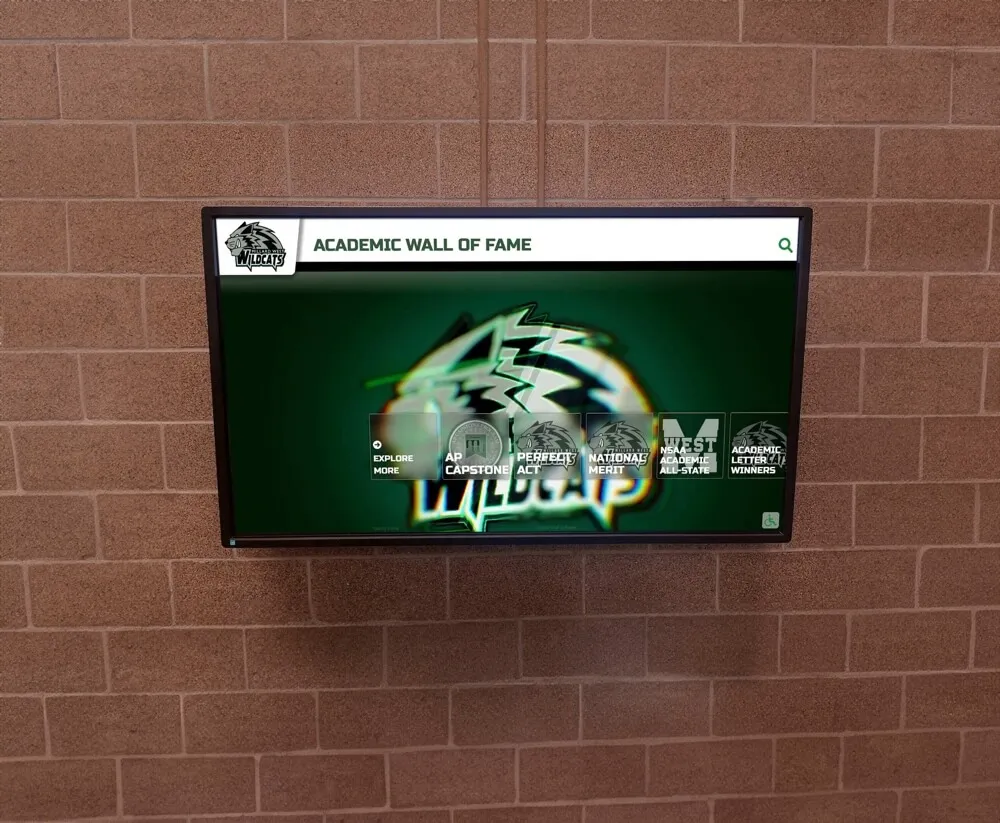
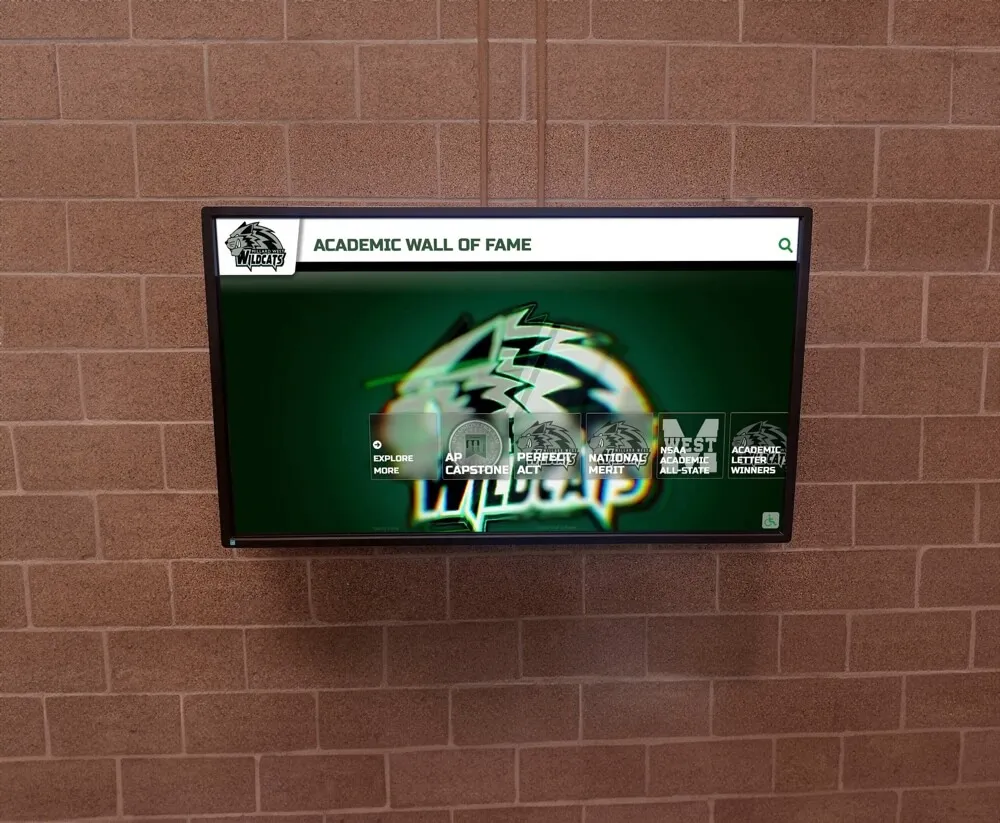
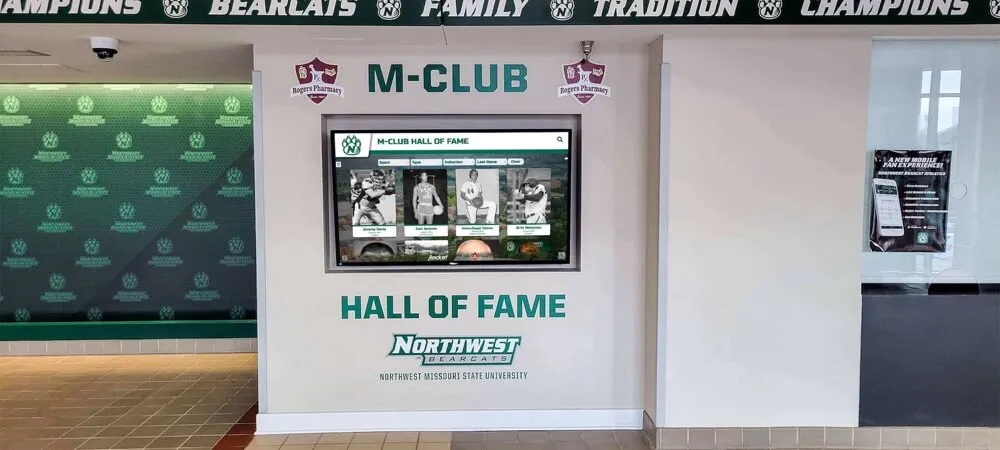
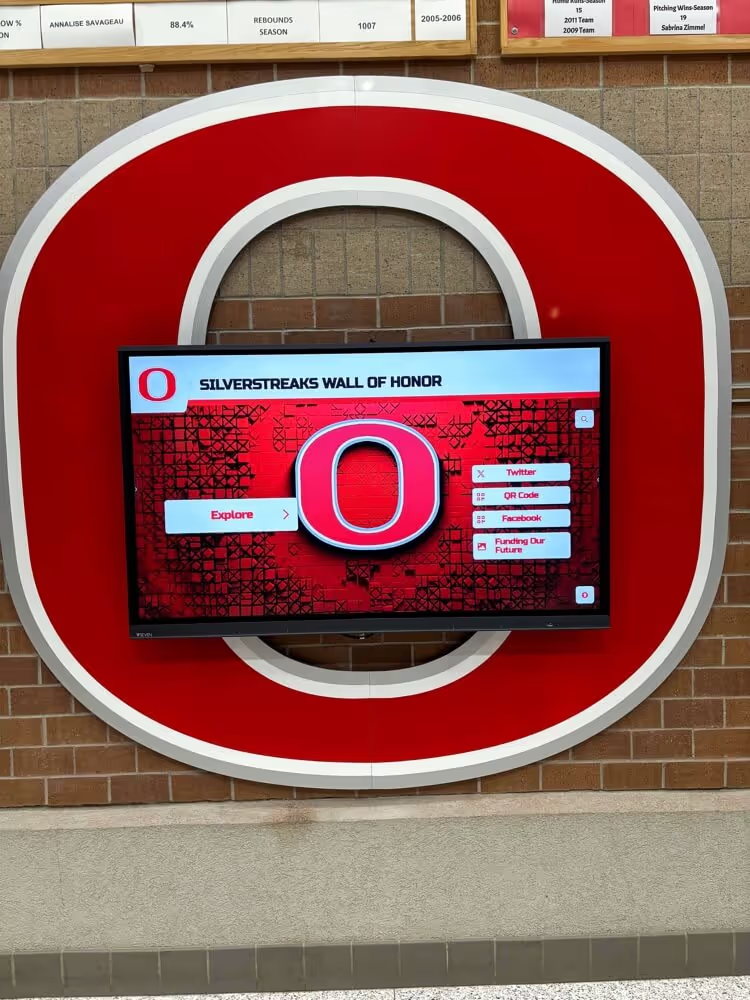
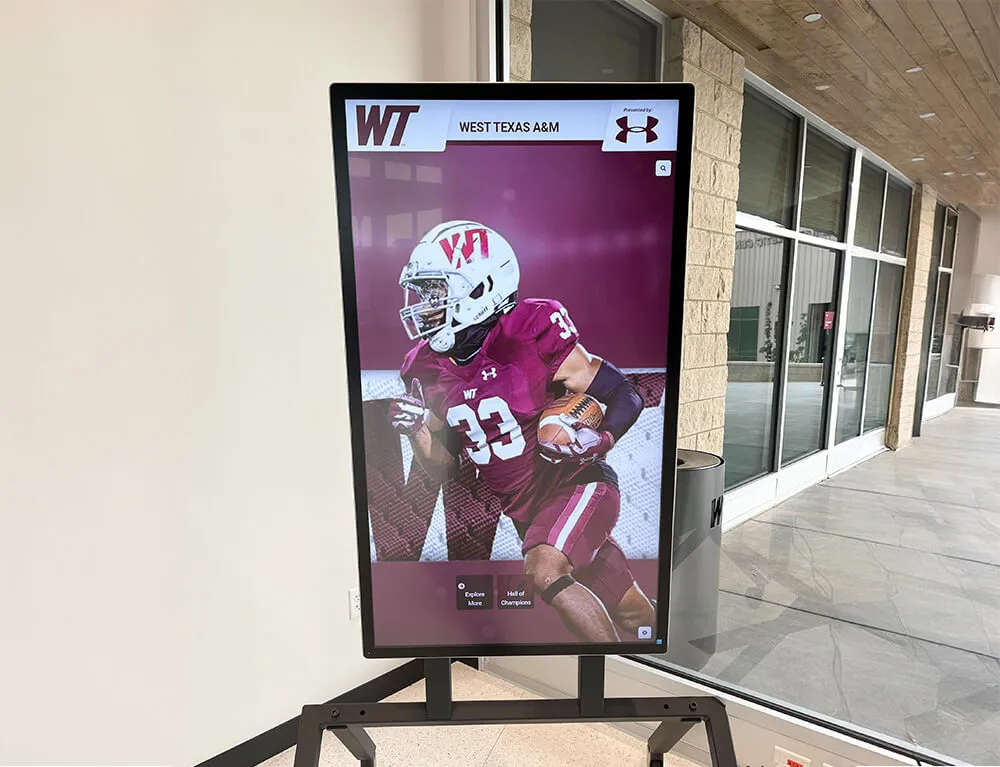
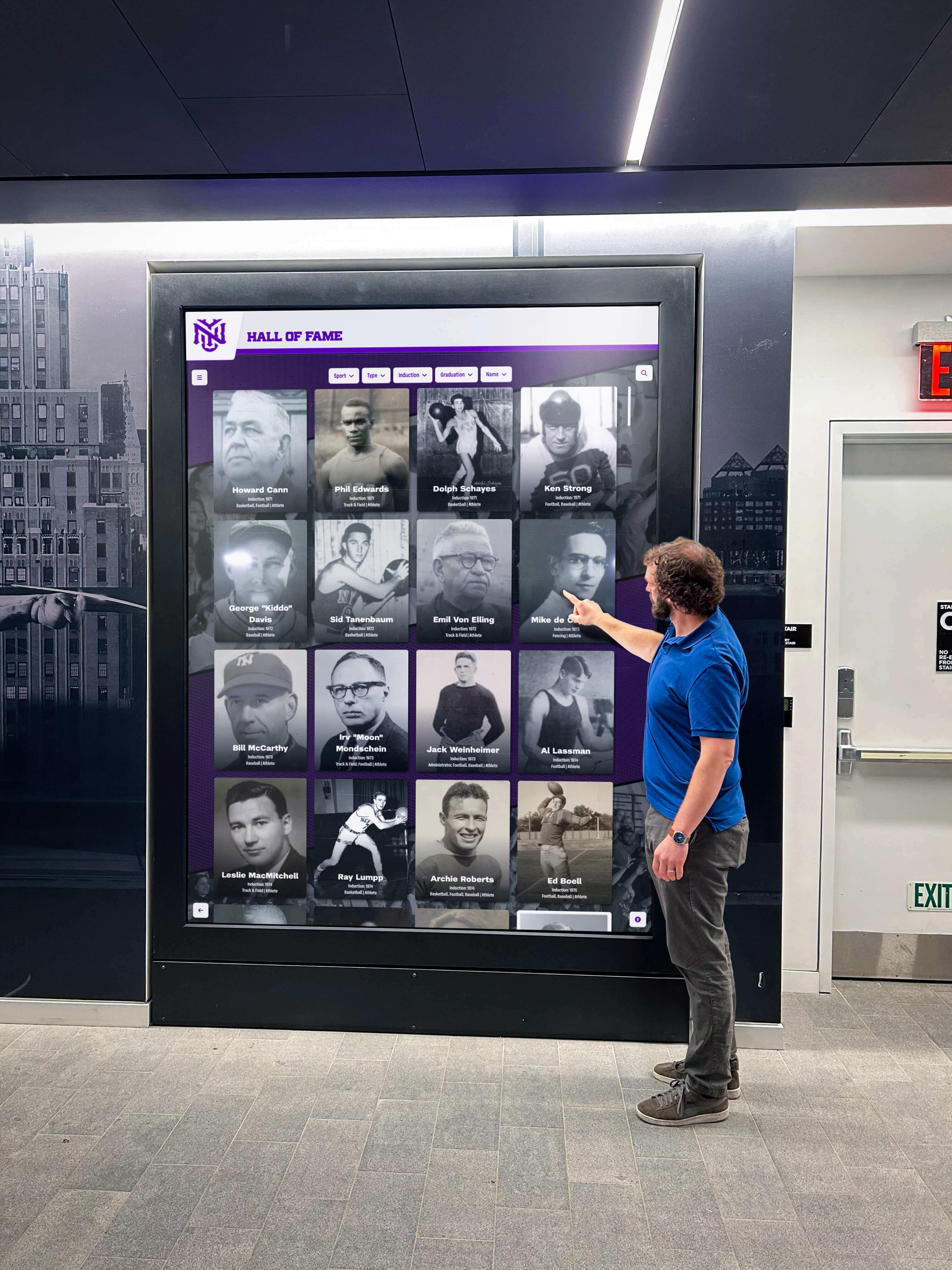
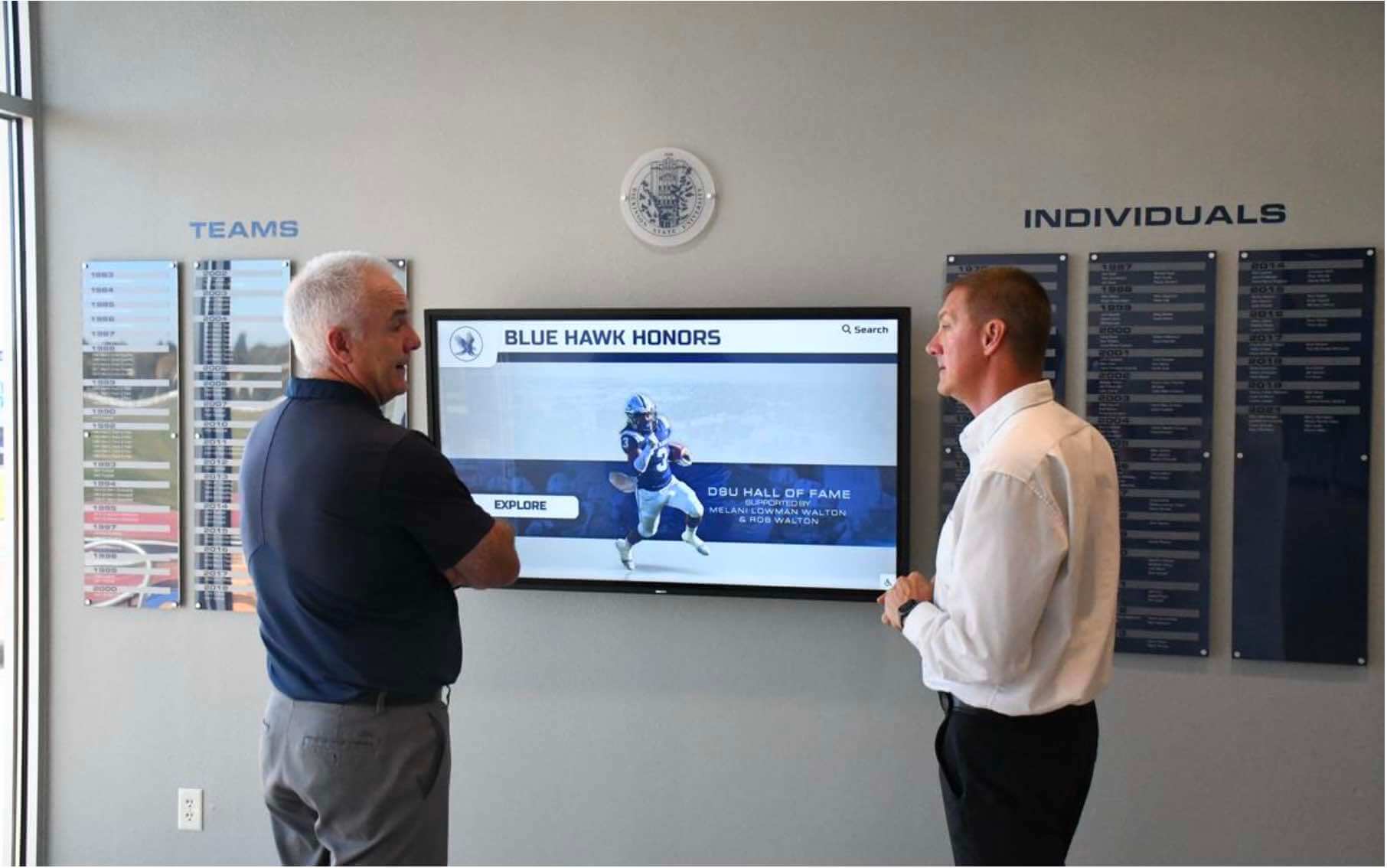
Modern interactive touchscreen displays have significantly expanded what schools can show for each inductee. Rather than being limited to a name, years, and a summary sentence on a plaque, programs using digital recognition systems can include full career statistics, multiple photographs from different seasons, video highlights, quotes from coaches and teammates, and links to post-graduation accomplishments. The depth of information you can capture through a thorough nomination form maps directly onto the richness of what you can display.
Schools using digital gym lobby displays have reported that visitors spend significantly more time engaging with recognition content when it is interactive rather than static—a dynamic that rewards the investment in collecting thorough nomination documentation. Programs exploring this transition can find practical guidance on touchscreen display options for high school gym lobbies.
Maintaining the Archive
Every nomination form submitted—regardless of whether the nominee was selected—represents institutional memory. Schools that retain all completed nomination forms, not only those for inductees, build a searchable archive that benefits future committees. A nominee who narrowly missed selection in one year may be reconsidered with fresh perspective five years later; having the original documentation available saves nominators from starting over and gives the committee a longitudinal view of the candidate.
Digital nomination submission systems, even simple ones built on tools like Google Forms or a school survey platform, automatically create this archive without requiring physical file management. Schools transitioning from paper to digital nomination systems should digitize historical forms as a priority before paper records deteriorate.
Communicating the Process to Your Community
The best nomination form in the world produces poor results if the community does not know it exists. Outreach strategy is as important as form design.
Annual announcement. Open the nomination window at the same time every year and announce it through every available channel: alumni newsletter, school social media accounts, booster club communications, coach networks, and local media where appropriate. Consistency builds awareness over time.
Plain-language summary. Post a one-page summary of your selection criteria in public-facing locations: school website, athletic program pages, booster club newsletter. Community members should not need to read the full policy document to understand what the hall of fame values.
Respond to nominators. Acknowledge every nomination received. Even if a nominee is not selected, the nominator invested time in the school’s heritage. A brief acknowledgment that the nomination was received and will be reviewed demonstrates institutional respect. A follow-up note after the selection process explaining that the nominee remains in the pool (if applicable) sustains nominator engagement for future cycles.
Coach and alumni outreach. Current and retired coaches are among the best nominators for athletes who competed before modern record-keeping made information easily searchable. Actively soliciting nominations from coaches who worked with specific eras of athletes surfaces candidates who might otherwise be overlooked.
Programs that combine effective nomination outreach with strong recognition of team milestones—like planning a strong year-end celebration for sports programs—tend to see higher nomination rates because the community’s engagement with recognition is reinforced across multiple touchpoints. Resources on planning memorable team celebrations can help programs think about the full recognition ecosystem.
Reviewing and Improving Your Process Annually
No nomination form or selection criteria document should be treated as permanent. Programs that never revisit their criteria tend to produce induction classes that reflect the values of whoever originally drafted the form rather than the evolving values of the current institution.
Schedule an annual brief review of the process immediately after each induction cycle. Ask the selection committee: Were there cases where the rubric produced results the committee found clearly wrong? Were there categories where nominees consistently lacked documentation, suggesting that the nomination form needs clearer guidance? Were there disputes about criteria interpretation that a policy clarification could prevent next time?
Track the diversity of inductees across graduation years, sports, and achievement categories. If your hall of fame inductees cluster heavily in certain decades or sports, examine whether your outreach is reaching all relevant alumni communities or whether the criteria inadvertently favor certain achievement types.
Programs that serve athletic communities with long competitive histories—including programs that compete across many sports and have cultivated records in coaching, team building, and community engagement—will find that their nomination criteria evolve as the program’s own values and accomplishments deepen. Thinking about how different programs document and celebrate their histories is useful context; for instance, understanding how baseball programs build coaching legacies can inform how multi-sport schools structure their coaching recognition criteria.
Frequently Asked Questions
How long should a hall of fame nomination form be?
Should nominees be notified before the selection committee makes its decision?
How many inductees should a school select each year?
Can a school rescind hall of fame membership?
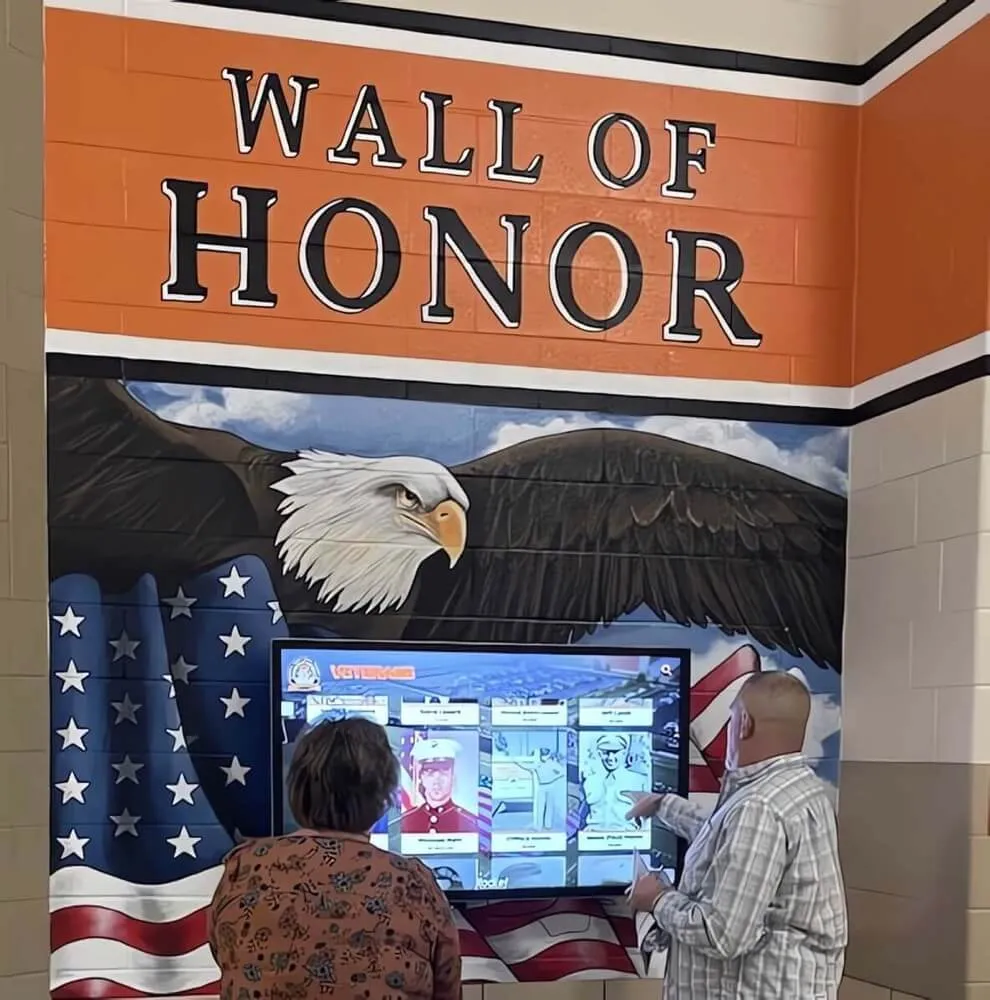
What is the difference between a hall of fame and a wall of honor?
A hall of fame nomination form is not administrative overhead—it is the foundation that determines whether your program’s recognition means anything. A process with documented criteria, a structured rubric, a well-composed committee, and consistent outreach produces induction classes that the community respects because they understand how decisions were made. That credibility compounds over time: each year’s class builds on the legitimacy of every class before it, creating a legacy that genuinely honors what your institution values and inspires everyone who encounters it.
Once inductees are selected through this kind of rigorous process, they deserve recognition that matches the effort that identified them. Rocket Alumni Solutions builds interactive touchscreen recognition walls specifically for schools, universities, and athletic programs—systems that transform the documentation gathered through a thorough nomination process into compelling, permanent displays that engage your community for years. If your nomination process is ready, your display should be too.