Championship football programs share one undeniable trait: their players maintain explosive speed, physical dominance, and relentless effort from opening kickoff through final whistle. Elite teams don’t fade in fourth quarters, slow down during two-a-days, or lose physical battles when games intensify—they’re conditioned to outlast, outrun, and overpower opponents when fatigue becomes the deciding factor. The difference between programs that finish strong and those that collapse late in games comes down to systematic, sport-specific conditioning that prepares athletes for football’s unique physical demands: explosive bursts, repeated high-intensity efforts, rapid recovery between plays, and sustained performance across four quarters and full seasons.
Modern football conditioning has evolved significantly from outdated punishment-based approaches (endless laps and exhaustion drills) toward evidence-based training that enhances performance while reducing injury risk. Programs implementing systematic conditioning progressions—developing speed and power during preseason, maintaining fitness levels during competitive seasons, and incorporating recovery protocols preventing overtraining—create athletes who perform at their best when games matter most while avoiding the breakdown and injuries that plague improperly conditioned teams.
The drills detailed below address four critical conditioning dimensions: speed and acceleration drills developing explosive first-step quickness and top-end velocity, strength and power exercises building the force production necessary for physical dominance, stamina and work capacity workouts creating the endurance that sustains performance through fourth quarters, and position-specific conditioning preparing athletes for their unique on-field demands. Each section provides complete workout structures including warm-up protocols, specific drill parameters, rest interval recommendations, and progressive overload strategies that systematically improve conditioning across training cycles.
Understanding Football’s Energy System Demands
Before implementing specific drills, coaches must understand the physiological demands football places on athletes. This knowledge informs conditioning program design, ensuring training actually prepares players for game situations rather than developing fitness that doesn’t transfer to on-field performance.
The Three Energy Systems and Football Performance
Human bodies produce energy through three distinct metabolic pathways, each dominating during different activity durations and intensities. Football uniquely demands all three systems, requiring comprehensive conditioning addressing each pathway:
Phosphagen System (0-10 seconds of maximum effort): This immediate energy system fuels the explosive movements defining football—sprint starts, collision impacts, cutting, and jumping. The phosphagen system provides maximum power output but depletes rapidly, typically lasting only 6-10 seconds before other systems must contribute. Most football plays (3-8 seconds) occur almost entirely within this energy window, making phosphagen capacity absolutely critical for position performance.
Football conditioning must develop this system through repeated maximum-intensity efforts with adequate recovery between reps. Short sprints, explosive jumps, heavy lifts, and plyometric exercises stress the phosphagen system appropriately. Recovery between efforts matters enormously—rushing to the next rep before phosphagen stores replenish prevents the maximum-intensity effort necessary for adaptation.
Glycolytic System (10 seconds to 2-3 minutes of high effort): When plays extend beyond 10 seconds or recovery between plays proves insufficient for phosphagen replenishment, the glycolytic system provides energy by breaking down stored carbohydrates (glycogen). This pathway produces significant power (though less than phosphagen) and accumulates metabolic byproducts (lactate and hydrogen ions) that create the burning sensation in working muscles and contribute to fatigue.
Football stresses the glycolytic system during long drives featuring rapid play tempo, hurry-up offenses, goal-line stands, and conditioning drills themselves. Training this system requires sustained high-intensity efforts lasting 20-90 seconds with incomplete recovery, forcing athletes to perform while managing accumulating fatigue—exactly what games demand.
Aerobic System (sustained efforts beyond 2-3 minutes): The aerobic system burns fuel using oxygen, providing limitless energy but at lower power outputs than anaerobic pathways. While individual plays don’t last long enough for aerobic dominance, this system plays critical roles in football: facilitating rapid recovery between plays and drives, supporting overall work capacity across practices and games, sustaining performance across full seasons, and providing the conditioning base upon which anaerobic systems build.
Programs that neglect aerobic development create athletes who can sprint explosively when fresh but lack the recovery capacity for repeated efforts or the endurance for four-quarter performance. Conversely, programs overemphasizing long-distance aerobic training at the expense of explosive work develop athletes with endurance but insufficient speed and power for position demands.
Position-Specific Conditioning Requirements
While all football players need comprehensive conditioning, positional roles create specific emphasis patterns that training programs should reflect:
Skill Position Players (RB, WR, DB, LB): These athletes cover the most ground during games, require explosive acceleration and top-end speed, must change direction rapidly and efficiently, and perform repeated high-intensity efforts with minimal rest during fast-tempo drives. Conditioning emphasis should prioritize speed development, movement efficiency, repeated sprint ability, and relatively higher aerobic capacity supporting recovery between explosive efforts.
Offensive and Defensive Linemen: Interior players engage in sustained physical battles requiring maximum strength and power for 3-8 seconds per play, encounter limited sprint demands but significant strength endurance requirements, and face recovery challenges when tempo increases. Conditioning should emphasize strength and power development, short-burst explosive capacity, work capacity for sustained physical effort, and sufficient aerobic base preventing dramatic performance decline during hurry-up situations.
Special Teams Specialists: Kickers, punters, and long snappers face unique demands—relatively low total volume with extremely high stakes on every repetition, explosive power requirements for distance, and mental pressure management. Conditioning focuses on explosive power, consistency under fatigue and pressure, and injury prevention through flexibility and proper mechanics.
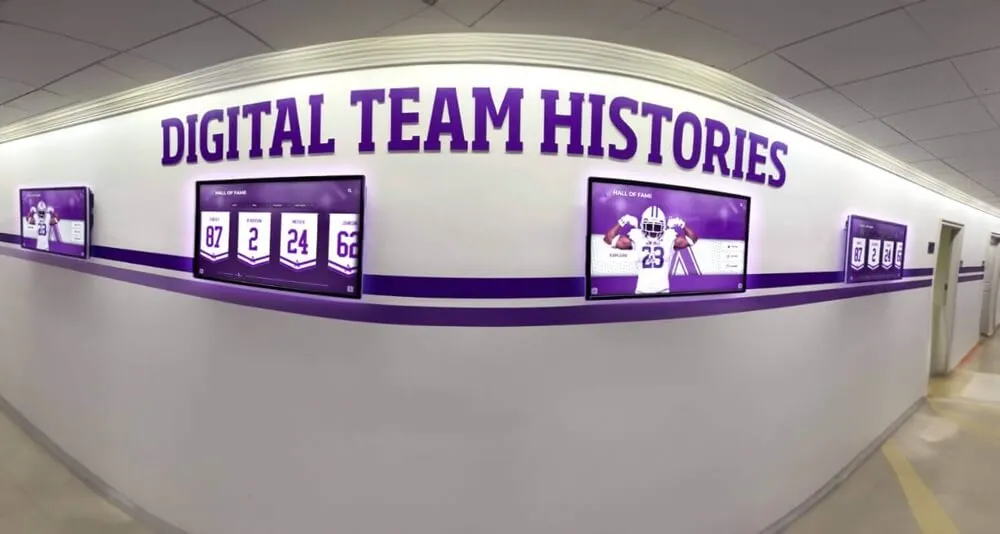
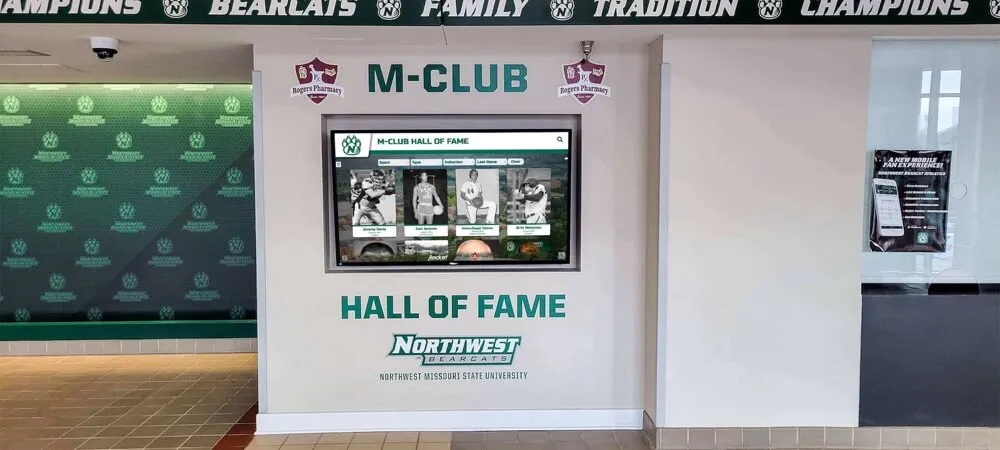
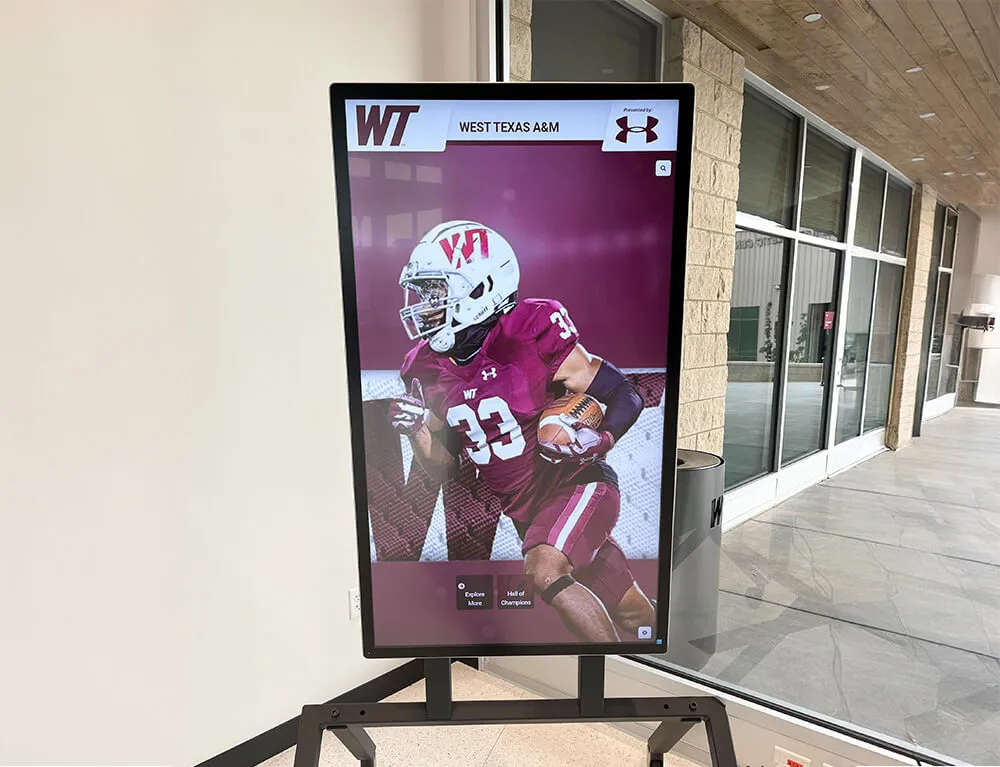
Elite football programs recognize conditioning excellence alongside game performance, often celebrating athletes whose year-round dedication to fitness helped them earn spots on all-conference recognition boards and achieve individual performance milestones that contribute to team championships.
Speed and Acceleration Conditioning Drills
Speed separates good football players from elite competitors. These drills develop the explosive first-step acceleration and sustained top-end velocity that create separation, prevent big plays, and generate touchdowns.
Drill 1: 10-Yard Acceleration Bursts
Purpose: Develop explosive starting acceleration and the first three steps that determine success in most football situations—release from line of scrimmage, closing on ball carriers, pursuing angles.
Setup: Mark start line and 10-yard finish line. Athletes start in three-point stance (linemen) or two-point stance (skill positions) matching their position requirements.
Execution:
- On whistle or ball movement, explode from stance driving powerfully with first three steps
- Maintain forward lean (chest over toes) through first 5 yards, gradually rising to upright sprinting position
- Maximum effort through 10-yard line (don’t slow down approaching finish)
- Walk back recovery between repetitions
Specific Parameters:
- Reps: 8-10 repetitions per session
- Rest: 45-60 seconds between reps (full phosphagen recovery)
- Frequency: 2-3x per week during preseason, 1-2x during season
- Progression: Week 1-2: 8 reps, Week 3-4: 9 reps, Week 5+: 10 reps with timed performance tracking
Coaching Points: The first step determines everything in acceleration. Athletes should drive explosively off the back foot, maintaining low body angle (45-degree forward lean), powerful arm drive coordinated with leg movement, and avoiding standing upright too early (common mistake reducing acceleration). Focus on “pushing” the ground backward rather than “reaching” forward with the feet—ground force production creates acceleration, not stride length alone.
Common Mistakes: Rising upright too quickly in first 3-5 steps, insufficient arm drive, looking up too soon (maintain forward vision through 5 yards), and decelerating before 10-yard line.
Drill 2: Flying 20-Yard Sprints
Purpose: Develop maximum velocity maintenance—the sustained top-end speed that turns 40-yard runs into 60-yard touchdowns and allows defensive backs to recover on deep routes.
Setup: Establish 40-yard running lane with markers at 0, 20, and 40 yards. Athletes perform 20-yard buildup acceleration zone (0-20 yards) followed by maximum velocity 20-yard sprint zone (20-40 yards).
Execution:
- Begin with controlled acceleration through first 20 yards (approximately 75-80% effort)
- Hit maximum velocity at 20-yard mark
- Maintain top speed through full 20-yard timed zone (20-40 yards)
- Gradual deceleration beyond 40-yard mark
Specific Parameters:
- Reps: 5-6 repetitions per session
- Rest: 2-3 minutes between reps (complete recovery for maximum velocity work)
- Frequency: 1-2x per week throughout season
- Progression: Track 20-40 yard split times, aim for 0.1-0.2 second improvements across 4-6 week training blocks
Coaching Points: Maximum velocity sprinting demands different mechanics than acceleration: upright posture with slight forward lean, rapid leg turnover with feet cycling quickly beneath hips, relaxed upper body (tension slows movement), powerful arm swing driving elbows backward, and sustained rhythm without overstriding. Athletes often try too hard at maximum velocity, creating tension that reduces speed—emphasize “controlled explosion” rather than desperate straining.
Drill 3: Pro Agility Shuttle (5-10-5)
Purpose: Build the change-of-direction speed and body control essential for position-specific movements—defensive backs breaking on routes, linebackers flowing to ball carriers, receivers creating separation.
Setup: Mark three lines 5 yards apart (left, center, right). Athletes start at center line in athletic stance facing sideline.
Execution:
- Sprint 5 yards right, touch line with hand
- Immediately change direction, sprint 10 yards left, touch line
- Change direction again, sprint 5 yards right through center finish line
- Total distance: 20 yards with two direction changes
Specific Parameters:
- Reps: 6-8 repetitions alternating starting direction
- Rest: 60-90 seconds between reps
- Frequency: 2x per week during preseason, 1x during season
- Progression: Track completion times, implement competitive brackets with teammates, increase reps as conditioning improves
Coaching Points: Efficient direction changes require specific technique: approach change point under control (don’t run full speed into turns), plant outside foot and drop hips while turning, maintain low body position throughout turn (don’t rise up), and accelerate explosively out of direction change. The athlete who changes direction most efficiently often beats faster linear runners in this drill—technique matters more than pure speed.
Common Mistakes: Overrunning change points requiring multiple adjustment steps, rising upright during turns (losing leverage and speed), reaching across body instead of planting outside foot, and inconsistent effort across all three segments (going hard initially then fading).
Drill 4: Tempo Runs (200-Meter Repeats)
Purpose: Develop the aerobic speed base that supports recovery between explosive efforts and maintains movement quality throughout games and practices.
Setup: Use track or measured field distance of 200 meters (roughly half a football field length plus one end zone).
Execution:
- Run 200 meters at controlled pace (approximately 75-80% maximum effort)
- Pace should feel “comfortably hard”—breathing heavily but able to sustain rhythm across full distance
- Active recovery walk for prescribed rest interval
- Repeat for specified number of sets
Specific Parameters:
- Reps:
- Week 1-2: 4 x 200m
- Week 3-4: 5 x 200m
- Week 5-6: 6 x 200m
- Week 7+: 6-8 x 200m based on position
- Rest: 60-90 seconds walking recovery between reps
- Target Times:
- Skill positions: 32-36 seconds per 200m
- Linebackers/tight ends: 35-38 seconds
- Linemen: 38-42 seconds
- Frequency: 1-2x per week during base conditioning phase, reduced to 1x every 2 weeks during competitive season
Coaching Points: Tempo runs aren’t maximum-effort sprints or comfortable jogs—they’re sustained submaximal efforts that stress aerobic conditioning without creating excessive fatigue or injury risk. Athletes should finish each rep feeling challenged but controlled, never completely exhausted. If athletes can’t maintain consistent pace across all reps, reduce target time or increase rest intervals. The goal is aerobic development, not proving toughness through exhaustion.
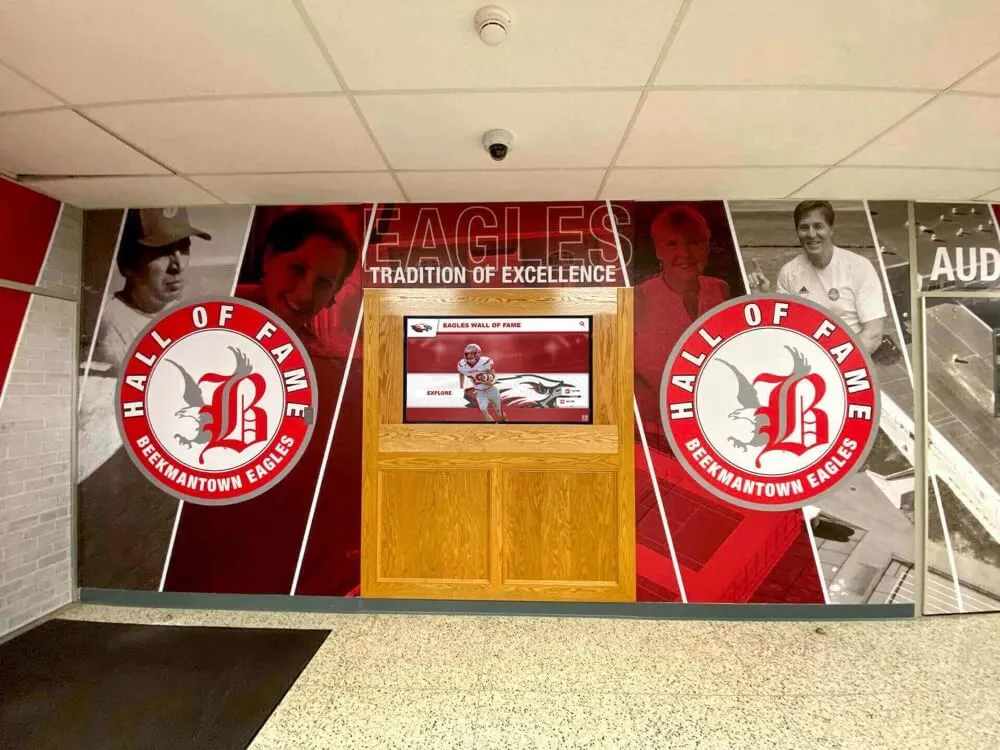
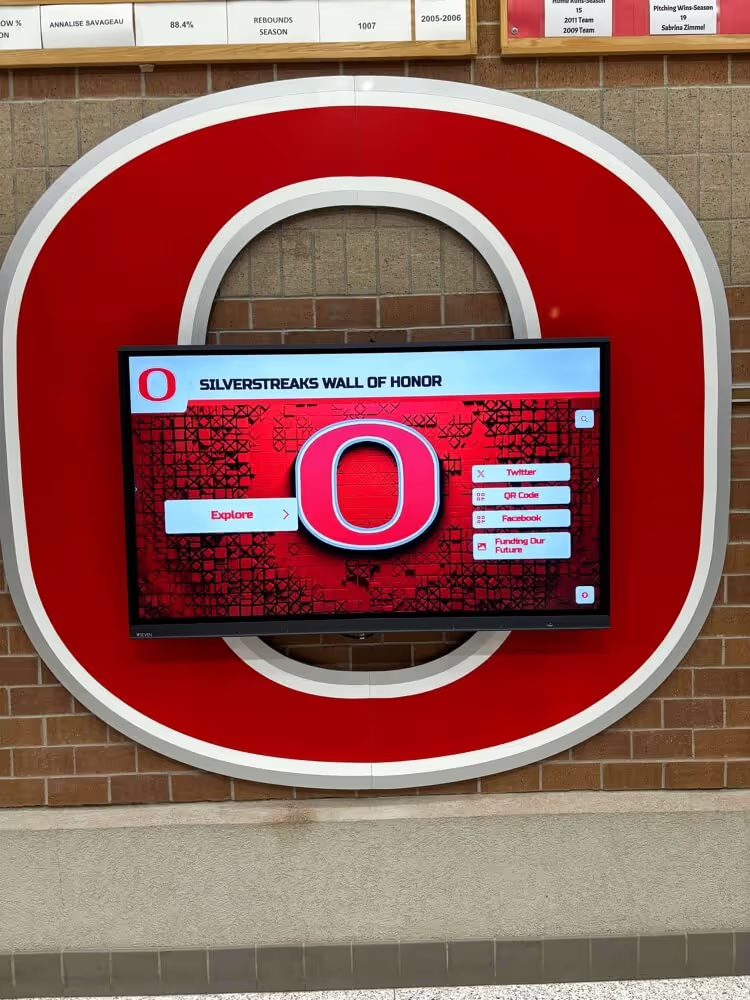
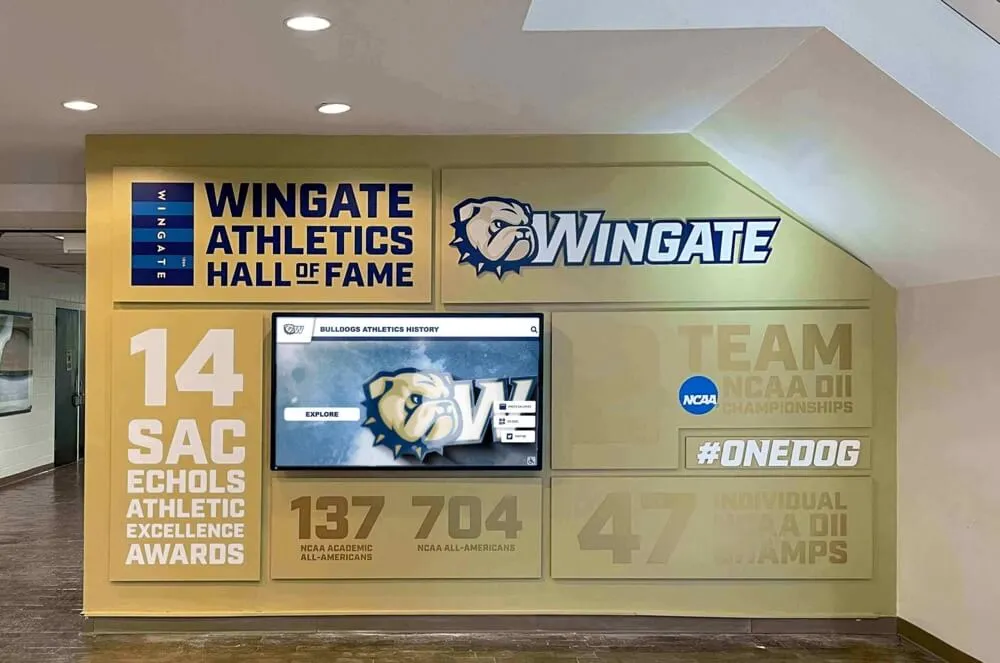
Elite conditioning programs celebrate athletes who dedicate themselves to year-round development, often recognizing dedication through permanent athletic recognition displays that honor not just game statistics but the commitment to preparation that makes success possible.
Strength and Power Development Drills
Football is a collision sport where force production determines outcomes. These conditioning-focused strength drills build the explosive power that drives opponents backward and the muscular endurance that sustains physical dominance.
Drill 5: Sled Push Intervals
Purpose: Develop leg drive power, forward body lean mechanics, and the sustained push strength required for offensive and defensive line play.
Setup: Load weight sled with appropriate resistance (bodyweight to 1.5x bodyweight depending on athlete strength and training phase). Establish 20-yard pushing lane.
Execution:
- Grip sled handles with arms extended
- Maintain forward body lean (chest over toes, hips driving forward)
- Drive sled forward with powerful leg extension, rapid foot turnover
- Push through full 20-yard distance maintaining consistent speed
- Walk back recovery
Specific Parameters:
- Reps: 6-8 x 20 yards
- Load: Start with bodyweight, progress to 1.25-1.5x bodyweight as strength improves
- Rest: 90-120 seconds between pushes
- Frequency: 2x per week during preseason, 1x during season
- Progression: Increase load by 10-20 pounds every 2-3 weeks, or reduce rest intervals while maintaining load
Coaching Points: Sled pushing directly mimics offensive line drive blocking and defensive line penetration movements. Emphasize maintaining forward lean throughout push (don’t allow sled to push athlete upright), keeping head up with eyes forward, powerful leg drive with full hip extension each step, and arms driving sled forward not just holding on. This drill builds both explosive power and muscular endurance—the exact combination needed for sustained line-of-scrimmage battles.
Position Variations:
- Linemen: Heavier loads (1.25-1.5x bodyweight), shorter distances (15-20 yards)
- Linebackers/Tight Ends: Moderate loads (bodyweight to 1.25x), standard distances (20 yards)
- Skill positions: Lighter loads (0.75-1x bodyweight), longer distances (25-30 yards) or increased reps
Drill 6: Partner Resistance Sprints
Purpose: Build explosive acceleration strength and running power without requiring specialized equipment—ideal for programs with limited resources or for additional work beyond weight room training.
Setup: Athletes pair up based on similar size/strength. Designate 10-15 yard sprint lane.
Execution:
- Working athlete wears resistance belt or partner grips behind shoulders of jersey
- Partner provides moderate resistance (not maximum—working athlete should be able to advance forward)
- Working athlete explodes forward, driving against resistance for 10-15 yards
- Maintain proper sprint mechanics despite resistance: forward lean, powerful leg drive, aggressive arm swing
- Partners switch roles between repetitions
Specific Parameters:
- Reps: 6-8 per athlete
- Distance: 10-15 yards
- Rest: 60-90 seconds between efforts
- Resistance: Partner should allow forward progress at roughly 50-60% normal sprint speed
- Frequency: 1-2x per week as supplement to other sprint work
Coaching Points: Resistance sprinting builds the specific strength-power combination required for football acceleration. Partner providing resistance must find the “sweet spot”—too little resistance provides insufficient stimulus, too much resistance prevents proper sprint mechanics and creates technique breakdown. The working athlete should feel challenged but able to maintain recognizable sprint form throughout the distance.
Drill 7: Broad Jump Series
Purpose: Develop explosive lower-body power and the hip extension force that creates acceleration, jumping ability, and collision strength.
Setup: Clear landing area (grass or rubberized surface, never concrete or hard surfaces). Mark start line.
Execution:
- Start standing with feet hip-width apart
- Perform quick counter-movement (drop hips back and down while swinging arms backward)
- Explosively extend hips, knees, and ankles while swinging arms forward and upward
- Jump forward maximum distance, landing on both feet simultaneously
- Stick landing in athletic position (don’t fall backward or take adjustment steps)
Specific Parameters:
- Reps: 5-6 maximum-effort jumps per session
- Rest: 90-120 seconds between jumps
- Frequency: 2x per week during preseason power phase, 1x during season
- Progression: Track jump distances, aim for 2-4 inch improvements across 4-6 week blocks
Coaching Points: Explosive jumps build the rate of force development (how quickly athletes generate maximum force) that determines collision outcomes and acceleration quality. Emphasize maximum effort on every rep—submaximal jumps don’t provide sufficient stimulus for power adaptation. Focus on triple extension (hips, knees, ankles all extending powerfully and simultaneously), coordinated arm swing adding to jump distance, and controlled landing demonstrating body control and strength.
Variations:
- Single-leg broad jumps (alternating legs): Build unilateral power and expose strength imbalances
- Continuous broad jumps (3-5 consecutive jumps): Develop repeated explosive power and landing mechanics
- Lateral bounds: Build lateral power for cutting and direction change
Drill 8: Hill Sprints
Purpose: Build leg strength, power endurance, and running mechanics through natural resistance training that’s joint-friendly compared to flat-ground repeated sprints.
Setup: Identify hill with moderate grade (6-8% incline ideal, approximately 20-30 yards length). Steeper hills shift emphasis to strength over speed; gentler hills maintain more sprint-specific mechanics.
Execution:
- Sprint uphill at maximum sustainable effort
- Maintain proper sprint mechanics: forward lean, powerful leg drive, arms driving elbows backward
- Push through top of hill (don’t slow down approaching crest)
- Walk down hill for recovery
Specific Parameters:
- Reps:
- Week 1-2: 6 reps
- Week 3-4: 8 reps
- Week 5+: 10 reps
- Distance: 20-30 yards
- Rest: Walk down recovery (typically 90-120 seconds)
- Frequency: 1-2x per week during base conditioning phase
Coaching Points: Hill sprints are self-regulating—the incline prevents athletes from reaching speeds that exceed their strength capacity, reducing injury risk compared to flat-ground repeated sprints while building similar conditioning. The incline naturally reinforces proper sprint mechanics, forcing forward lean, powerful push-off, and preventing overstriding. Athletes should feel significant muscular fatigue in glutes, hamstrings, and calves—this is desired stimulus building strength-endurance critical for repeated explosive efforts.
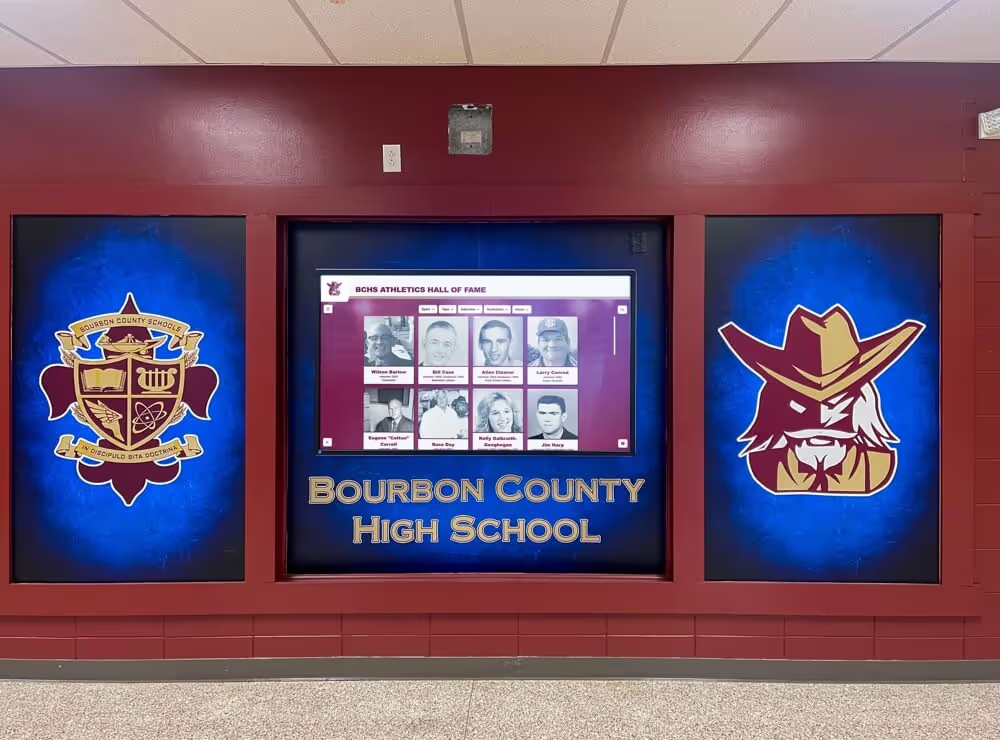
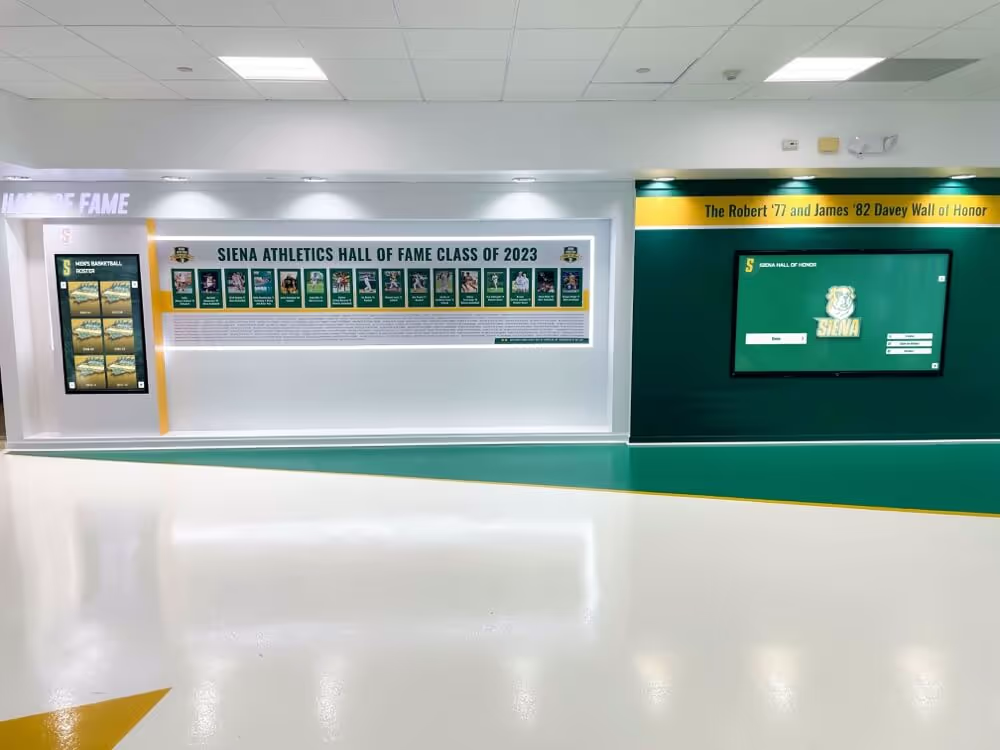
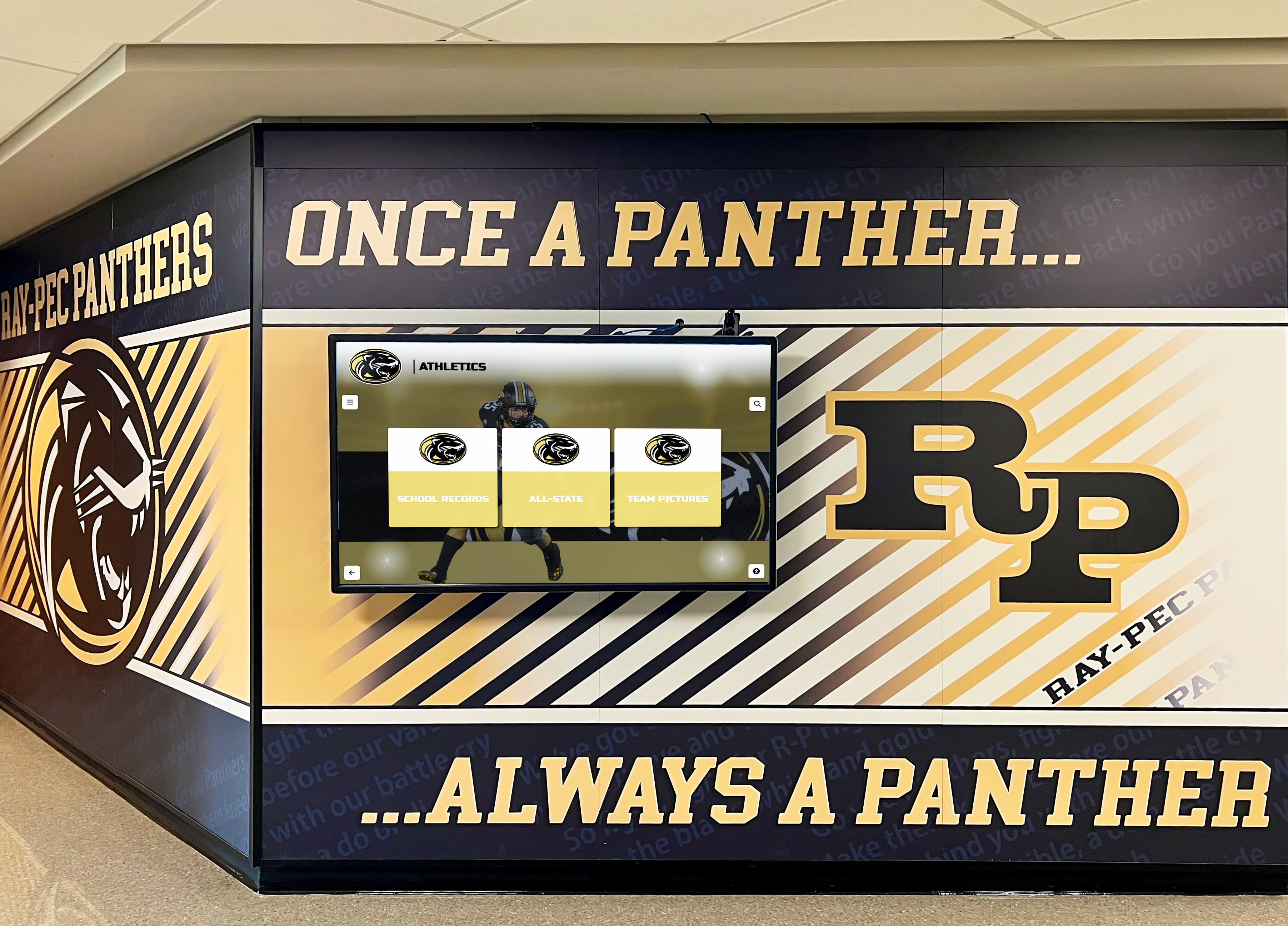
Championship football programs understand that consistent dedication to conditioning throughout the year, not just during competitive seasons, separates good programs from elite ones. Many successful schools recognize this commitment through athletic hall of fame displays that honor both on-field achievement and the behind-the-scenes dedication to training excellence.
Stamina and Work Capacity Building Drills
Fourth-quarter dominance requires work capacity that sustains performance when opponents fade. These drills build the cardiovascular fitness and mental toughness that create championship-level stamina.
Drill 9: Gassers (110-Yard Shuttles)
Purpose: Build the glycolytic capacity and mental toughness required for sustained high-intensity performance—the conditioning foundation that allows athletes to execute skills under fatigue.
Setup: Use football field sideline to sideline (approximately 53 yards). Athletes sprint width of field four times (down and back twice) for total of roughly 110 yards per repetition.
Execution:
- Sprint from sideline across field, touch far sideline with foot
- Immediately turn and sprint back to original sideline, touch with foot
- Continue for second down-and-back (four total widths)
- Complete effort within specified time standard
Specific Parameters:
- Reps: 4-6 total gassers per session
- Rest: 60-90 seconds between reps (incomplete recovery—intentionally performing subsequent reps while not fully recovered)
- Time Standards (adjust based on position and conditioning level):
- Skill positions: 24-26 seconds
- Linebackers/Tight Ends: 26-28 seconds
- Linemen: 28-32 seconds
- Frequency: 1x per week during preseason, reduced or eliminated during competitive season (replaced by practice and game demands)
Coaching Points: Gassers are challenging by design—they stress the glycolytic system, create significant metabolic fatigue, and require mental toughness to complete at standard while fatigued. However, they should develop conditioning, not destroy athletes. If completion rates fall below 75% (athletes making time standards at least 3 of 4 reps), either reduce reps, extend rest intervals, or adjust time standards. The goal is progressive conditioning stress, not punishment or creating injury risk through excessive fatigue.
Safety Considerations: Gassers are physically demanding and carry risk when implemented improperly. Always conduct in temperate conditions (not extreme heat), ensure athletes are properly hydrated before starting, allow athletes experiencing distress to stop without penalty, and monitor for signs of heat-related illness or overexertion. Consider whether this conditioning stress is appropriate for your athletes’ current fitness levels—less conditioned athletes may need modified versions with longer rest or fewer reps.
Drill 10: Position-Specific Conditioning Circuits
Purpose: Build work capacity through movement patterns and intensity cycles that closely mimic position-specific game demands, creating conditioning that transfers directly to on-field performance.
Setup: Design circuits matching position groups with 4-6 stations performed in sequence. Below are sample circuits for different position groups:
Defensive Back Circuit:
- Station 1: Backpedal 10 yards → Plant and sprint 15 yards forward
- Station 2: 5 yards left shuffle → 5 yards right shuffle → Sprint through 10 yards
- Station 3: 10-yard sprint, break down, shuffle 5 yards left/right based on coach signal
- Station 4: 15-yard vertical sprint
- Repeat circuit 3-4 times total with 90 seconds rest between circuits
Linebacker Circuit:
- Station 1: 5-yard forward sprint, break down, 5-yard backward shuffle
- Station 2: Flow shuffle 10 yards laterally → Plant and sprint forward 10 yards
- Station 3: 5 yards forward, shed imaginary blocker, sprint 10 yards
- Station 4: 20-yard pursuit angle sprint
- Repeat circuit 3-4 times with 90 seconds rest between circuits
Linemen Circuit:
- Station 1: Fire off and punch (shadow reps), 5 quick reps
- Station 2: 10-yard sled push
- Station 3: 5 yards forward sprint → Down to ground and back up → 5 yards sprint
- Station 4: Partner push drill, 10 yards
- Repeat circuit 3-4 times with 2 minutes rest between circuits
Specific Parameters:
- Duration: 15-20 minutes total circuit work
- Frequency: 2-3x per week during preseason, 1x per week during season
- Progression: Weeks 1-2: 3 circuits, Weeks 3-4: 4 circuits, Week 5+: 4 circuits with reduced rest
Coaching Points: Position-specific circuits create conditioning adaptations that transfer directly to game performance because movement patterns and effort cycles mimic actual positional demands. Circuits should maintain high effort quality—if technique deteriorates significantly due to fatigue, end the session rather than reinforcing poor movement patterns. Quality repetitions under moderate fatigue build proper conditioning; exhausted repetitions with terrible technique build neither conditioning nor skill.
Drill 11: Timed Interval Training (30-30s and 15-15s)
Purpose: Develop repeated sprint ability and rapid recovery capacity—the fitness foundation that allows sustained explosive performance across drives and games.
Setup: Use field markings or cones establishing 40-50 yard sprint lanes.
Execution (30-30 Protocol):
- Sprint submaximal distance (approximately 40 yards) in 30 seconds
- Active recovery (light jog or walk) for 30 seconds
- Immediately begin next sprint interval
- Continue for specified number of intervals
Execution (15-15 Protocol):
- Sprint shorter distance (approximately 20-25 yards) in 15 seconds
- Active recovery for 15 seconds
- Immediately begin next sprint interval
- Continue for specified number of intervals
Specific Parameters:
- 30-30 Intervals:
- Total intervals: 10-15
- Intensity: 75-80% maximum effort
- Total work time: 5-7.5 minutes
- Frequency: 1-2x per week
- 15-15 Intervals:
- Total intervals: 15-20
- Intensity: 85-90% maximum effort
- Total work time: 5-7 minutes
- Frequency: 1x per week
Coaching Points: Interval training builds the specific fitness football requires—repeated high-intensity efforts with incomplete recovery, exactly mimicking game tempo. The key is maintaining consistent effort quality across all intervals. If sprint speed declines more than 10-15% from first interval to last, either reduce total intervals or decrease intensity. Progressive conditioning comes from maintaining quality across increasing work volumes, not from exhausting athletes with work they can’t complete properly.
Progression: Begin with 30-30 intervals building aerobic base and repeated sprint tolerance, progress to 15-15 intervals as conditioning improves (shorter, more intense efforts), and vary between protocols throughout preseason to prevent adaptation plateaus and maintain engagement.
Drill 12: Oklahoma Drill Conditioning
Purpose: Combine physical contact demands with conditioning stress, preparing athletes for the unique fatigue that comes from blocking, tackling, and collisions—not just running.
Setup: Standard Oklahoma drill setup: two blocking dummies creating 5-yard-wide lane, ball carrier and blocker at one end, defender at other end.
Execution:
- Defender must shed blocker and tackle ball carrier within confined space
- Immediately after completing tackle, same defender stays in for next repetition (different ball carrier and blocker)
- Defender performs 3-4 consecutive reps before rotating out
- Next defender rotates in for their sequence
Specific Parameters:
- Reps per athlete: 3-4 consecutive reps before rotation
- Intensity: Full-speed execution
- Rest: Rotate through roster (typically 3-5 minutes rest between each athlete’s turn based on roster size)
- Frequency: 1x per week maximum (high physical and mental intensity), typically during mid-week practice
- Progression: Week 1-2: 3 consecutive reps, Week 3+: 4 consecutive reps
Coaching Points: Oklahoma drill conditioning creates unique fatigue—combining explosive physical effort with collision impact. This specificity makes it valuable for preparing athletes for game conditioning, but also increases injury risk and mental stress compared to non-contact conditioning. Implement carefully with appropriate supervision, proper progressions, and never as punishment. The goal is conditioning that includes contact stress, not creating excessive injury exposure.
Safety Considerations: Full-contact conditioning drills require careful implementation. Always use proper equipment, maintain fresh athletes as ball carriers (don’t condition them into exhaustion then use them for contact), monitor for technique breakdown (stop drill if athletes start demonstrating dangerous form), and consider whether your program’s injury situation and athlete development stage make contact conditioning appropriate or whether non-contact alternatives better serve your needs.
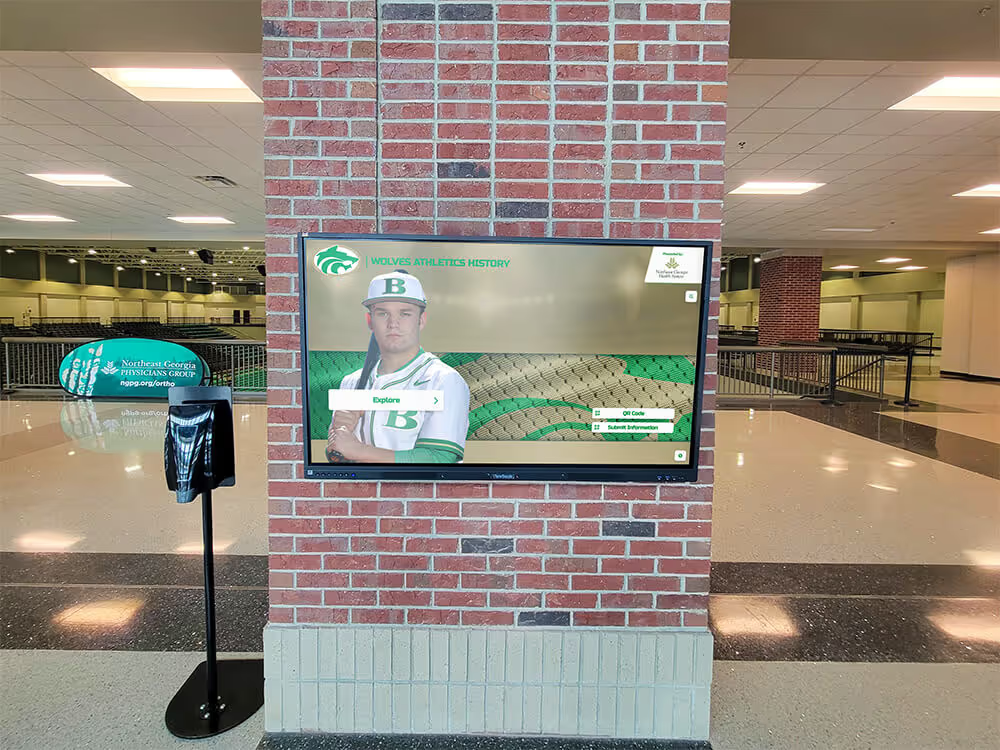
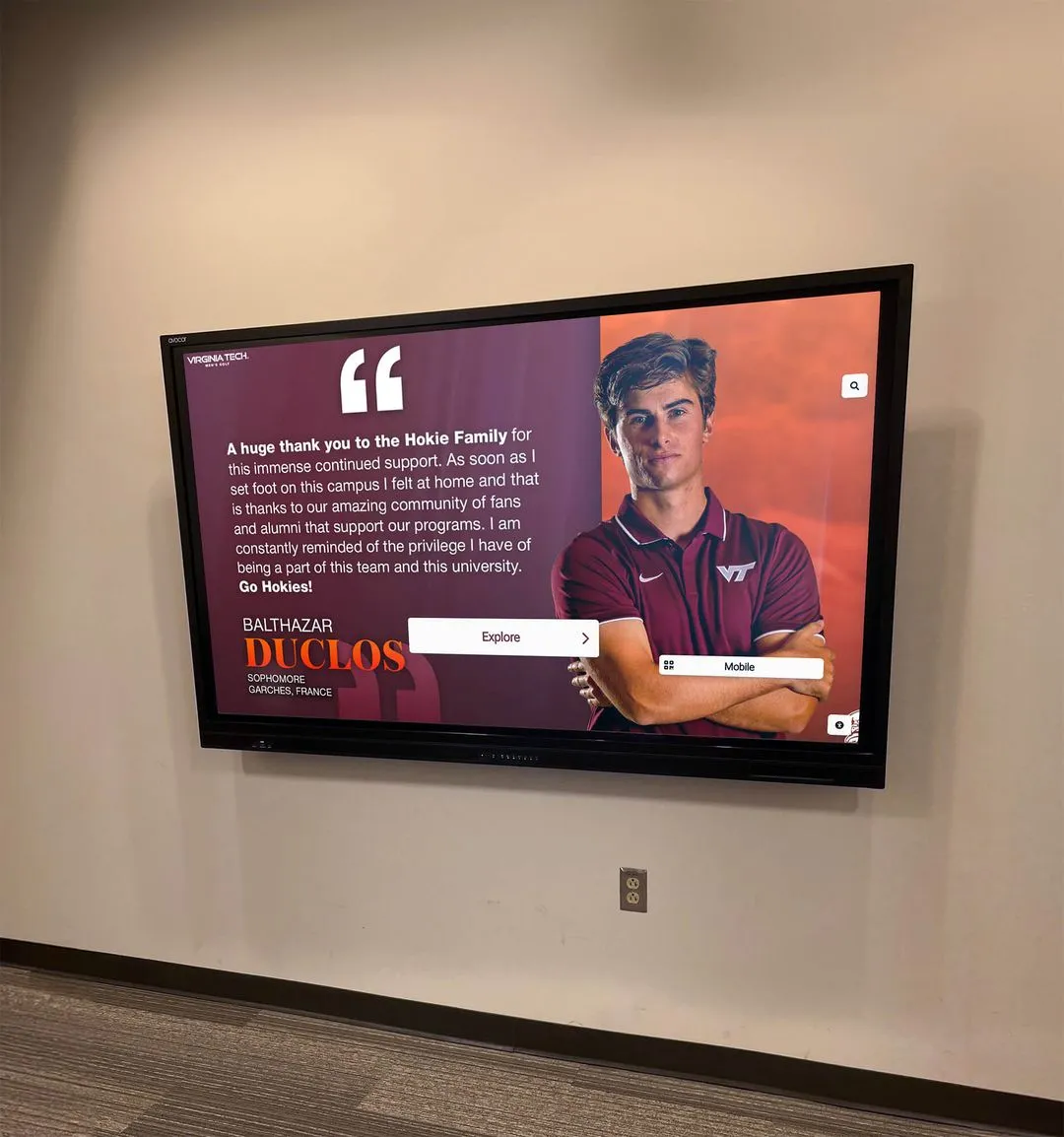
Programs that develop complete athletes—technically sound, physically prepared, and mentally tough—often celebrate this comprehensive development through athletic recognition programs honoring not just touchdowns and tackles but the dedication to training that makes championship performance possible.
Implementing Your Football Conditioning Program
Understanding individual drills provides the building blocks, but implementing effective conditioning programs requires systematic planning that progresses athletes appropriately, balances conditioning with skill work and recovery, and adapts to your program’s specific circumstances and competitive schedule.
Periodization Framework for Football Conditioning
Effective conditioning programs follow periodized structures that systematically develop fitness across training cycles while preventing overtraining and timing peak conditioning for championship opportunities.
Off-Season Phase (December-February for high school fall football):
- Focus: Building general fitness base, addressing individual weaknesses, developing strength and power foundations
- Volume: Moderate to high volume, lower intensity
- Sample Week Structure:
- Monday: Tempo runs (Drill 4) + Hill sprints (Drill 8)
- Wednesday: Position circuits (Drill 10) + Strength training
- Friday: 10-yard accelerations (Drill 1) + Broad jumps (Drill 7)
- Progression: Gradually increase work volumes (reps, sets, distances), introduce intensity variations, build work capacity tolerance
Pre-Season Phase (Spring and Summer):
- Focus: Converting general fitness into football-specific conditioning, increasing intensity, developing speed and power
- Volume: Moderate volume, high intensity
- Sample Week Structure:
- Monday: Flying 20s (Drill 2) + Sled pushes (Drill 5)
- Tuesday: Gassers (Drill 9) – low volume
- Wednesday: Pro agility (Drill 3) + Partner resistance sprints (Drill 6)
- Thursday: Position circuits (Drill 10)
- Friday: 30-30 intervals (Drill 11) or recovery work
- Progression: Increase intensity while managing volume, reduce rest intervals, introduce competitive elements and time standards
In-Season Phase (During competitive season):
- Focus: Maintaining conditioning levels developed during preseason, managing fatigue, recovering from game demands
- Volume: Low volume, maintained intensity on selected drills
- Sample Week Structure:
- Monday: Recovery (light tempo runs or off completely following Saturday game)
- Tuesday: Short speed work (Drill 1 or 3) integrated into practice
- Wednesday: Position circuits (modified Drill 10) or rest
- Thursday: Maintenance work based on opponent and game plan
- Friday: Pre-game prep (no conditioning)
- Saturday: Game day
- Approach: Practice demands provide significant conditioning stimulus, additional conditioning work supplements rather than replaces practice intensity
Post-Season Recovery and Transition:
- Focus: Physical and mental recovery, healing injuries, transitioning to off-season training
- Volume: Very low, optional participation
- Duration: 2-4 weeks depending on season length and playoff run
- Activities: Light aerobic work (swimming, cycling, walking), recreational sports, flexibility and mobility work
Balancing Conditioning with Other Training Demands
Football players face multiple simultaneous training stresses: technical skill development, tactical learning, strength training in weight room, position-specific work, and conditioning demands. Effective programs balance these competing priorities rather than allowing one area to compromise others.
Integration Strategies:
Within-Practice Integration: The most time-efficient approach incorporates conditioning naturally into practice activities. Segment practices with timed intervals between drills creating natural conditioning stimulus (example: offense runs play, immediately transitions to next play after 30 seconds—same interval pattern as Drill 11). Run position drills at game tempo with game-realistic rest intervals rather than standing around between reps.
Strategic Scheduling: Place highest-intensity conditioning work on days with lower technical and physical practice demands. Avoid combining maximum intensity conditioning with heavy contact practice or complex installation days when mental fatigue impairs learning. Schedule conditioning sessions at times that allow adequate recovery before next important training session or competition.
Position-Specific Adjustments: Skill position players typically can handle higher conditioning volumes due to their positional demands and typically lower body weight relative to strength. Linemen require more recovery time between high-intensity sessions due to size and contact demands. Adjust conditioning volumes and intensities based on position group needs rather than implementing identical programs for all players.
Recovery and Adaptation Principles
Conditioning adaptations occur during recovery, not during the workouts themselves. Programs that maximize conditioning improvements without creating overtraining or injury implement systematic recovery protocols.
Key Recovery Strategies:
Hydration and Nutrition: Adequate hydration before, during, and after conditioning sessions prevents performance decline and supports recovery. Post-workout nutrition (protein and carbohydrates within 30-60 minutes after training) accelerates recovery and glycogen replenishment. Programs should educate athletes on proper fueling strategies and provide resources when possible.
Sleep Requirements: Athletes require 8-10 hours of quality sleep for optimal recovery and adaptation. Chronic sleep deprivation impairs performance, increases injury risk, and prevents conditioning improvements regardless of workout quality. Coaches should emphasize sleep importance equal to training emphasis.
Active Recovery Days: Light activity (walking, easy cycling, swimming, mobility work) on recovery days promotes blood flow and recovery without creating additional training stress. Complete rest has its place, but most athletes recover better with appropriate light activity compared to complete sedentary rest.
Monitoring for Overtraining: Watch for warning signs that conditioning volume or intensity exceeds athletes’ recovery capacity: persistent fatigue across multiple sessions, significant performance declines, increased injury rates, illness frequency increases, and mood changes or motivation loss. When these signs appear, reduce training stress rather than pushing through—overtraining creates regression, not improvement.
Adapting Conditioning for Different Athlete Levels
Conditioning programs must reflect athletes’ current fitness levels, training age (years of systematic training), and development stage rather than implementing identical programs for freshmen and seniors.
Youth and Freshman Athletes: Emphasize movement quality and conditioning technique over volume and intensity. Build aerobic base through extended lower-intensity work (longer rest intervals, more tempo runs, less glycolytic stress). Develop proper sprint mechanics, landing technique, and body control before adding significant volume or intensity. Focus on creating positive associations with conditioning rather than punishment mindsets that create long-term motivation problems.
Intermediate Athletes (JV, Early Varsity): Progress toward position-specific conditioning demands, increase intensity and volume systematically, introduce competitive elements and time standards, and develop mental toughness alongside physical conditioning. These athletes can handle moderate volumes of high-intensity work but still require careful progression and adequate recovery.
Advanced Athletes (Multi-Year Varsity, College-Bound): Implement full-intensity conditioning programs with position-specific emphasis, use advanced periodization strategies targeting peak performance for championship opportunities, incorporate sport science tools when available (GPS tracking, heart rate monitoring, force plates), and develop self-directed conditioning habits that will serve athletes at next level.
Many championship football programs celebrate the complete athletic development—combining technical skill, physical preparation, and mental toughness—through comprehensive recognition systems that honor diverse contributions to team success beyond just statistical leaders, creating culture where conditioning dedication receives the appreciation it deserves.
Safety Considerations and Injury Prevention
Conditioning programs should enhance performance and reduce injury risk, never create unnecessary danger through improper implementation or inadequate safety protocols.
Environmental Factors and Heat Safety
Heat-related illness represents the most serious conditioning risk, particularly during summer training when temperatures and humidity create dangerous conditions even for well-conditioned athletes.
Heat Safety Protocols:
Temperature and Humidity Monitoring: Implement work-rest ratios based on wet bulb globe temperature (WBGT) measurements that account for temperature, humidity, sun exposure, and wind. When WBGT exceeds 82°F, reduce conditioning intensity and increase rest intervals. Above 92°F, consider moving conditioning indoors or rescheduling to cooler times.
Acclimatization Periods: Athletes need 10-14 days of gradual exposure to heat conditions for physiological adaptations that improve heat tolerance. Never implement full-intensity conditioning during first week of summer workouts—progressively increase volume and intensity while athletes acclimatize.
Hydration Requirements: Athletes should arrive at conditioning sessions well-hydrated (clear or light-colored urine). Provide unlimited water access during sessions, implement scheduled hydration breaks every 15-20 minutes during high-intensity work, and monitor post-workout weight loss (loss exceeding 2% of body weight indicates inadequate hydration). Consider electrolyte replacement for sessions exceeding 60 minutes or in high heat conditions.
Recognition of Warning Signs: All coaches must know signs of heat exhaustion (heavy sweating, weakness, nausea, dizziness) and heat stroke (altered mental state, cessation of sweating, body temperature exceeding 104°F). Heat stroke is medical emergency requiring immediate cooling and emergency medical services—never delay treatment hoping athlete will recover with rest alone.
Progressive Overload and Volume Management
Conditioning adaptations require progressive overload—systematically increasing training stress over time. However, increasing volume or intensity too rapidly creates injury risk rather than improved fitness.
Safe Progression Guidelines:
The 10% Rule: Increase total conditioning volume (combining distance, repetitions, and intensity) by no more than 10% per week. More aggressive increases exceed most athletes’ adaptation capacity, increasing injury risk particularly for overuse injuries (stress fractures, tendinopathies, muscle strains).
Recovery Integration: Every 3-4 weeks of progressive loading should include one recovery week with reduced volume (typically 40-50% of previous week’s volume) maintaining intensity. These planned recovery weeks prevent cumulative fatigue accumulation and allow adaptations to consolidate.
Individual Variation: Average progressions work for many athletes but not everyone. Monitor individual responses—some athletes adapt faster and tolerate aggressive progressions, others require more conservative approaches. Adjust programs based on individual response rather than forcing everyone through identical progressions.
Equipment and Surface Considerations
Where and how conditioning occurs significantly impacts effectiveness and injury risk.
Surface Selection: Grass provides cushioning reducing impact forces during running and cutting drills. Synthetic turf offers consistent surface but generally creates higher impact forces than grass. Concrete and asphalt create excessive impact forces and should be avoided for conditioning work. Running tracks offer measured distances and appropriate impact absorption for specific speed work.
Equipment Requirements: Athletes must wear appropriate footwear for conditioning work—proper athletic shoes with adequate cushioning and support, never casual shoes or worn-out footwear lacking support. Consider positional differences—linemen may need more substantial footwear given higher body masses and impact forces. Resistance equipment (sleds, resistance bands, weighted vests) must be appropriate for athlete strength levels and properly maintained to prevent equipment failure during use.
Mental Health and Psychological Safety
While often overlooked, mental health and psychological safety represent critical components of comprehensive athlete welfare.
Conditioning as Development, Not Punishment: Programs that use conditioning as punishment for mistakes or rule violations create negative associations that undermine intrinsic motivation and can contribute to burnout or sports dropout. Conditioning should be framed as essential preparation for success, not consequence for failure. Save disciplinary measures for appropriate contexts separate from training.
Individual Differences in Pain Tolerance and Expression: Athletes experience and express discomfort differently based on personality, cultural background, and previous experiences. Some athletes dramatically vocalize during challenging work; others suffer silently. Coaches must recognize individual differences rather than assuming quiet athletes are fine while vocal athletes are weak. Learn to distinguish productive discomfort (normal training stress) from harmful pain (injury or overtraining signals).
Psychological Support Resources: Recognize that some athletes may struggle with training demands for mental health reasons (anxiety, depression, eating disorders, body image issues) beyond physical fitness limitations. Programs should provide access to appropriate support resources (athletic trainers, school counselors, sports psychologists) for athletes facing these challenges rather than treating all conditioning struggles as motivation or effort issues.
Testing and Progress Tracking
Systematic assessment quantifies conditioning improvements, identifies athletes needing additional support, and demonstrates program effectiveness.
Essential Conditioning Tests
Implement baseline and periodic testing measuring key conditioning components:
Speed Tests:
- 10-Yard Dash: Acceleration measurement (test Drill 1 effectiveness)
- 40-Yard Dash: Combined acceleration and maximum velocity (broad speed assessment)
- Flying 20: Maximum velocity specific measurement (test Drill 2 effectiveness)
Agility Tests:
- Pro Agility (5-10-5): Change of direction speed (matches Drill 3)
- Three-Cone Drill: Multi-directional agility assessment
Power Tests:
- Broad Jump: Horizontal power measurement (matches Drill 7)
- Vertical Jump: Vertical power assessment
Endurance/Work Capacity Tests:
- Gasser: Position-specific time standards (matches Drill 9)
- 300-Yard Shuttle: Sustained sprint endurance
Testing Schedule:
- Baseline: Beginning of off-season training
- Pre-Season: Before competitive season starts
- Mid-Season: Optional mid-season assessment (consider training load when scheduling)
- Post-Season: End of competitive season (when appropriate after adequate recovery)
Using Data to Drive Program Adjustments
Testing data should inform program modifications rather than simply ranking athletes or satisfying administrative requirements.
Individual Athlete Analysis: Compare each athlete’s current testing to their previous results (not just to team averages). Athletes showing stagnation or regression despite consistent training may need programming modifications, additional recovery, or assessment for underlying issues. Athletes showing improvements deserve recognition and can progress to more challenging conditioning levels.
Position Group Assessment: Analyze position group trends—if linebackers collectively show speed improvements but agility stagnation, increase agility training emphasis for that group. Position group analysis can reveal whether conditioning programs appropriately address position-specific needs or require adjustment.
Program Effectiveness Evaluation: Year-over-year analysis reveals whether conditioning programs effectively develop athletes or require significant revision. Programs consistently producing improvements across multiple testing metrics likely feature appropriate structure and intensity; those showing widespread stagnation need reevaluation.
Elite football programs understand that consistent training and development across years, not single-season efforts, build championship foundations. Many programs celebrate this long-term commitment through permanent team achievement displays that honor both individual excellence and collective accomplishments spanning decades of program history.
Conclusion: Building Championship Conditioning
Elite football conditioning doesn’t happen by accident—it results from systematic implementation of evidence-based drills, intelligent program design that balances intensity with recovery, progressive overload that develops without destroying athletes, and coaching commitment to conditioning as essential component of championship preparation rather than afterthought or punishment tool.
The 12 drills detailed in this guide provide comprehensive conditioning addressing every physical demand football places on athletes: explosive acceleration that creates separation and closes pursuit angles, maximum velocity maintenance that turns big plays into touchdowns, strength and power for winning physical battles at line of scrimmage and in open field, work capacity for sustaining performance through fourth quarters and championship seasons, and position-specific fitness matching the unique demands each role places on athletes.
Core Principles for Conditioning Success:
- Specificity: Train energy systems and movement patterns that actually matter for football, not generic fitness that doesn’t transfer to on-field performance
- Progressive Overload: Systematically increase conditioning stress across training cycles, allowing adaptations to occur without exceeding recovery capacity
- Recovery Integration: Recognize that adaptations occur during recovery, not during workouts, and program adequate rest for improvements to manifest
- Individual Optimization: Adjust programs based on position demands, individual athlete needs, and response to training rather than forcing identical programming for diverse athletes
- Safety First: Implement proper progressions, environmental monitoring, and athlete welfare protocols ensuring conditioning develops rather than damages athletes
- Positive Culture: Frame conditioning as preparation for success rather than punishment for failure, creating intrinsic motivation and sustainable training habits
- Systematic Assessment: Test regularly to quantify improvements, identify athletes needing support, and demonstrate program effectiveness
Programs implementing comprehensive, intelligently designed conditioning programs create undeniable competitive advantages: athletes who maintain speed and power when opponents slow down, defenders who pursue relentlessly into fourth quarters, offenses that impose physical will throughout games, special teams units that create explosive plays through superior speed and stamina, and most importantly, confident athletes who trust their conditioning to sustain performance when games hang in balance.
Ready to celebrate the dedication, work ethic, and achievements that systematic conditioning makes possible? Rocket Alumni Solutions provides comprehensive recognition platforms that honor not just game statistics but the year-round commitment to training excellence that creates championship-caliber football programs. Our interactive digital displays, permanent recognition systems, and comprehensive content management solutions help schools celebrate every aspect of athletic excellence—from touchdowns and tackles to the conditioning dedication that makes success possible.