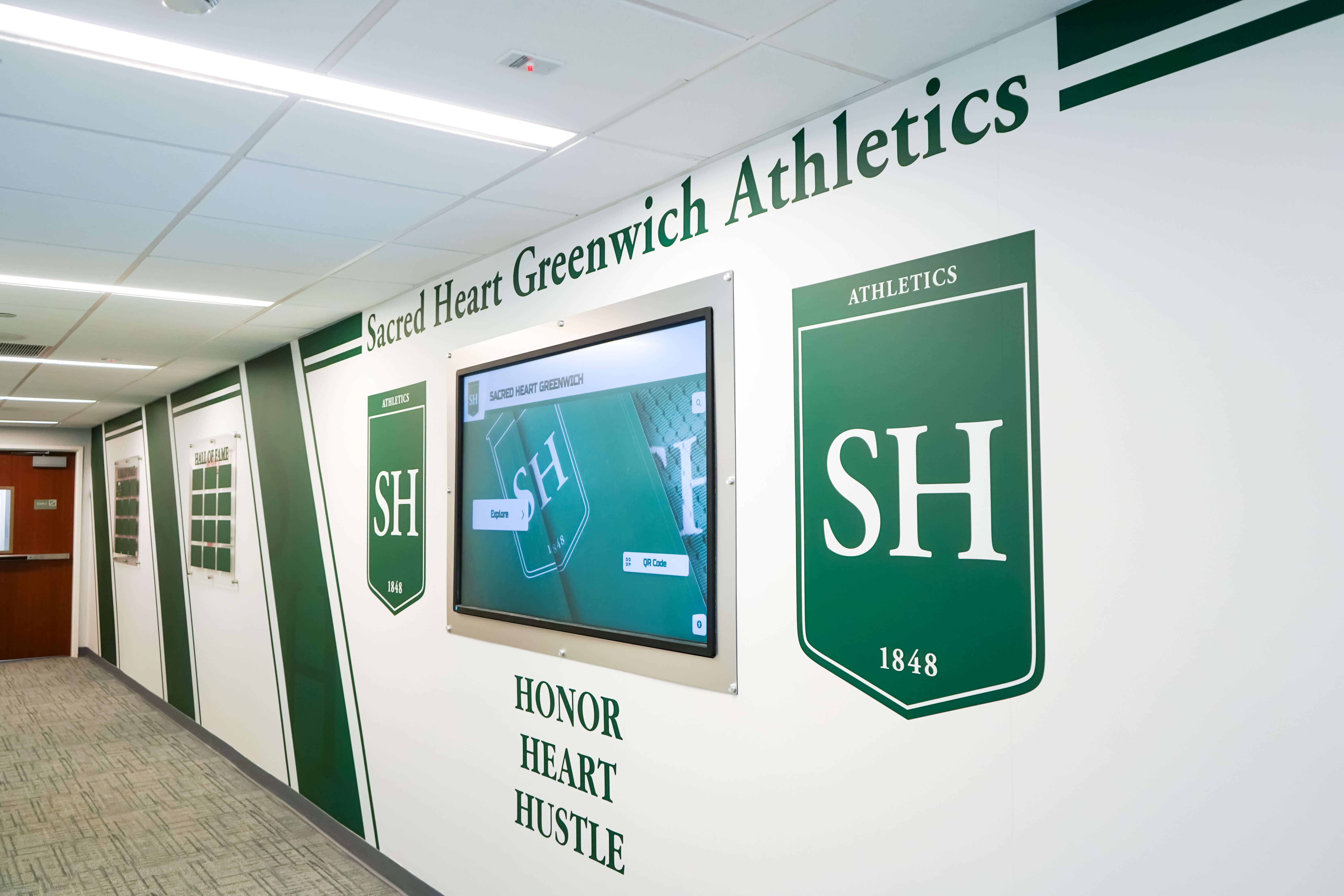
Every high school athletic department eventually faces the same moment: a championship season ends, the trophy arrives, and it gets slid into a glass case beside trophies from seven other years. The engraving disappears behind a reflection. The story behind the season — the injured player who came back in time for regionals, the coach’s adjustments that unlocked a run, the seniors who had waited three years for that moment — goes untold.
Championship trophy display ideas have evolved significantly beyond the standard trophy case. The schools doing it best now stage their championship hardware as part of a layered recognition environment that includes championship banners hung at the right height, plaques and rings behind well-lit glass, retired jerseys given dedicated wall space, and touchscreen story panels that let anyone tap into the full history of a dynasty. This guide walks through each layer and explains how to combine them into something that actually moves people when they walk past.
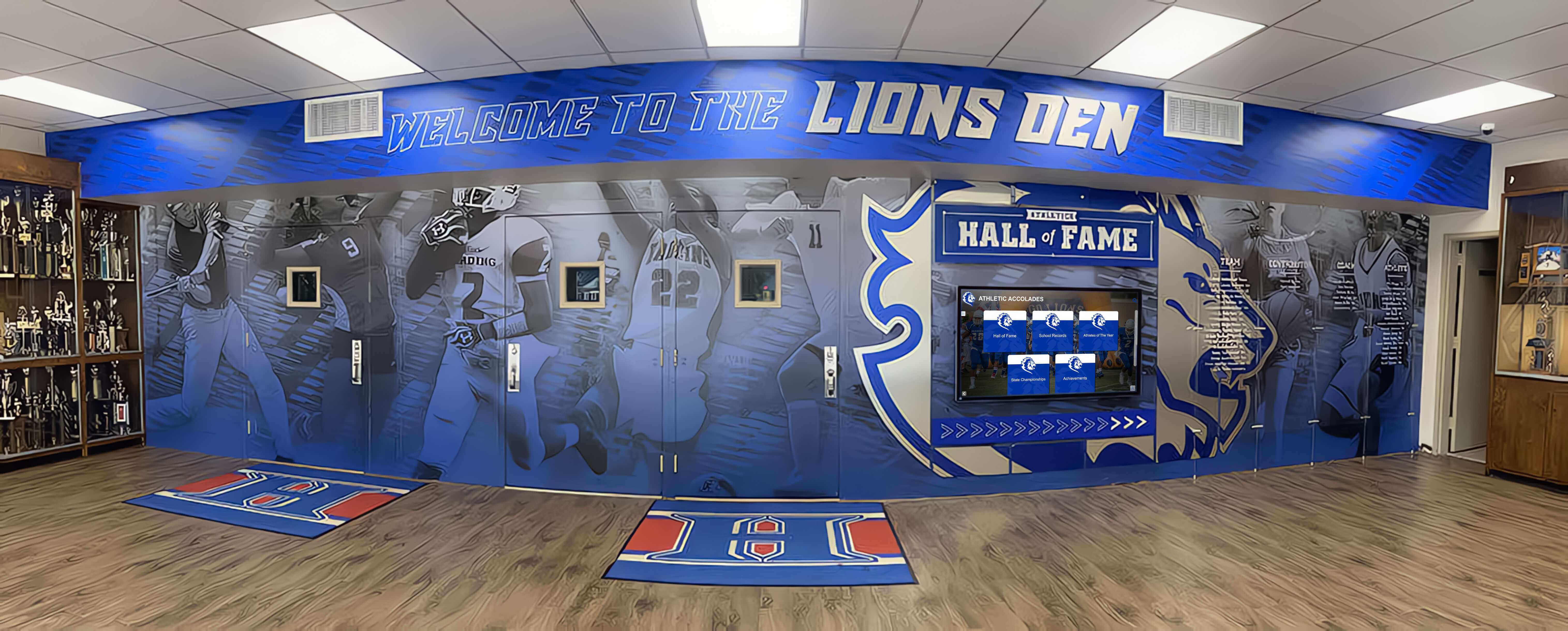
Why the Standard Trophy Case Falls Short
The trophy case is not the problem. The problem is treating it as the complete solution.
A traditional floor-to-ceiling trophy case handles the physical preservation question adequately. Trophies stay clean, out of reach, and visible. But case-only recognition leaves several things unaddressed:
No context for new visitors. A prospective student-athlete touring your gym in 2026 sees a 2019 state championship trophy and a nameplate. They don’t know that team went 28-2, that three seniors on the roster went on to play Division I, or that the program had lost in the finals three consecutive years before that breakthrough. None of that fits on a nameplate.
No depth for returning alumni. When a player from that 2019 team brings her own child to a tournament twelve years from now, she wants to show them the trophy. She also wants to tell the story. A static case can’t help with the story.
Physical capacity runs out. A program winning championships across multiple sports will outgrow a fixed case. Every new trophy added means older trophies pushed to less prominent spots or moved to storage entirely, quietly erasing history.
No differentiation between achievement levels. A regional championship trophy and a state championship trophy look similar in a crowded case. They don’t feel similar to the athletes who earned them.
Effective championship trophy display ideas address all four of these gaps by building recognition environments rather than just recognition containers.
Championship Banners: Staging, Scale, and Placement
Championship banners are the highest-visibility element in most athletic recognition programs, and they’re also the most frequently mishandled.
Height and Visibility
Banners hung too high lose their text legibility. The standard school gymnasium ceiling is 22 to 30 feet. A 3-foot-wide championship banner hung at 25 feet is visible from across the gym floor, but the text requires effort to read and the year is essentially invisible. Banners that inform and inspire need to be positioned where text is readable at a glance — typically 10 to 16 feet high in a lobby or hallway where visitors are standing nearby, rather than rafter-height in a competition space where they function more as visual atmosphere than readable recognition.
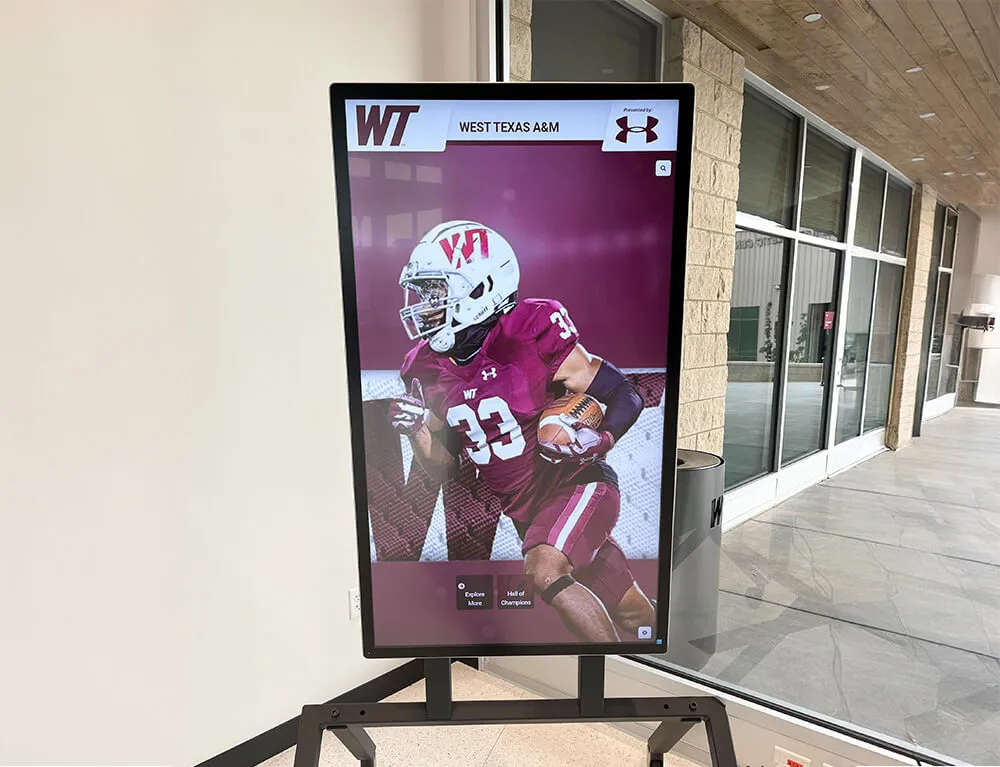
When rafters are the appropriate venue (as they are for naming the program’s most significant championships), consider supplementing with a lobby-level banner display that repeats the information at human scale. Touchscreen banner displays for schools offer one approach to this problem: a digital panel that cycles through championship years, sport by sport, at eye level in the lobby while the physical banners maintain their presence above.
Banner Content Beyond Year and Sport
Most championship banners contain three data points: sport, year, championship level. The best programs add a fourth: final record. “State Champions — Girls Basketball — 2024 — 31-3” does more work than “State Champions — Girls Basketball — 2024.” The record gives immediate context for how dominant that season was without requiring a separate display.
Some programs include coach name and a short one-line note (“First state title in program history” or “Back-to-back champions”). This additional line is worth the cost on significant championships and adds nothing burdensome to the production.
Clustering vs. Sport-by-Sport Layouts
Schools with championships across many sports face a choice: hang all banners together in a single prominent space, or organize them by athletic wing so each sport’s championships appear near where that sport competes. Both approaches have merit. Clustering creates an impressive combined statement of program-wide excellence. Sport-specific placement creates daily visibility for athletes in each program who see their sport’s history every time they enter their locker room area.
Many schools use both: a curated “championship corridor” near the main athletic entrance that features the school’s most significant titles, with sport-specific installations elsewhere in the facility.
Championship Rings and Physical Awards: Display Principles
Championship rings represent some of the most emotionally resonant artifacts in high school athletics. They’re expensive to produce, intimate in scale, and loaded with meaning for the athletes who earned them. Displaying them well requires different thinking than displaying trophies.
Dedicated Ring Cases
A championship ring displayed alongside twelve other items in a crowded case disappears. Rings deserve their own display infrastructure: a lighted, framed case with each ring positioned against a dark velvet or leather backing, with a brief label identifying the sport, year, and championship level. Some schools pair the ring with the corresponding team photograph, placing photo and ring case side by side in a unified presentation.
Connection to Physical Documentation
Physical championships generate physical documentation — programs, newspaper covers, game tickets, tournament brackets, and photographs — that collectively tell a richer story than the trophy or ring alone. Schools that incorporate these materials into their championship displays create something closer to an exhibit than a trophy case. A wall-mounted shadow box containing a ring, a tournament bracket, a headline from the local paper, and the starting lineup gives viewers five minutes of material rather than five seconds.
Dedication plaque ideas can extend this approach beyond athletic hardware — acknowledging the coaches, boosters, and supporters who made championship seasons possible alongside the athletes who won them.

Retired Jersey Displays: The Highest Individual Honor
A retired jersey hung in a school’s athletic space communicates something distinct from any other form of recognition: this individual’s contribution was so significant that we will not give their number to another athlete. That statement deserves display infrastructure that matches its weight.
Jersey Display Standards
Jerseys hung from standard wire hangers on a crowded wall look like a lost-and-found. Framed jerseys mounted behind UV-protective glass, with a nameplate identifying the player’s name, number, years, and accomplishments, communicate institutional seriousness about the honor.
The framing standard matters. A jersey in a shadow box with mounting hardware, team logo graphics, and a brief biographical note becomes a piece of institutional art. The same jersey on a wire hanger reads as afterthought.
Placement Considerations
Retired jerseys work best when they’re positioned where the sport’s current athletes will see them regularly — in or near locker room corridors, weight room entrances, or team meeting spaces. The motivational function of seeing a predecessor’s retired number before practice differs from seeing it once a year at homecoming. Proximity and frequency of exposure matter.
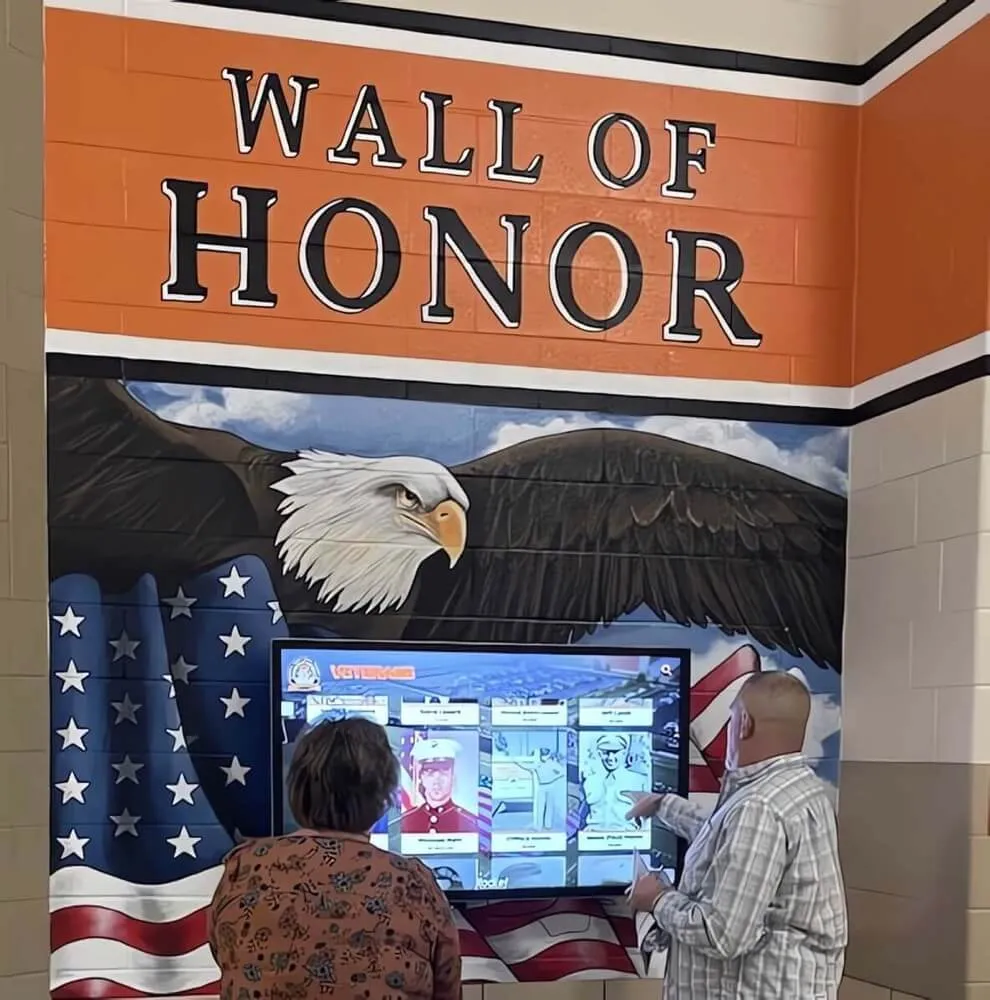
For programs with many retired numbers, a dedicated “Wall of Honor” section organized by sport provides structure and prevents the display from becoming an undifferentiated accumulation of frames.
Championship Plaques and Wall Treatments
Where trophies are three-dimensional and highly visible at distance, plaques serve a different function: they provide comprehensive, readable documentation at close range. A well-designed championship plaque wall tells the complete story of every title in program history — sport, year, record, coach, key players — in a format that visitors can read in detail when they have a moment.
Content Hierarchies for Championship Plaques
Effective plaque walls establish clear visual hierarchy: the championship level prominent at the top (State Champions, Regional Champions, District Champions), sport and year in secondary text, and supporting details (record, coach name, key recognitions) in smaller supporting text. This hierarchy lets quick visitors extract the essential information and gives detail-seeking visitors — typically alumni and families of athletes from that season — all the context they’re looking for.
For a deep dive on creating exhibits that achieve this kind of layered communication, museum-style displays offer a useful framework for thinking about how information density, visual hierarchy, and physical presentation work together.
Material and Durability Choices
Painted wood, laser-engraved metal, vinyl-applied wall graphics, and cast bronze all appear in school athletic recognition. For championship displays expected to last decades, metal plaques — laser engraved aluminum or stainless steel — combine professional appearance with genuine durability. Bronze carries traditional weight but at significantly higher cost. Vinyl-applied wall graphics are cost-effective for large coverage but require full replacement rather than individual updates when additional championships are added.
The choice often comes down to how frequently you expect to update the display. A sport winning championships annually benefits from modular plaque systems where individual plaques can be added without rebuilding the entire wall. A sport with infrequent championships might justify a more permanent, premium installation that won’t need to change for years.
Touchscreen Story Panels: The Missing Layer
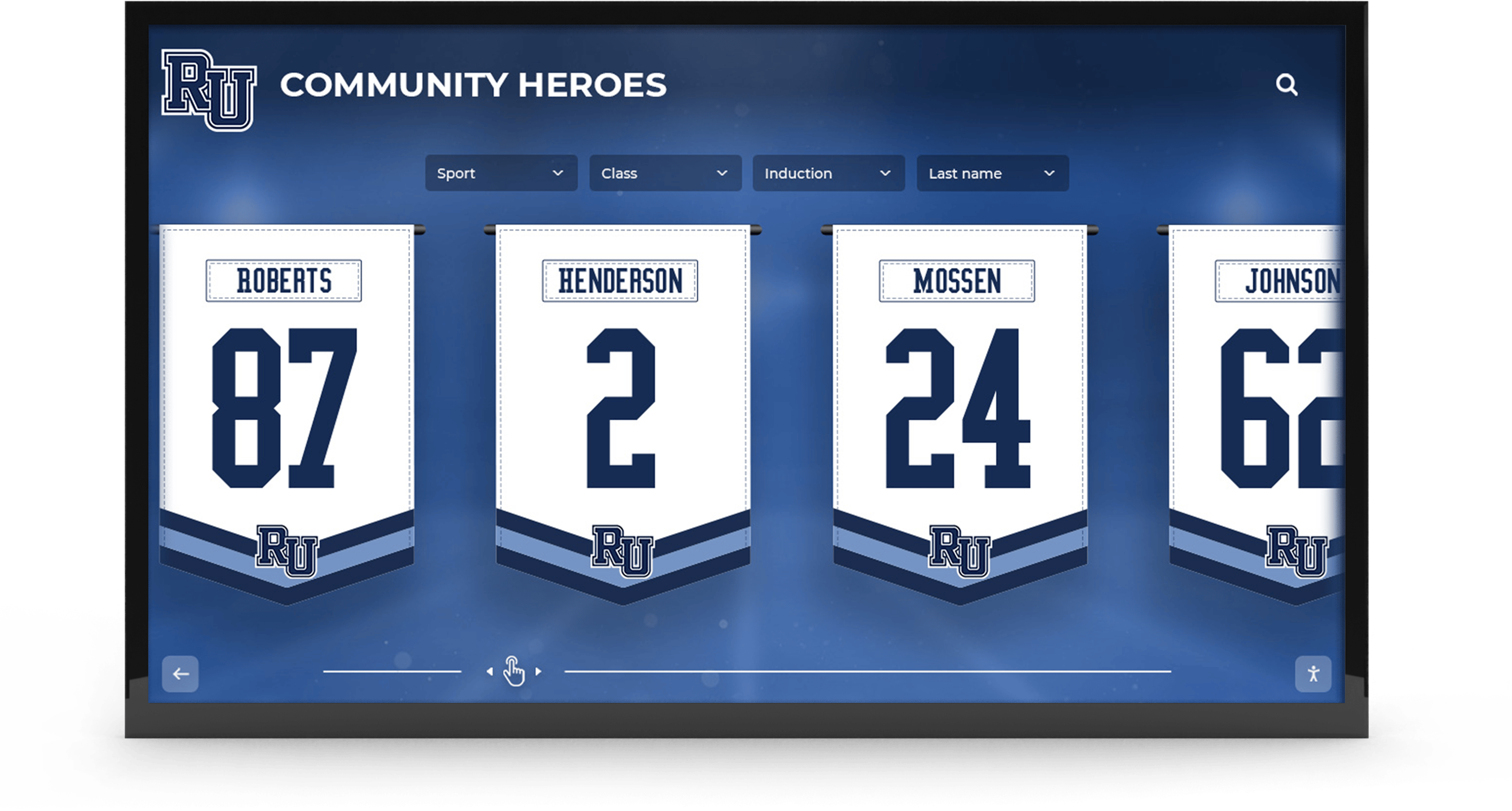
Every championship trophy display idea described so far shares one limitation: static content at fixed information density. A touchscreen story panel solves this by providing unlimited informational depth without increasing the physical footprint of the display.
What a Touchscreen Story Panel Does
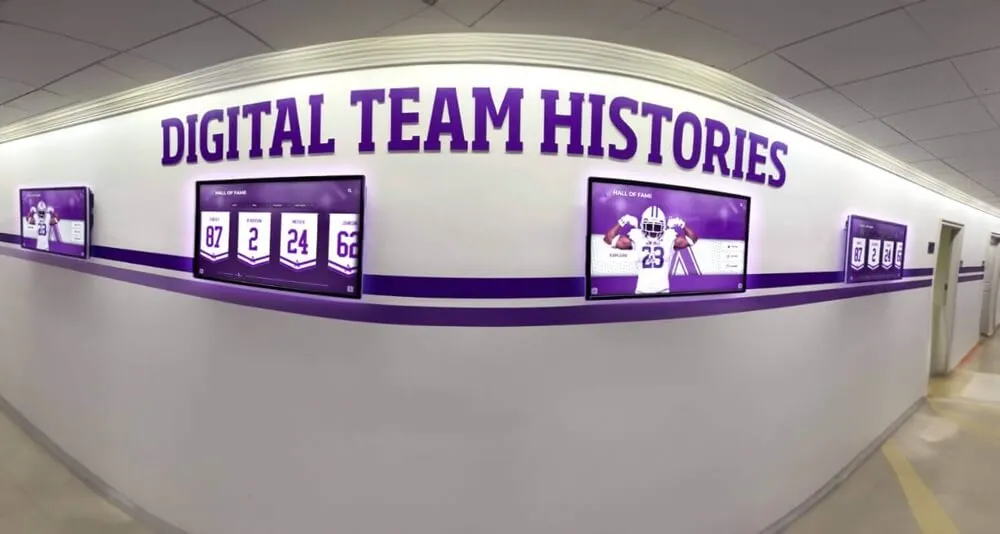
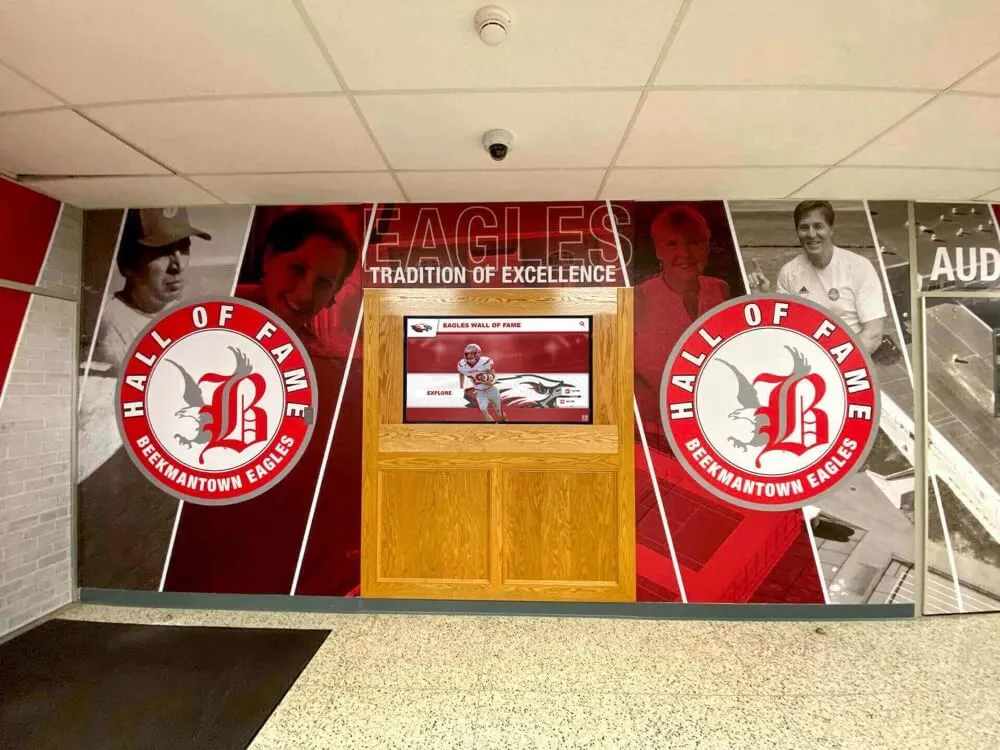
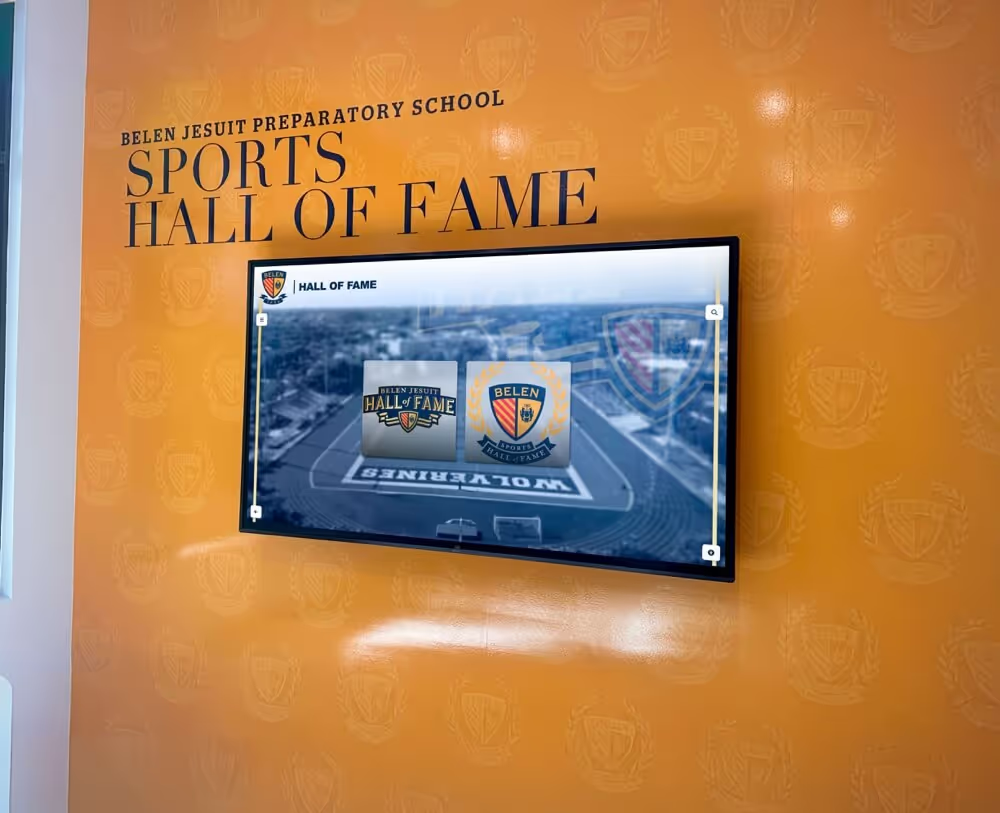
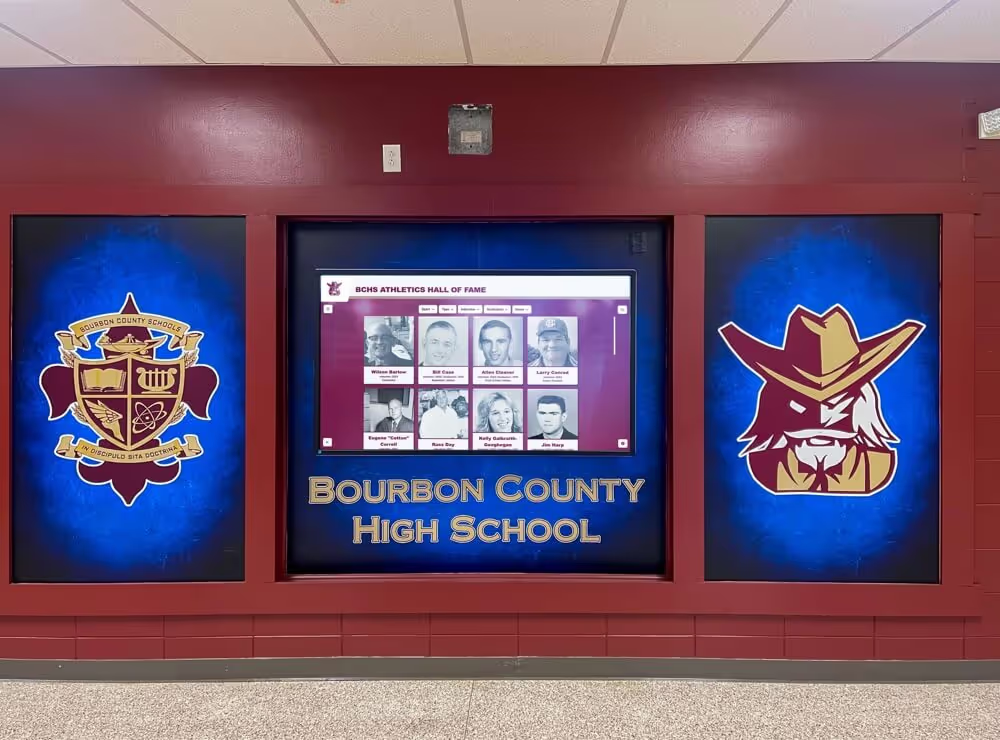
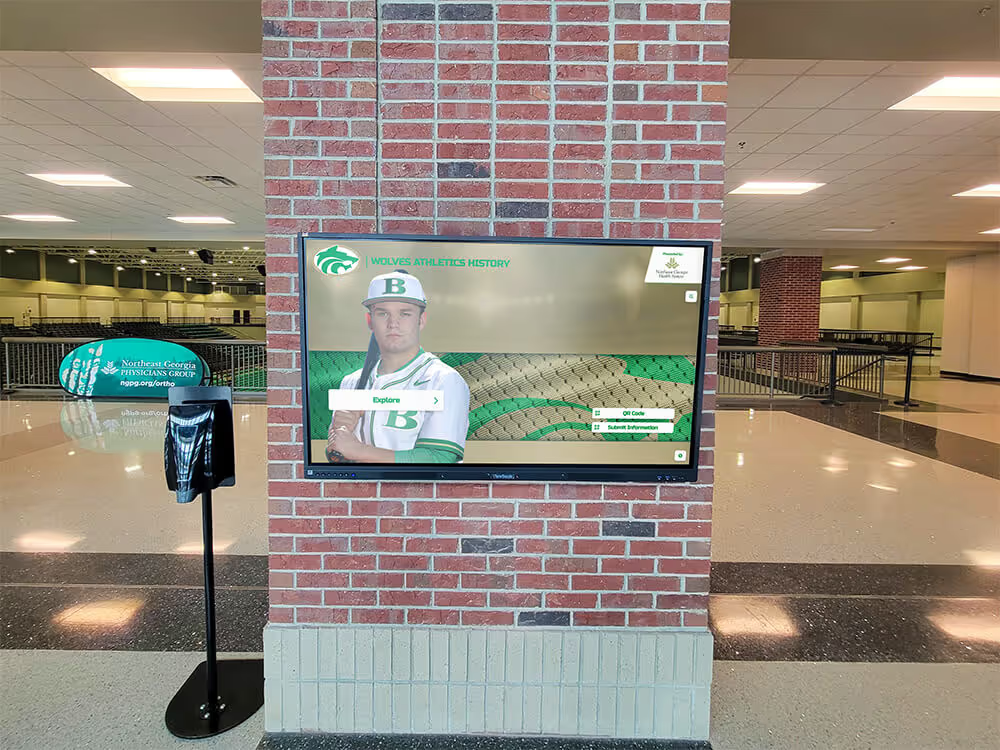
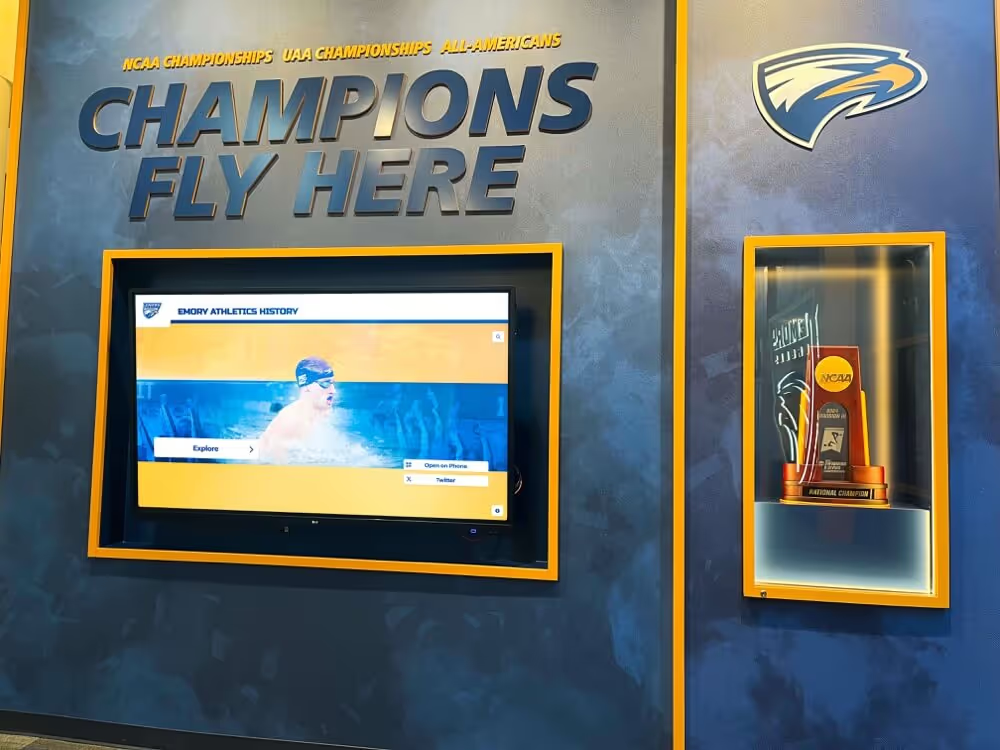
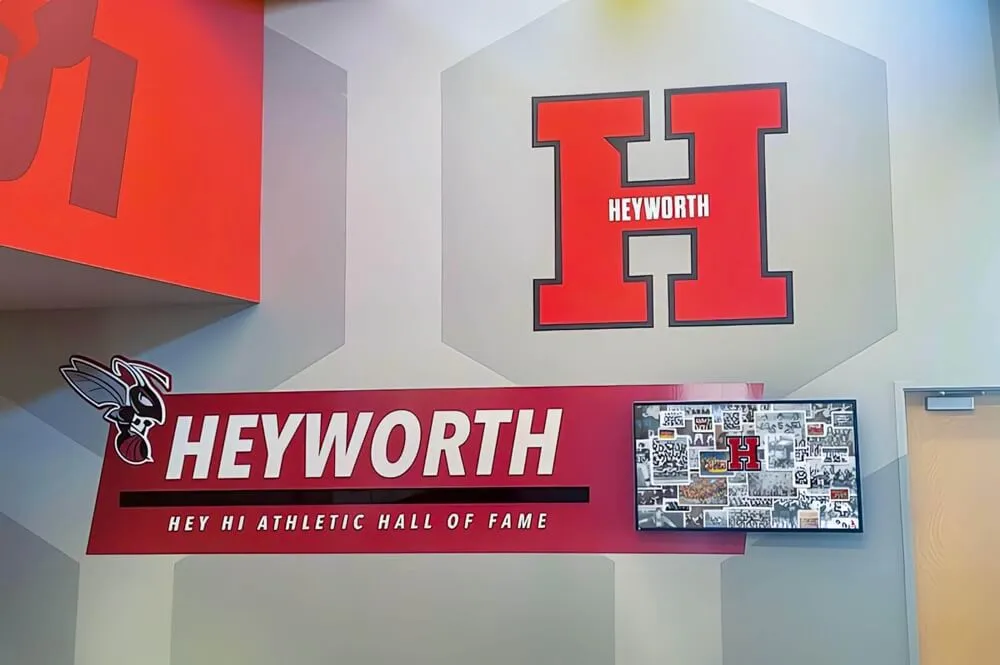
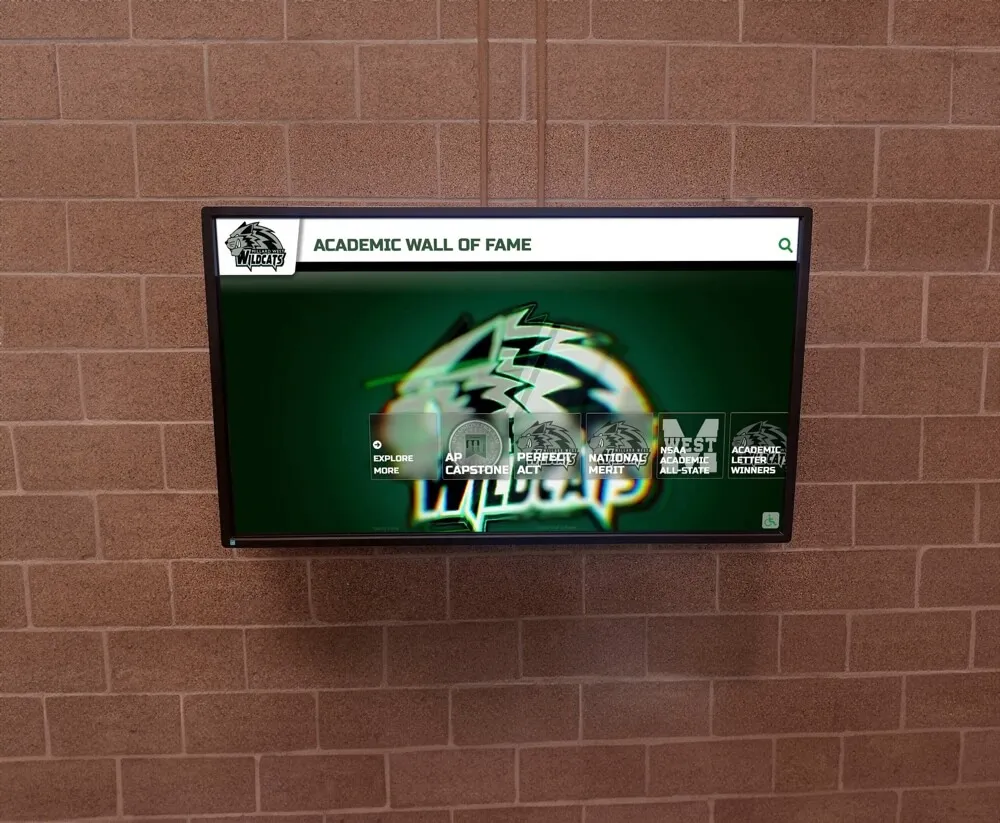
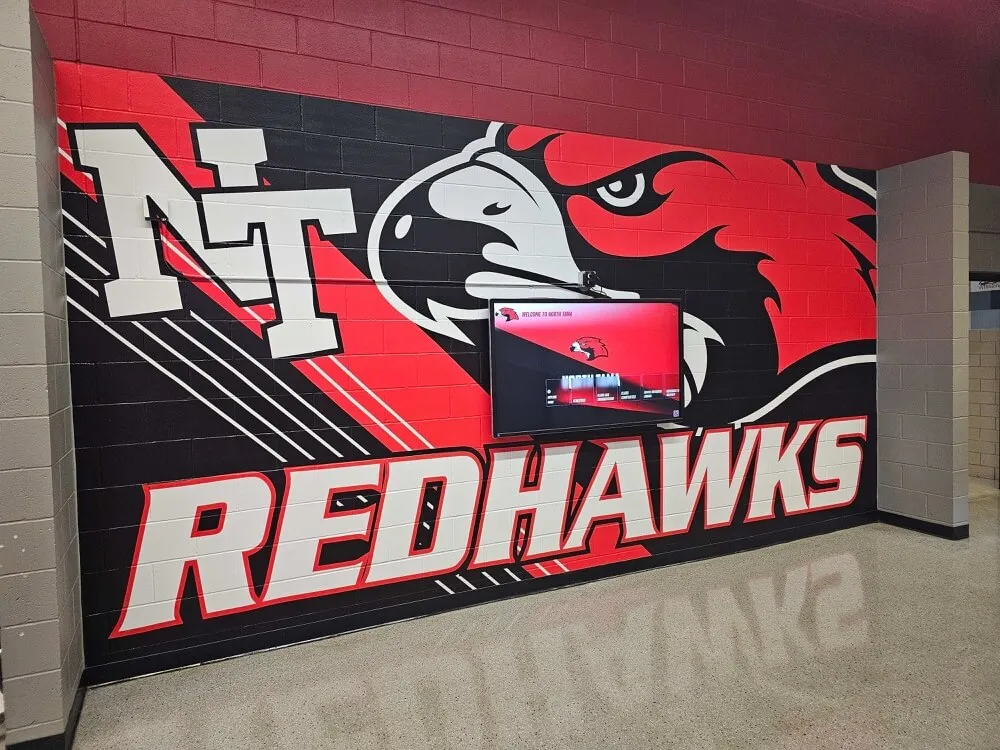
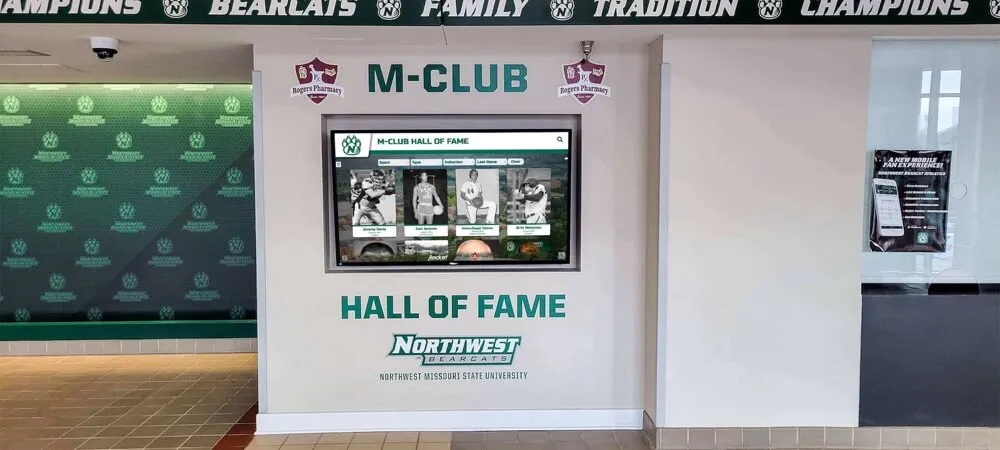
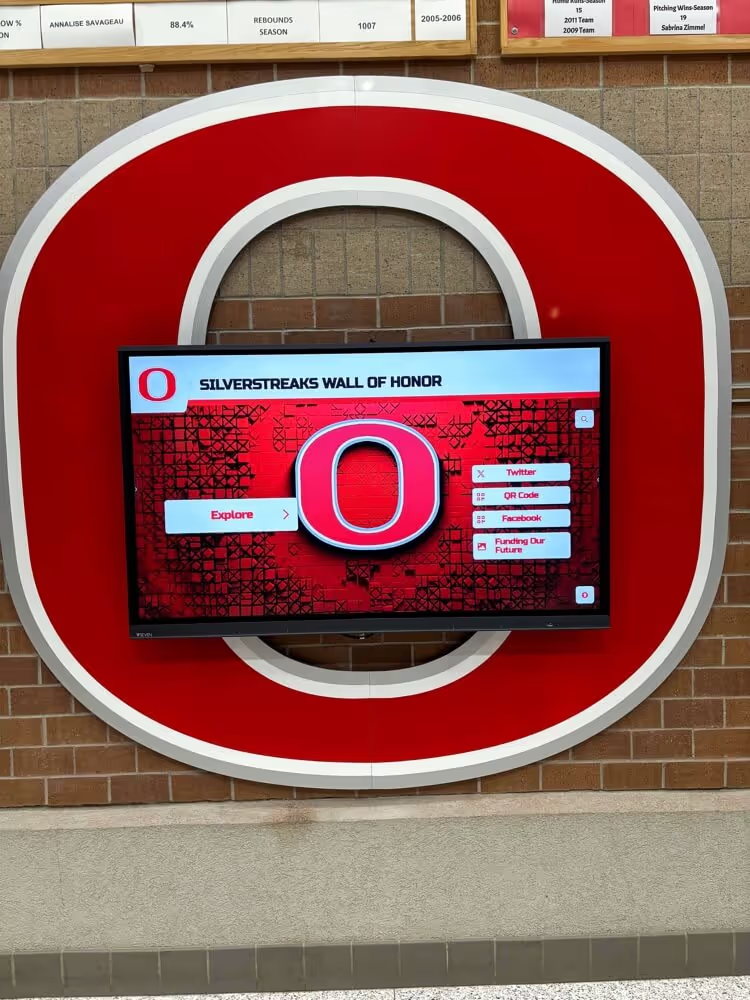
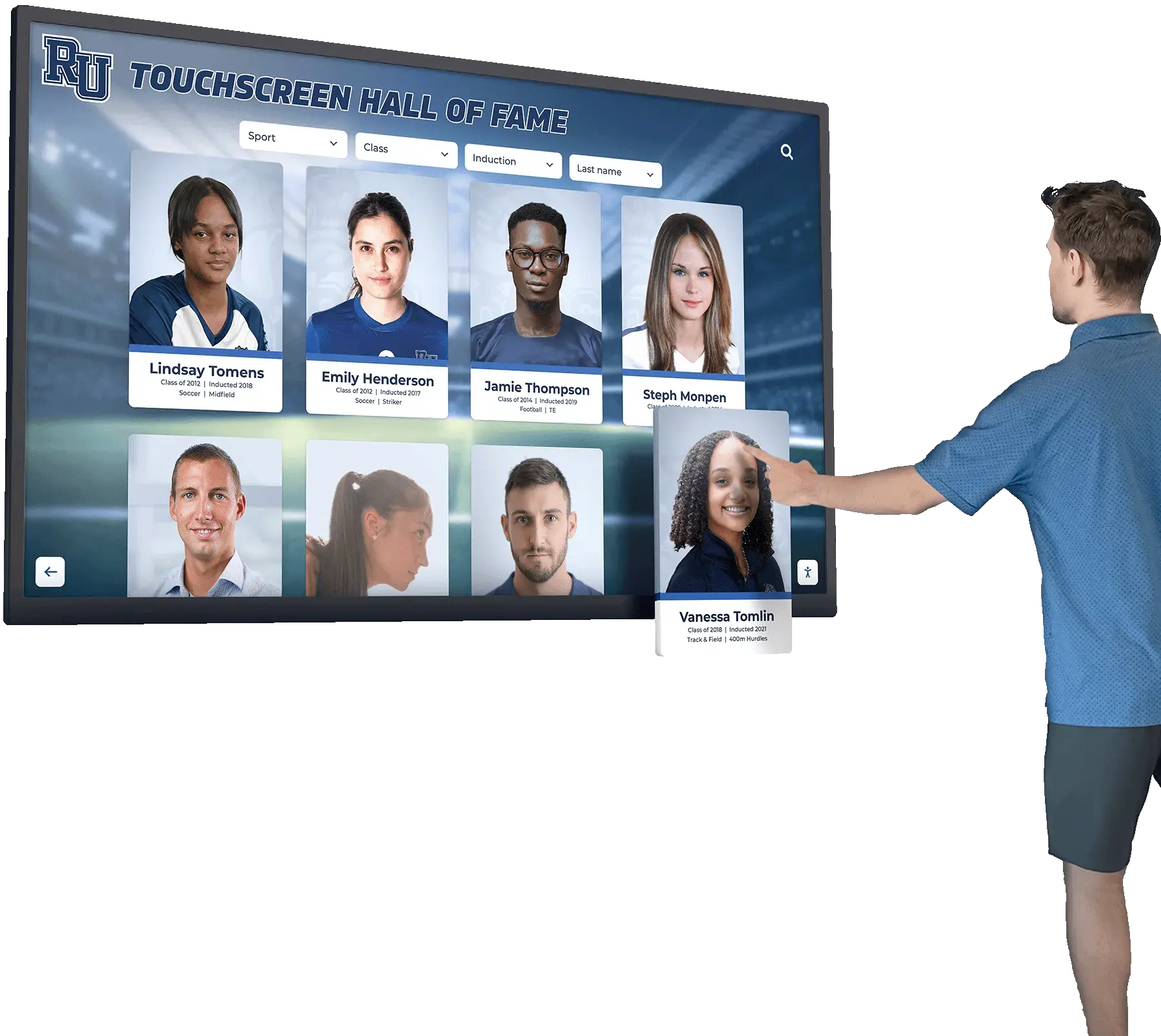
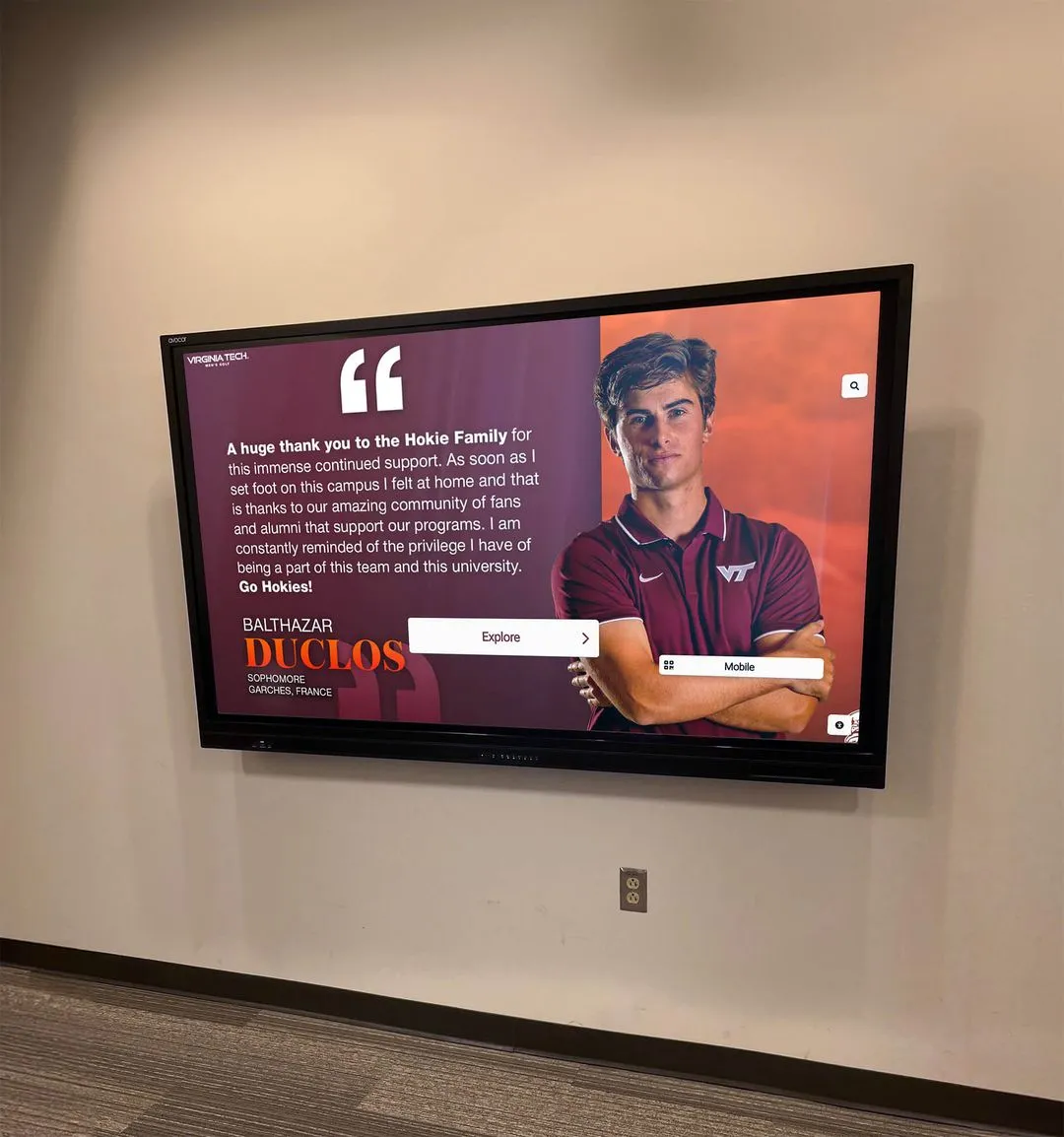
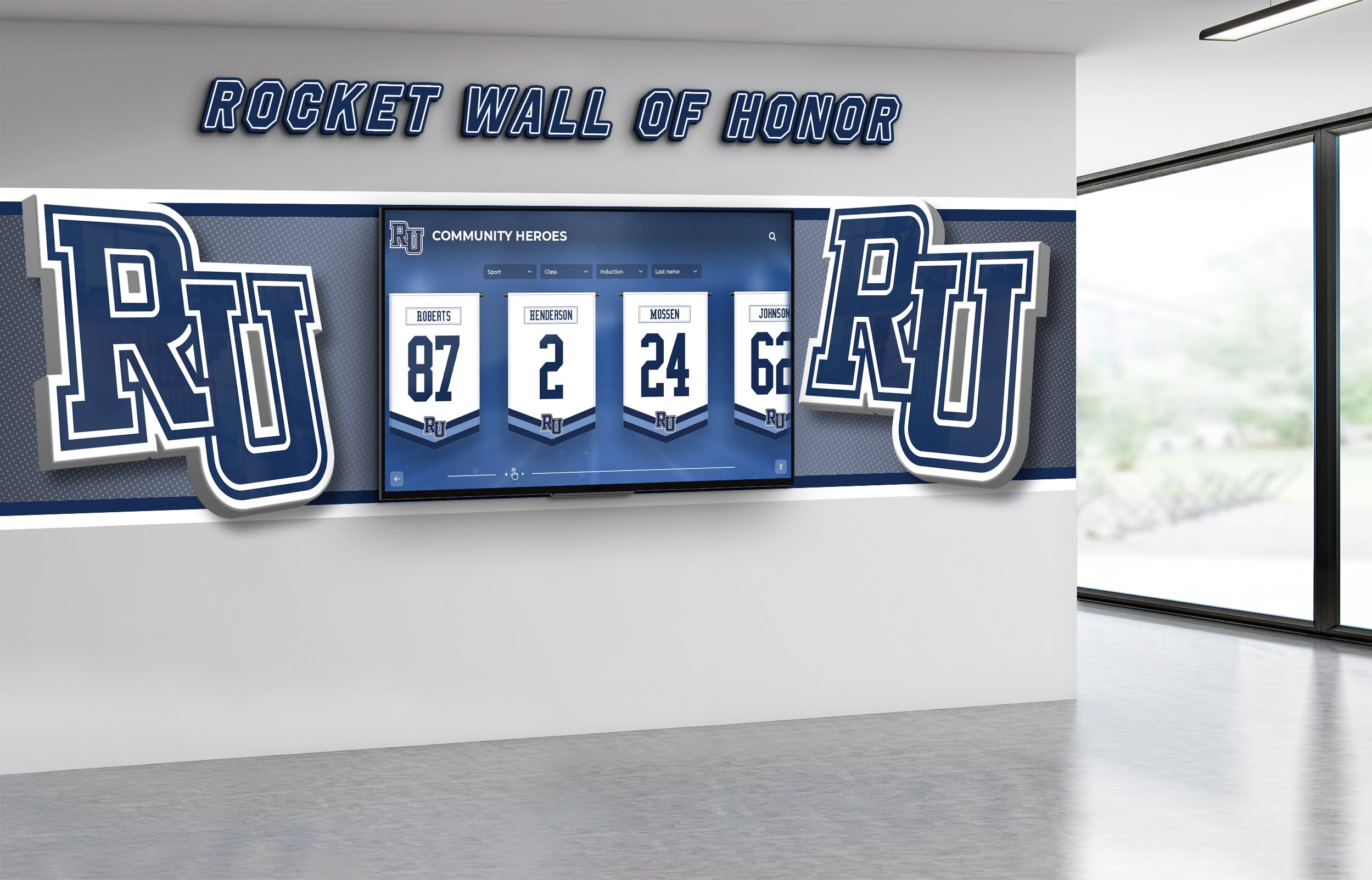
A touchscreen display mounted near your trophy case, championship banner wall, or plaque installation becomes the narrative layer of the entire recognition environment. A visitor who stops in front of the 2019 basketball championship trophy can tap to see the full season results, the tournament bracket with each game score, individual player statistics, photographs from the championship game, and a short video highlight. Everything the static display cannot accommodate becomes accessible through the interactive panel.
This depth serves several distinct audiences. Current athletes can explore the programs that preceded them in detail. Recruits and their families can assess program history beyond a count of trophies. Alumni from specific championship years can find themselves documented, share content on their phones, and reconnect with the institution. The general public — parents, community members, facility visitors — can engage with the school’s athletic identity in a way that a trophy case alone never enables.
Interactive touchscreen displays as a school recognition tool provide a comprehensive look at how these systems work in practice across different school settings and program types.
Integration with Physical Championship Displays
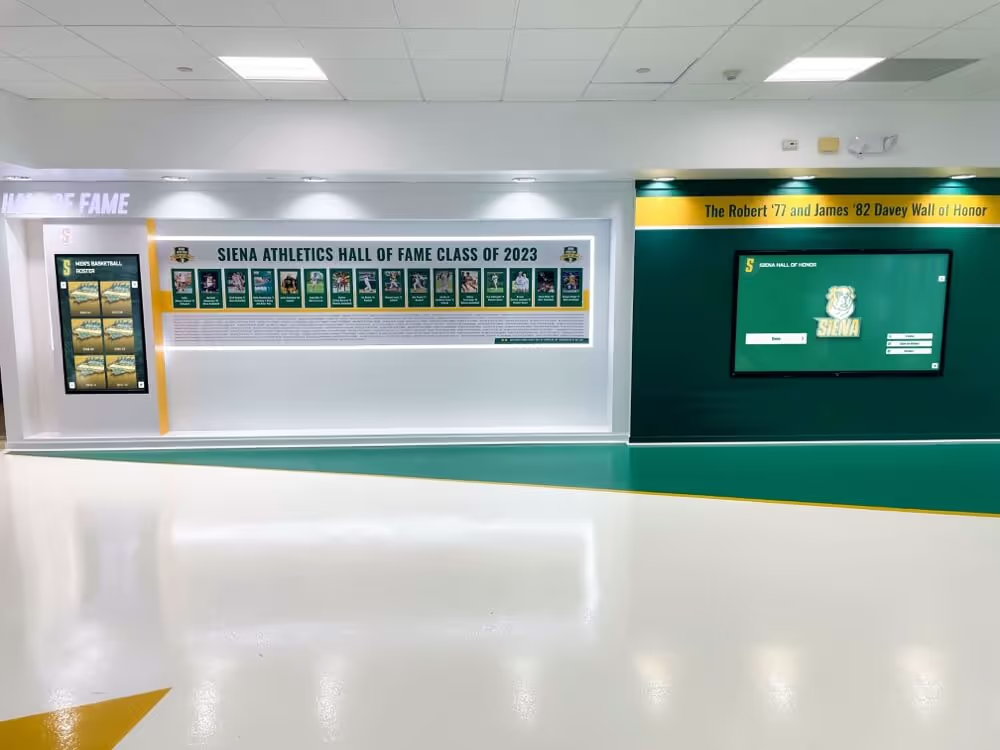
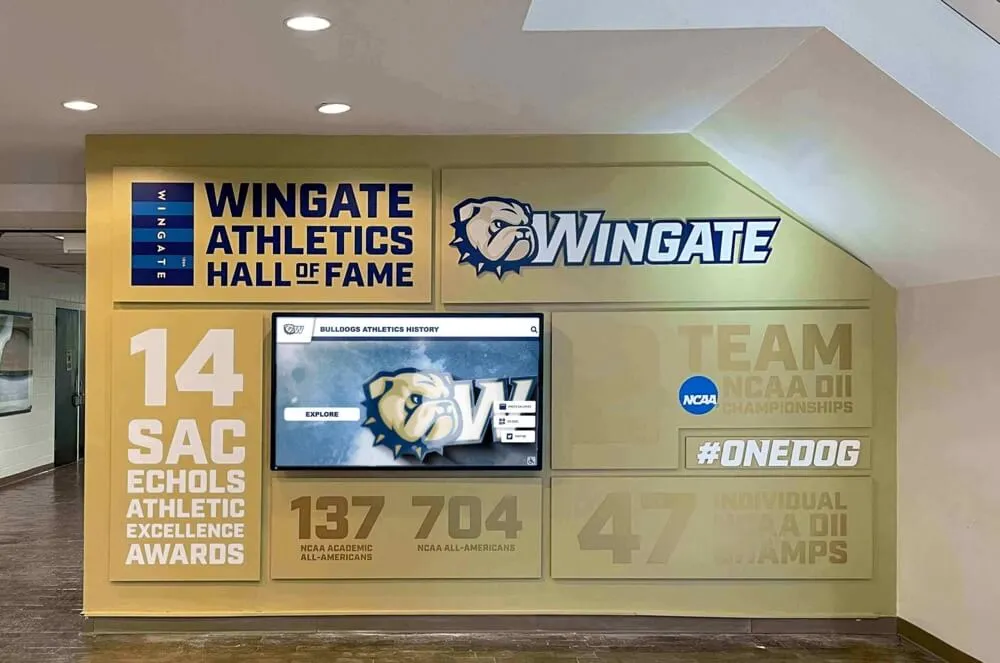
The most effective implementations use the touchscreen as a complement to physical artifacts, not a replacement for them. The trophy stays in the case. The banner stays on the wall. The touchscreen sits nearby, clearly positioned as the place to go for more. QR codes on individual trophies or plaques can link directly to the corresponding digital content on the touchscreen, bridging the physical and digital layers.
TV and touchscreen solutions for athletic information at high schools outline the practical installation and content management considerations for schools adding this layer for the first time.
Content That Makes Touchscreen Panels Worth Using
The touchscreen’s value depends entirely on the content loaded into it. A panel showing only what’s already on the plaques next to it provides little additional value. The content that makes these systems genuinely engaging includes:
- Full tournament brackets with game-by-game scores
- Team photographs from every championship season
- Individual player profiles with career statistics
- Coach biography and career record
- Video highlights where footage exists (even short clips significantly increase engagement)
- Links to newspaper coverage or historical documentation
- Post-graduation accomplishments of championship team members
Schools planning a touchscreen implementation should budget for content development alongside the hardware and software. The panel is the platform; the content is what makes it worth stopping at.
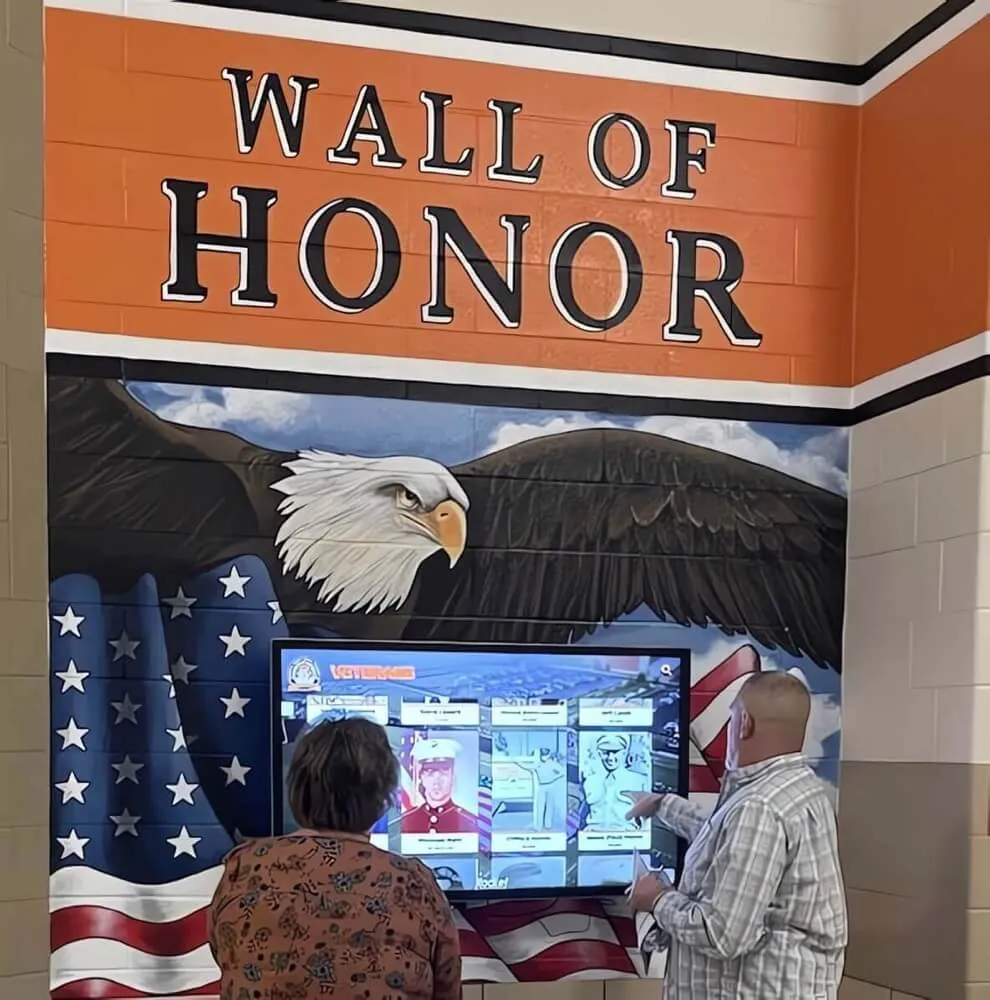
Location Strategy: Where Each Element Belongs
A championship recognition environment works best when each element is positioned strategically rather than consolidated into a single display zone.
Primary Athletic Lobby
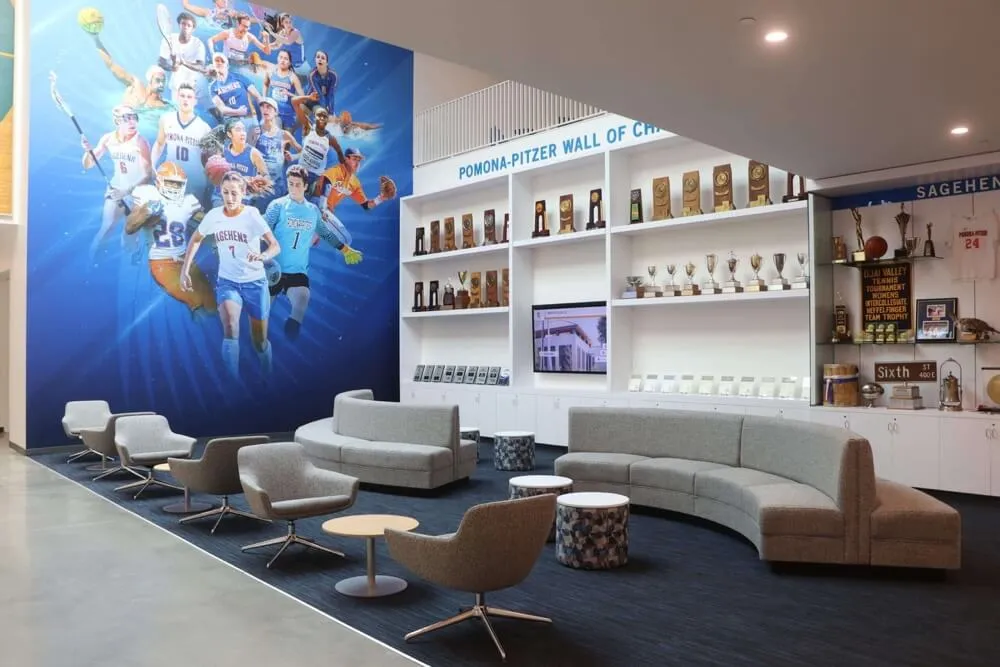
The main lobby of the gymnasium or athletics building is the correct location for the school’s signature championship display — typically the most significant trophies, the sport-organized championship plaque wall, and the touchscreen story panel. This is the highest-visibility space in the building, seen by all visitors, including prospective families on tours and community members attending games.
School lobby digital signage addresses the broader design question of how digital display infrastructure fits into athletic lobby environments alongside physical recognition elements.
Gymnasium Rafters and Competition Space
Championship banners for significant titles belong in the rafters, visible during competition. This is as much about ritual as it is about display — teams competing under their program’s championship history carry that history into every game. The rafter installation is a different function than the lobby display; it’s environmental and atmospheric rather than informational.
Athletic Wing Hallways and Locker Room Corridors
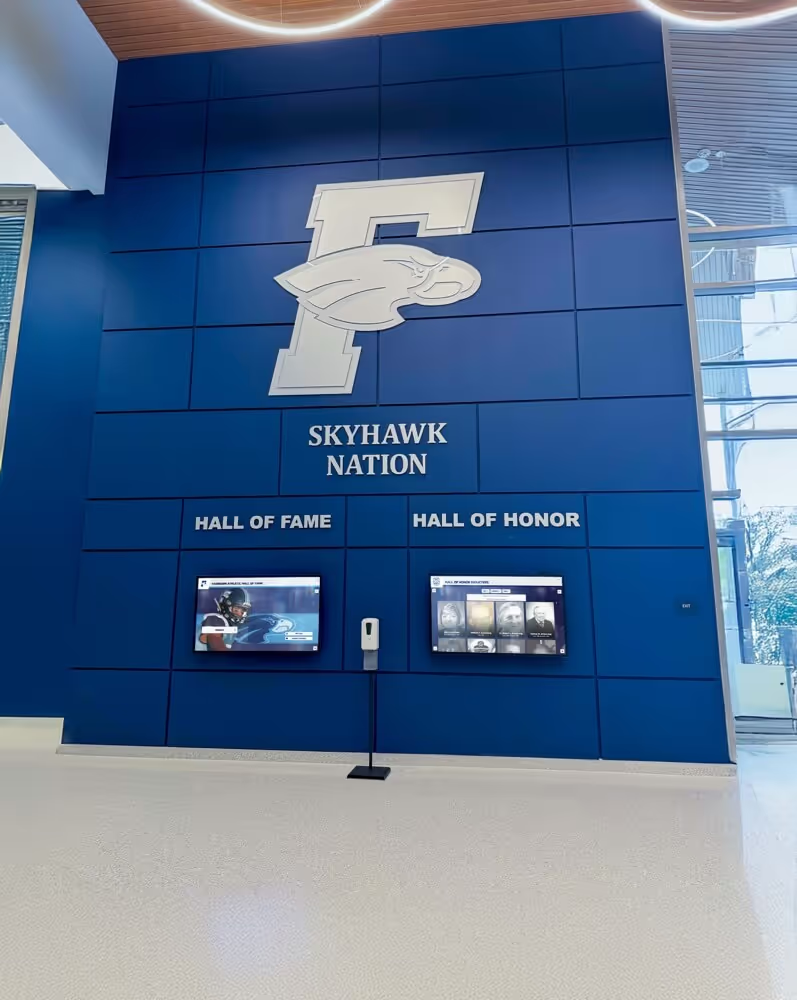
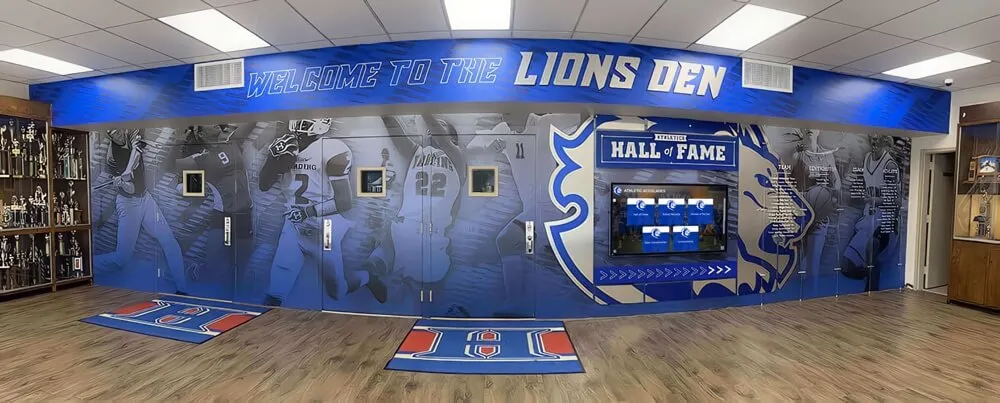
Retired jerseys, sport-specific championship plaques, and individual award recognition belong in the spaces where the relevant athletes spend their time. A wrestling team that passes their sport’s hall of honor on the way to every practice carries that recognition differently than athletes who only see it on game nights.
Touchscreen displays in high school gym lobbies and trophy areas offers practical guidance on how schools have integrated digital and physical recognition in these transition spaces.
Multi-Sport Coordination
Schools with robust recognition programs across many sports benefit from establishing consistent visual standards — matching frame styles, consistent plaque dimensions, coordinated color schemes — so that the display system reads as intentional rather than accumulated. When each sport’s recognition was installed by a different booster organization at a different time, the cumulative effect can read as chaotic even when individual elements are high quality.
Budget Strategies and Phased Implementation
Comprehensive championship recognition doesn’t require a single large budget commitment. Most schools build these environments incrementally, prioritizing the highest-visibility elements first and expanding over time.
Sequence of Investment
The most common successful sequencing:
Phase 1 — Upgrade the primary trophy case presentation. Better lighting, improved labeling, and background materials that stop the hardware from looking anonymous. Cost: $500–$2,500 depending on case condition.
Phase 2 — Professional championship banner installation. Custom-printed banners with consistent branding, properly mounted at appropriate heights. Cost: $200–$600 per banner, depending on size and materials.
Phase 3 — Championship plaque wall for the main lobby. A unified wall treatment covering the school’s complete championship history across all sports. Cost: $3,000–$12,000 depending on scope and materials.
Phase 4 — Touchscreen story panel. A 55-inch commercial touchscreen with content management software, mounted near the primary championship display. Cost: $8,000–$20,000 including installation and content development.
Phase 5 — Retired jersey program with proper framing standards, retired number plaques in sport-specific locations, and continued content expansion on the touchscreen.
Youth sports awards ideas provide a broader framework for thinking about tiered recognition that applies to high school championship recognition programs as well.
Funding Sources
Athletic booster organizations frequently fund physical display upgrades — banners, cases, and plaque walls fall cleanly within their mission. Technology-oriented upgrades (touchscreen panels, digital signage) sometimes require different funding pathways: capital improvement budgets, facility renovation allocations, or targeted alumni giving campaigns that connect donors to specific recognition investments.
Schools successfully funding touchscreen implementations often frame the ask around access and engagement rather than technology: “We want every family who ever cheered for a team in this gym to be able to find that team’s championship history and see their player’s name.” That framing resonates with donors in a way that “we need a 55-inch commercial display” does not.
High school awards ceremony ideas include approaches for using recognition events to build both community engagement and donor support for recognition infrastructure.
Maintaining Championship Recognition Over Time
The most common failure mode for championship recognition programs isn’t the initial installation — it’s the failure to update consistently. A touchscreen panel that still shows a 2022 championship as the “most recent title” in 2026 teaches visitors to distrust the entire display. Banners from a 2020 championship that were never hung communicate that the school doesn’t actually take this seriously.
Maintenance requires process as much as budget. Assign a specific person the responsibility for updating championship recognition after each season. Create a checklist that covers every element: does the trophy case include the new hardware? Has the banner been ordered? Has the plaque wall been updated? Has the touchscreen content been added? Have the photographs from the season been uploaded?
Cloud-based content management systems for touchscreen panels reduce the technical barrier for updates significantly — a non-technical staff member can add a championship season’s worth of photographs and statistics through a browser interface in an hour. This ease of update is a significant factor in choosing display platforms; systems requiring specialized technical skills to update will inevitably fall behind.
New school building touchscreen display timing and installation addresses the planning question for schools building or renovating facilities, including how to ensure infrastructure supports recognition needs from the start rather than requiring retrofitting later.
What Separates Good Championship Recognition from Great
The difference between a good championship recognition program and a great one usually comes down to whether the display tells a story or just lists achievements.
A list of championships — sport, year, record — serves a counting function. It establishes credibility and demonstrates program success over time. But it doesn’t do what the best recognition environments do, which is create an emotional connection between the people walking through the space and the athletic tradition they’re encountering.
Story-driven championship recognition includes individual narratives: the player who holds the record, the coach who built the dynasty, the season that seemed lost before a late-season run. It includes context: what made this championship especially meaningful, what the path through the tournament looked like, who was in the locker room when it became real. It includes human detail that makes achievements feel like achievements rather than entries in a database.
Physical artifacts — trophies, rings, retired jerseys — carry this kind of weight when displayed with care. Touchscreen story panels extend that weight into complete narratives. Together, they build the kind of recognition environment where current athletes feel the history of what they’re part of, and where alumni feel genuinely honored rather than perfunctorily listed.
Understanding how notable alumni recognition and touchscreen systems work together offers an example of how these principles apply beyond championship displays to broader athletic and alumni recognition programs.
Getting Started
If you’re looking at your current championship display and recognizing the gap between what it is and what it could be, the practical first step is a display audit: inventory every championship your school has won, then map each one to its current representation in your physical space. How many are documented in the trophy case? How many have banners hung? How many have plaques? How many have no physical recognition at all?
That gap — championships won but not visibly honored — tells you where to start. In most schools, addressing it requires less budget than expected and more process than infrastructure. The trophies and hardware already exist. The story already happened. The display just needs to catch up.
When you’re ready to move beyond physical-only recognition and explore what a touchscreen story panel could add to your championship display environment, Rocket Alumni Solutions provides purpose-built platforms for exactly this application — designed for high school and collegiate athletic programs that want to pair their physical championship recognition with the digital storytelling layer that lets each achievement speak fully.