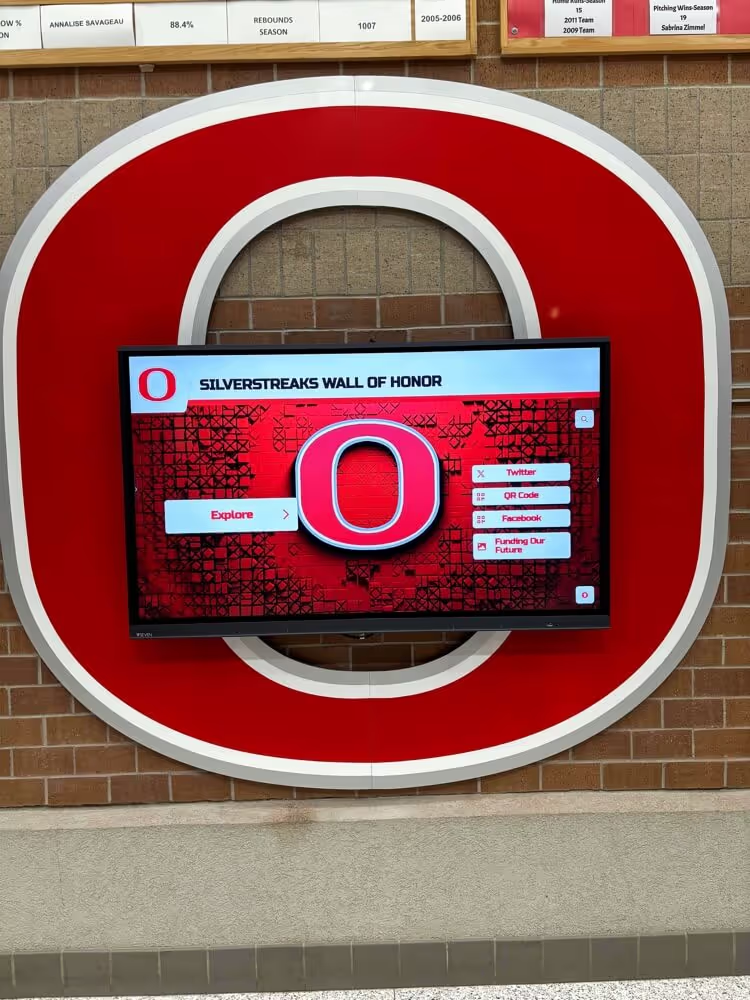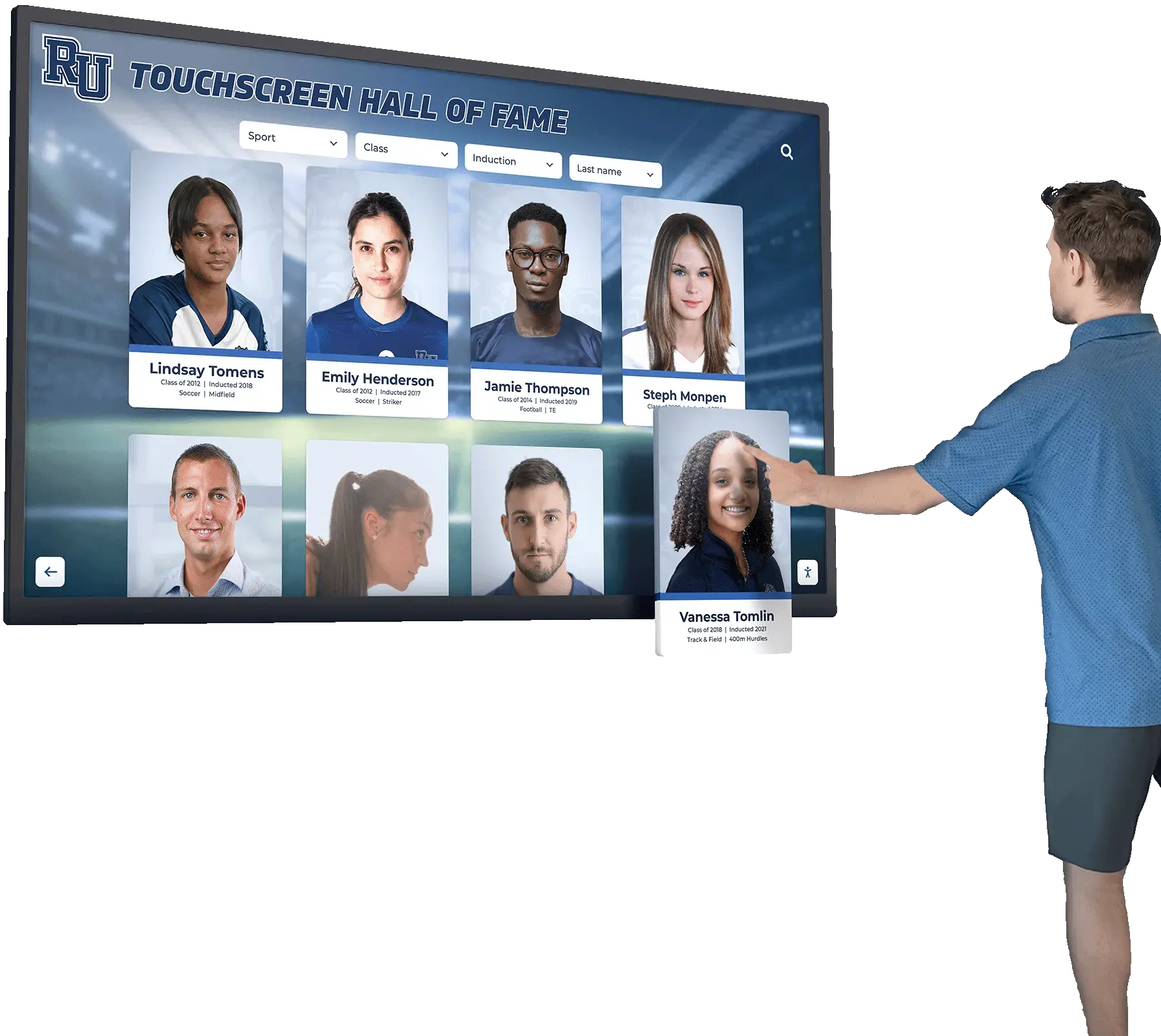
A school athletic department creates a digital hall of fame page for a 1998 state championship team. The athletic director shares the link in the alumni newsletter. Over the next three years, the school redesigns its website twice and migrates to a new content management system. Every inbound link from that newsletter, from social media posts, and from the local newspaper’s online archive now resolves to a 404 error. The team page still exists — it just lives at a different URL with no redirect connecting the old address to the new one.
This is the problem persistent identifiers solve. A persistent identifier is a record label — a stable slug, numeric ID, or structured URL pattern — assigned to an entity at the time it is created and protected across system changes. When athlete profiles, team records, award pages, and artifact entries carry identifiers that survive migrations and redesigns, every external link, printed QR code, and cross-reference within the archive continues to work.
What this athletic archive persistent identifier guide covers:
This guide addresses how school administrators, athletic directors, and archives staff can design and maintain stable identifier systems for four core entity types in a school athletic archive:
- Athlete profiles — inductee pages, player records, and recognition entries for individual athletes
- Team records — season pages, championship documentation, and roster archives by year and sport
- Awards and honors — hall of fame classes, conference honors, record-book entries, and postseason awards
- Artifacts and media — physical memorabilia records, digitized photographs, game footage references, and document scans
Each section explains what a stable identifier looks like for that entity type, why common naming choices create fragility, and what a durable alternative looks like in practice.
This guide applies whether your school manages athletic records in a dedicated recognition platform, a general-purpose content management system, or a simple file-based archive. The principles are system-agnostic; the implementation details vary by platform.
Why Athletic Archive Links Break — and Why It Matters
School athletic websites are among the least stable publishing environments in institutional web management. Athletic departments typically operate with limited technical staff, change web platforms with school-wide IT migrations, and rarely have the resources to implement systematic redirects when URLs change. The result is a predictable cycle: recognition content is published with one URL structure, a platform change assigns new URLs, and the old addresses are abandoned without forwarding rules.
The downstream effects extend beyond broken links. A coach who includes an inductee’s hall of fame page in a retirement tribute cannot guarantee that link will still resolve when the tribute is reprinted five years later. A booster club donor whose named award has a stable recognition page can share that URL confidently; if the URL changes silently, so does the visibility of the recognition. Schools that use QR codes on physical trophy cases or wall displays to connect visitors to online records create a particularly visible failure mode: a QR code printed on vinyl or engraved into a plaque cannot be updated after installation.
Persistent identifiers treat each record as a permanent entity that happens to be displayed through a current interface — rather than a page whose address is determined by whatever platform is running today. The distinction matters most at the moments when systems change, which in school environments happen regularly and often without advance notice to the staff managing recognition content.
For schools evaluating how digital and physical recognition systems interact, the comparison of digital hall of fame displays versus traditional trophy cases is useful context: digital systems offer searchability and remote access, but only if the underlying records are stable enough to link to reliably.
Core Principles of a Persistent Identifier System
Before addressing specific entity types, three design principles apply across any athletic archive identifier scheme.
Identifiers must be independent of display content. A URL that includes an athlete’s name (/hall-of-fame/jennifer-walsh-basketball) will break if the name is corrected, the sport category is reorganized, or the display template changes. An identifier built around a stable, assigned code (/athletes/2003-bball-f-walsh-j or /athletes/a-00437) survives those surface changes because it does not reflect the content — it merely labels the record.
Identifiers must be documented outside the publishing platform. If a school’s only record of its identifier scheme lives inside the platform that assigns them, a migration can destroy the mapping. Maintaining a parallel identifier registry — even a simple spreadsheet with columns for entity type, identifier, record name, and creation date — ensures the scheme survives platform changes.
Redirects must be treated as mandatory, not optional, at migration time. When a school moves from one system to another, every old URL should be mapped to its new equivalent and a redirect should be implemented before the old system is taken offline. This step is frequently skipped because it is invisible to the user during a migration — until external links begin failing.
Identifier Types and Their Appropriate Uses
Different identifier formats serve different purposes in a school athletic archive. The table below summarizes the common options and their appropriate applications.
| Identifier Type | Example | Best For | Fragility Risk |
|---|---|---|---|
| Human-readable slug | athletes/chen-marcus-swimming-2011 | Athlete profiles where human readability is valued | High — breaks on name corrections, sport reclassification |
| Year-sport-class code | teams/2019-girls-soccer | Team season records | Medium — stable if sport names and year format stay consistent |
| Sequential numeric ID | athletes/id/4402 | Any entity type; easiest to protect | Low — no dependency on content changes |
| UUID | awards/a3f9c1b2-... | High-volume or federated archives needing global uniqueness | Very low — no meaningful pattern to become stale |
| Structured composite | hof/class-2018/basketball/female/reyes-a | Hall of fame class entries with multiple attributes | Medium — stable if class, sport, and gender taxonomy remain fixed |
| External registry handle | hdl:12345/athletes/4402 | Institutions using library or archival registry systems | Very low — externally maintained and resolvable |
For most school athletic programs — K-12 and community college — a sequential numeric ID combined with a human-readable slug and a 301 redirect policy provides a practical balance between readability and durability. The numeric ID serves as the canonical identifier; the slug provides human-readable URLs that can be updated via redirect when they inevitably need to change.
Athlete Profiles: Designing Stable Identifiers
An athlete profile is the most-linked entity type in a school athletic archive. Alumni share inductee pages. Coaches reference record-holder entries. Local media link to championship-season profiles. A profile that moves without a redirect erases that accumulated link value and breaks every reference in external systems.
Common identifier mistakes for athlete profiles
Using the athlete’s name directly in the path without a stable backing ID. Names change through marriage, legal corrections, and preferred-name updates. A URL built entirely on a name has no stable anchor.
Using graduation year as the primary identifier without a sport or role qualifier. A school may have multiple athletes from the same graduation year, and year-only identifiers create collision problems in larger programs.
Using jersey numbers. Numbers are reissued. A URL built on jersey number 24 becomes ambiguous when two athletes across different eras wore that number.
A durable athlete identifier structure
A practical identifier scheme for athlete profiles combines three elements:
- An internal sequential ID assigned at the time the record is created and never changed (
athlete_id: 4402) - A display slug derived from the athlete’s name and primary sport, used in the public URL (
athletes/reyes-anita-track-field) - A redirect rule maintained in the school’s web server or platform settings that maps the internal ID to the current display slug — so that links using the internal ID always resolve to the current profile page
When an athlete’s name is corrected or a sport classification is reorganized, the display slug changes and a redirect is added from the old slug to the new one. The internal ID never changes. External links built on the internal ID continue to resolve; external links built on the old slug forward to the correct current address.
For schools managing records of athletes across programs with complex naming conventions, the workflow for athletic record correction and verification illustrates the formal process for documenting changes — a process that should trigger both a record update and a redirect entry in the identifier registry.

Team Records: Stable Identifiers for Season and Roster Archives
Team record pages document program history at a different level of granularity than individual athlete profiles. A season archive page typically includes roster data, coaching staff, season statistics, and championship outcomes. These pages are often linked from local newspaper archives, booster club newsletters, and alumni directories — and they share the same vulnerability to platform migrations as athlete profiles.
A durable team record identifier structure
Team records benefit from a composite identifier that encodes the elements that define the team uniquely:
- Academic year (using the ending year:
2019for the 2018–2019 season) - Sport (using a stable controlled vocabulary:
girls-soccer, notwomens-soccerorgsoccer— whichever the school uses, it must be consistent across all records) - Program level where applicable (
varsity,jv,freshman)
A composite key for a team record might be structured as teams/2019-girls-soccer-varsity. This identifier works because the constituent elements — year, sport, level — are fixed historical facts that do not change after the season ends. The risk of collision is low when the sport vocabulary is controlled, and the risk of staleness is low because historical records are not reclassified.
The primary maintenance obligation is consistency: ensuring that every new season’s records use the same sport vocabulary and year format as all previous seasons. A school that uses girls-basketball in records from 2010 through 2018 and then switches to womens-basketball in 2019 has created a split taxonomy that will require remediation. Documenting the controlled vocabulary in the identifier registry — alongside the record IDs — prevents this drift.
Awards and Honor Records: Identifiers That Outlast Programs
Awards present a specific identifier challenge: they are often named after people or programs that themselves change over time. An award named for a donor may be renamed after a subsequent gift. A conference honor may change its name after a conference realignment. A record-book category may be subdivided when the athletic program grows.
Award identifier principles
Award identifiers should not embed the award’s current name. An identifier like awards/johnson-family-sportsmanship-award will become inaccurate if the Johnson family award is renamed or the program is discontinued and relaunched under a different name.
Award identifiers should embed a stable classification instead. A scheme that uses the year the award was established and an assigned serial number (awards/est-1994-001) ties the identifier to a fact that does not change: when the award was created. Display names, eligibility criteria, and sponsorship arrangements can change; the founding year does not.
Individual award instances — the specific recipient in a specific year — need their own identifier layer. Separating the award definition (which is stable) from the award instance (one recipient, one year) allows schools to link to either level depending on the use case. A booster club announcement might link to the award definition page; an inductee profile might link to the specific instance record.
Recognition programs that span multiple entity types — such as those that honor students, athletes, and community contributors within the same framework — benefit from a parallel identifier scheme for each type. Schools managing honor society or academic recognition alongside athletic awards, for example, should extend the same identifier discipline to those programs. A guide to honor society induction recognition programs illustrates the breadth of recognition data that schools maintain — each of which benefits from the same stable identifier practices.
Schools that connect award records to donor recognition programs face a related challenge: donor names, fund names, and recognition arrangements change, but the award history should remain accessible. A structured identifier system that decouples award identity from current donor attribution allows award histories to remain intact through donor transitions. The considerations for donor recognition display programs address some of the parallel governance questions involved in maintaining stable recognition records for donors.
Artifact and Media Records: Identifiers for Physical and Digitized Objects
Athletic archives typically contain physical artifacts — trophies, jerseys, game programs, photographs, plaques — many of which have been partially digitized. The identifier challenge for artifacts is distinct from that of people and events: artifacts may move between storage and display, be loaned to alumni events, undergo conservation treatment, or be transferred between facilities. Their digital records need to remain stable even as the physical objects move.
A practical artifact identifier scheme
For physical artifacts and their associated digital records, a three-component identifier covers the essential tracking needs:
- Object category prefix — a short code for the artifact type (
TRPfor trophy,JRYfor jersey,PHOfor photograph,DOCfor document) - Acquisition sequence number — assigned at the time the object enters the collection, never reused
- Optional sub-record suffix — used when multiple digital files or condition records are associated with the same object (
-001,-002, etc. for multiple scans of the same document)
An artifact identifier under this scheme might be PHO-0892 for the 892nd photograph to enter the collection, with PHO-0892-001 and PHO-0892-002 identifying two different scan resolutions for the same original image.
The object record — containing provenance, condition notes, location, and digitization history — carries this identifier permanently. When the object moves from storage to display, a location field in the record is updated; the identifier does not change. When a new scan is added, a new sub-record is created with the next suffix; previous scan records are not deleted.
For schools that maintain physical display cases alongside digital archives, the practices for display case management for collectibles offer relevant context on the physical organization side — and the same artifacts that appear in a physical case should have corresponding digital records with stable identifiers that link the physical display to the archival record.

Step-by-Step: Implementing a Persistent Identifier System
The following steps provide a practical workflow for schools starting or formalizing a persistent identifier program for an athletic archive of any size.
Step 1 — Audit the current state of your identifiers. Before assigning new identifiers, document how existing records are currently addressed. List all athlete profile URLs, team record pages, award pages, and artifact catalog entries currently in use. Identify which of these addresses are derived from content (names, years, sport categories) and which are assigned numeric or coded IDs that can survive content changes.
Step 2 — Choose an identifier format for each entity type. Select the identifier structure appropriate to your program’s scale and technical environment. For most K-12 programs, a sequential numeric ID backed by a human-readable slug is sufficient for athlete profiles and awards; a structured composite identifier works for team seasons; and an object-category prefix with a sequence number works for artifacts. Document the chosen format in writing before assigning any new identifiers.
Step 3 — Create an identifier registry. Build a simple spreadsheet or database table with one row per entity and columns for: entity type, assigned identifier, current display URL, record name, creation date, and notes. This registry is the canonical source of truth for the identifier scheme — it must be maintained outside the publishing platform, since it needs to survive platform migrations.
Step 4 — Assign identifiers to all existing records. Work through the audit list from Step 1 and assign an identifier to each record that does not already have one. For records with existing numeric IDs from a current CMS, use those IDs as the assigned identifier if they are stable. For records identified only by name-based slugs, assign a new numeric or coded ID and note the current slug in the registry.
Step 5 — Implement redirect rules for all current URLs. For every existing URL, ensure that a redirect exists from the old address to the current one if the address has ever changed. For URLs that are current and correct, document them in the registry so that future migrations know which addresses to preserve or redirect.
Step 6 — Test QR codes and external links before publishing changes. If your school uses QR codes on physical displays, trophy cases, or printed materials, test each code after any URL change to confirm it still resolves. A broken QR code on a mounted plaque is not correctable without physical replacement; the only prevention is verifying resolution before the code is printed or installed.
Step 7 — Establish a migration policy. Write a one-page policy specifying that any future platform change must include a redirect mapping step before the old platform is retired. Assign responsibility for maintaining the identifier registry to a specific role — not a specific person — so the obligation survives staff transitions.
For schools that use touchscreen kiosk systems to display athletic recognition content, the identifier scheme needs to extend to the kiosk software’s internal record structure as well. A review of touchscreen kiosk software options for schools can help identify platforms that support stable internal record IDs — a feature to evaluate explicitly when selecting or migrating kiosk systems.
Connecting Identifiers Across Physical and Digital Systems
An athletic archive rarely lives in a single system. A school might maintain athlete profiles in a web-based recognition platform, artifact records in a spreadsheet, physical objects in trophy cases and storage rooms, and award histories in an athletic department database. Persistent identifiers provide the connective tissue across these systems — but only if the identifier scheme is consistent.
A practical cross-system connection approach uses the identifier registry as the linking mechanism. When an artifact’s physical record (PHO-0892) is digitized and the scan is loaded into the recognition platform, the platform’s internal record ID is added to the registry row for PHO-0892. When the digitized image appears on an athlete’s profile page, the athlete’s identifier (athlete_id: 4402) is added to the artifact record as a related-entity reference. The result is a network of cross-references that allows any record to be located from any other connected record, regardless of which system holds the primary data.
This cross-system coherence is particularly valuable when schools update donor recognition programs, since donor names and award fund designations often appear across athlete profiles, award records, and physical plaques simultaneously. A change to a donor’s recognition arrangement that is made in one system without updating the others creates data inconsistency that persists until it is discovered and corrected. A donor impact report framework for schools addresses the governance of donor recognition data — a parallel concern to the identifier consistency problem, and one that benefits from the same cross-system documentation discipline.
Maintaining the Identifier System Over Time
A persistent identifier system requires ongoing maintenance to remain useful. The following practices keep the system functional as the archive grows and staff changes.
Run an annual registry audit. Once per year, test a sample of URLs from the registry against the current website to confirm they resolve correctly. Flag any broken links and implement redirects or record corrections.
Update the registry at every platform migration. Designate the registry review as a required step in any web platform migration project, with a sign-off from the person responsible for the athletic archive before the migration is considered complete.
Train incoming staff on the identifier system. The identifier registry and its maintenance procedures should be documented in the athletic department’s operational reference materials and included in onboarding for new administrative staff. An identifier system that only one person understands is a system that will fail when that person leaves.
Separate display content from identifier assignment. Remind staff that changing how a record looks — updating a profile photograph, correcting a statistics entry, adding a new award — does not require changing the record’s identifier. The identifier is assigned once and never changed; it does not reflect current display content.

See How Schools Build Recognition Archives That Last
Rocket Alumni Solutions builds interactive digital halls of fame that give each athlete profile, team record, and award a stable, searchable home. Schools use Rocket-powered platforms to make decades of athletic recognition consistently accessible to alumni, current students, and visitors — without losing records to platform migrations or redesigns.
Schedule a Free DemoFrequently Asked Questions
What is a persistent identifier in the context of a school athletic archive?
A persistent identifier is a stable label — a numeric ID, a structured code, or a protected URL slug — assigned to an athletic archive record at the time it is created and maintained unchanged through platform migrations, content updates, and website redesigns. For athlete profiles, team records, award pages, and artifact entries, a persistent identifier ensures that links, QR codes, and cross-references continue to resolve to the correct record regardless of what changes in the underlying publishing system.
Why do athletic archive links break so often in school environments?
School websites change platforms more frequently than most institutional sites, often without dedicated technical resources to implement redirect rules. When a school migrates from one content management system to another, URLs typically change because the new platform assigns different path structures. Without a redirect mapping step — which requires advance planning and is frequently skipped in time-constrained migrations — every previously published link stops resolving. Athletic department pages are particularly vulnerable because they are often managed outside the central IT team and may not be included in migration planning until after the new system is already live.
What is the minimum viable persistent identifier system for a small school?
For a small athletic program with limited technical staff, a spreadsheet-based identifier registry combined with a slug protection commitment covers the essential need. The registry tracks each record’s entity type, assigned ID, current URL, and record name. The slug protection commitment means that when a platform migration occurs, the person responsible for the athletic archive confirms that all current URLs either remain the same in the new system or have redirect rules mapping old addresses to new ones before the old system is retired. No specialized software is required; consistent procedure is the critical element.
How do QR codes interact with persistent identifiers for athletic displays?
A QR code printed on a physical display encodes a specific URL at the time of printing. If that URL changes after the code is installed — because a platform migrated, a slug was corrected, or a page was reorganized — the QR code resolves to a 404 error or an unrelated page. The only reliable protection is ensuring that the URL encoded in a QR code intended for permanent physical installation is either a persistent identifier URL that will never change, or a short redirect URL (often called a vanity URL) that the school controls independently of the publishing platform. For trophy cases, mounted plaques, and permanent recognition walls, the URL encoded in a QR code should be treated as a permanent commitment requiring the same protection as any other persistent identifier.
Should athlete identifiers include personally identifiable information?
Athlete identifiers used in URL structures that are publicly accessible should be treated with the same privacy considerations as any other published personal data. Names in URLs are publicly indexed by search engines. For current students or recently graduated athletes, schools should confirm that public profile pages and their identifiers are consistent with the school’s privacy policies and applicable regulations. For historical records of alumni who have graduated, standard privacy considerations for public athletic recognition apply. Schools should consult their legal or compliance staff if they are uncertain about the appropriate scope of public-facing athlete record identifiers.
How do persistent identifiers help when a school changes athletic department software?
When a school migrates from one athletic software platform to another — from a legacy recognition system to a modern digital hall of fame platform, for example — a persistent identifier system provides the mapping that allows the migration to preserve continuity. The identifier registry documents every record’s current URL and internal ID; the migration team uses that registry to create redirect rules in the new system before the old one is retired. Without the registry, migration teams must reconstruct the mapping from incomplete platform data or accept that old links will fail. With the registry, the migration produces a complete redirect table that can be implemented immediately, keeping all external links functional throughout the transition.
What is the relationship between persistent identifiers and athletic record corrections?
Record corrections — updating a statistical entry, correcting a name spelling, revising an award date — do not require changing a record’s identifier. The identifier is a stable label attached to the record as an entity; the content of the record can change without affecting the identifier. The practical consequence is that when a correction is made, the URL and internal ID for the record remain the same, and any external links continue to resolve to the corrected record automatically. This is one of the primary operational benefits of separating identifier assignment from content: corrections become internal data updates rather than publishing events that break external references.
How should schools document their identifier scheme for staff transitions?
The identifier scheme documentation should cover four items: the format used for each entity type (athlete, team, award, artifact), the location of the identifier registry, the procedure for assigning new identifiers to new records, and the redirect policy that applies at every platform migration. This documentation should be stored in a location that is independent of the athletic department’s current publishing platform — a shared drive, a policy binder, or an institutional knowledge base — and should be included in the onboarding materials for any role with responsibility for athletic archive management.