When a school athletic archive lists a 1987 state champion as “Michael T. Johnson,” a 1992 donor wall credits “Mike Johnson,” and a 2005 hall-of-fame induction program names the same person “M. Johnson,” the institution has not honored one person three times — it has fragmented one person’s recognition into three unconnected entries that no search will reliably link. Authority control is the library-derived practice that prevents this outcome. It assigns each person, organization, or named entity a single preferred form of name and records the variant forms that refer to the same entity — so every record pointing to Mike Johnson, Michael T. Johnson, and M. Johnson resolves to the same recognition profile.
This guide explains how school athletic programs can apply name authority control principles to athlete profiles, coach records, and team labels. It covers the most common sources of naming inconsistency in athletic archives, provides a step-by-step normalization process, and includes practical tables for reference.
What this athletic archive name authority control guide covers:
Name authority control in athletic archives addresses four recurring problem areas:
- Athlete names — legal name variants, nicknames, name changes through marriage or legal process, and initial-versus-full-name variation across decades of records
- Coach names — title changes, credential abbreviations, preferred-name updates, and coaching staff role labels that shift between record systems
- Team and program names — sport name changes, gender-qualifier updates, conference reclassifications, and mascot or school name changes that affect how teams are labeled across different eras
- Award and record-book names — recognition categories that have been renamed, combined, or restructured over time, making it unclear whether two entries refer to the same award
None of these problems requires specialized archival software to address. A school with a spreadsheet and a consistent written policy can implement functional name authority control that meaningfully reduces duplicate profiles, broken cross-references, and recognition gaps.
Why Athletic Archives Accumulate Name Inconsistencies
School athletic records are created across many departments, over many decades, by many different staff members who have no reason to coordinate naming conventions. A year-end athletic report uses formal names from enrollment records. A game program uses nicknames chosen by the athletes themselves. A newspaper archive uses whatever name the reporter used. A hall-of-fame nomination form uses whatever the nominator recalls. A booster club donor recognition plaque uses the name the donor provided.
Each of these sources reflects a legitimate naming choice at the time. None of them is wrong in isolation. The problem emerges when a recognition program tries to aggregate those records into unified athlete profiles, team histories, or coaching career entries — and finds that the same person or team appears under different names across different source documents.

The four most common causes of athletic archive name inconsistencies are:
Nickname and formal name variation. An athlete whose legal name is Elizabeth Anne Reyes may appear in game programs as “Liz Reyes,” in academic records as “Elizabeth A. Reyes,” in a newspaper recap as “Beth Reyes,” and in a hall-of-fame nomination as “Elizabeth Reyes.” These are four valid references to one person that will not automatically link in any database or recognition system.
Name changes over time. Marriage name changes, legal name corrections, and preferred-name updates create records under multiple surnames for the same individual. Athletic archives that span decades frequently hold records under both a maiden name and a married name for the same athlete, with no cross-reference connecting them.
Inconsistent initial use. Records from different decades apply inconsistent conventions for middle initials. One era’s practice of including middle initials (“James R. Carter”) creates mismatches with later records that omit them (“James Carter”) or use full middle names (“James Robert Carter”).
Team and sport label changes. A program listed as “Girls’ Basketball” in 1985 records may appear as “Women’s Basketball” in 1998 records, “Girls Basketball” (without the apostrophe) in 2006 records, and “JV Girls Basketball” versus “Varsity Girls Basketball” as a separate distinction in another era’s records. Without an authority file for team names, each variant functions as a separate entity in any system that relies on string matching.
Step-by-Step Name Authority Control Process
The following process can be implemented by a single staff member with access to existing athletic records. It does not require archival credentials or specialized software, though dedicated recognition platforms make several steps easier to maintain over time.
Step 1: Audit Existing Name Variants Before Building the Authority File
Before deciding on preferred forms, collect the variant names that actually appear in your records. This audit should cover every data source the program uses: physical trophy labels, hall-of-fame program books, sports record books, newspaper archives in the school library, yearbooks, athletic department filing systems, and any digital platforms.
For each person or team, create a list of every form of the name encountered across sources. This list becomes the input for the authority file — the document that maps every variant to a single preferred form.
A practical audit table for athlete names looks like this:
| Preferred Form (Authority Entry) | Variant Forms Found in Records | Sources Where Variants Appear | Notes |
|---|---|---|---|
| Reyes, Elizabeth A. | Liz Reyes; Beth Reyes; Elizabeth Reyes; E. Reyes | Game programs (1994–1996); newspaper archives (1995); hall-of-fame nomination (2018); trophy label (1996) | Prefers "Liz" informally; legal name confirmed from graduation records |
| Carter, James R. | James Carter; Jim Carter; James Robert Carter; J.R. Carter | Record book (1988); yearbook (1989); booster newsletter (1991); induction program (2010) | Middle initial from enrollment records; "Jim" is preferred informal form |
| Washington, Marcus D. | Marcus Washington; M. Washington; Marcus D. Washington | Athletic report (2003); newspaper (2003–2004); alumni directory (2012) | No name change; initial inconsistency only |
Step 2: Establish Preferred Form Rules
A name authority file is only consistent if the rules for choosing a preferred form are applied uniformly. The following rules apply across most school athletic archive contexts:
For athlete names:
- Use the legal surname at the time of competition as the primary entry point, with later name changes cross-referenced rather than used as the primary form
- Include first name in full (not initials) where documented
- Include middle initial only if it was consistently used in official records from the competition period
- Append the sport and graduation year as a disambiguator when two athletes share the same name:
Johnson, Michael R. (Basketball, 1994)
For coach names:
- Use the name under which the coach is most consistently identified in institutional records from the period of coaching service
- Include title (Coach, Head Coach, Assistant Coach) as a role field separate from the name, not embedded in the authority entry
- Cross-reference maiden names and name changes with a note indicating the period each name was in use
For team labels:
- Use a standardized sport name that applies consistently regardless of era-specific variation
- Separate gender qualifier, level (varsity/junior varsity/club), and year as structured fields rather than embedding them in the team name string
- Document era-specific name variants in a separate notes field
Step 3: Build the Authority File
The authority file is the reference document the program uses to assign consistent labels across all records. At minimum, it should be a structured table with the following columns:
| Authority ID | Entity Type | Preferred Form | Variant Forms | Active Period | Disambiguator | Cross-References |
|---|---|---|---|---|---|---|
| ATH-00441 | Athlete | Reyes, Elizabeth A. | Liz Reyes; Beth Reyes; Elizabeth Reyes; E. Reyes | 1993–1996 | Soccer, Class of 1996 | — |
| COACH-00089 | Coach | Patterson, Sandra K. | Sandy Patterson; S. Patterson; Sandra Patterson-Hughes (post-2001) | 1988–2007 | Head Coach, Women's Soccer | See also: Patterson-Hughes, Sandra K. (post-2001 records) |
| TEAM-00017 | Team | Girls Basketball — Varsity | Girls' Basketball; Women's Basketball; Lady Panthers Basketball | 1972–present | — | Variant "Women's Basketball" used in records 1998–2006 |
| ATH-00512 | Athlete | Thompson, David L. | Dave Thompson; D. Thompson; David Thompson | 2001–2004 | Football, Class of 2004 | — |
The Authority ID connects every record in every other system to a single source of truth. When a new hall-of-fame induction program is printed, each inductee’s name is pulled from the preferred form in the authority file rather than transcribed fresh from a nomination form. When a digital display is updated with a new athlete profile, the display system references the authority ID — and any future name corrections update every display using that ID automatically.

Step 4: Apply the Authority File to Existing Records
Once the authority file exists, the program must work backward through existing records to replace inconsistent variant forms with authority-controlled preferred forms — or, where the original documents cannot be changed, to add cross-reference notes that connect the variant to the preferred form.
This retrospective normalization should proceed entity-by-entity rather than document-by-document. Choose one athlete’s complete record across all systems before moving to the next, rather than normalizing one yearbook at a time. This approach surfaces inconsistencies more efficiently and ensures that the authority file is tested against real records as each entry is applied.
For digital recognition platforms, this step is often a data update — replacing the variant name string with the preferred form in every record that references that entity. For physical records (trophy labels, mounted plaques, printed programs), the appropriate response is documentation in the authority file rather than physical alteration: the physical record stays as created, and the authority file notes that this variant form refers to the preferred entry.
Step 5: Establish a Naming Intake Procedure for New Records
Name authority control fails if the authority file is applied only to historical records and ignored for incoming material. Every new record created by the program — a new inductee profile, a new season record, a new award entry — should be checked against the authority file before the name is finalized.
For many school programs, this intake procedure is a single step added to an existing workflow: before entering a name into the hall-of-fame database or recognition display, check whether an authority entry already exists. If it does, use the preferred form. If it does not, create a new entry following the established rules before entering the name.
A brief intake checklist for new records:
- Search the authority file for the person’s or team’s name using multiple search terms (nickname, surname only, maiden name if applicable)
- If a matching entry exists, use the preferred form from that entry exactly as written
- If no matching entry exists, create a new authority entry before adding the record — do not add the record using an uncontrolled name form
- Document any new variant forms encountered in the source material in the authority file’s variant field
- Note any disambiguating information needed to distinguish this entry from similar names
Programs that use interactive touchscreen recognition systems or digital hall-of-fame platforms benefit from building authority control directly into their content management workflow — so that name lookups against the authority file happen at the point of data entry rather than as a separate review step. Schools exploring digital recognition options may find the discussion of basketball scoreboard features and digital display capabilities for school athletic programs useful for understanding how integrated digital systems can support consistent data entry alongside display functions.
Handling Specific Name Authority Challenges in Athletic Archives
Married Name Changes and Legal Name Updates
Married name changes are the most frequent name change scenario in athletic archives. A female athlete who competed under her maiden name in 1991 may appear in alumni directories, donation records, and hall-of-fame nomination materials under her married name decades later. Without a cross-reference connecting the two names, the program has no way to recognize that the nominated alumni is the same person as the record-book holder.
The recommended authority file approach: maintain the competition-era name as the preferred form for the athletic record, and create a cross-reference entry for the post-change name that points to the athletic record. The authority entry for the person’s athletic achievements does not change; the cross-reference ensures that anyone searching under the later name reaches the correct record.
This approach also applies to legal name corrections — situations where an athlete’s name was recorded incorrectly in original documents and a correction is needed. The correction should update the preferred form in the authority file and be noted with a correction date, so the record accurately reflects the name while the change history is preserved.
Coaches Who Served in Multiple Roles
A coach who served as an assistant coach from 1985 to 1992 and then as head coach from 1993 to 2008 should have a single authority entry covering the full career, with the role history documented as a structured field rather than reflected in the name itself. Records from the assistant coaching period that identify the person as “Assistant Coach [Name]” and records from the head coaching period that use “Head Coach [Name]” should both be linked to the same authority entry.
This matters because coaching recognition — whether in a hall of fame, a booster acknowledgment, or a digital recognition display — typically honors the full career rather than a single role. An authority file that separates roles into separate entries creates the same fragmentation problem that separate name entries create for athletes.
For programs building out coaching recognition alongside athlete profiles, exploring modern approaches to alumni and coach spotlight displays offers useful context on how role history and career narratives can be organized within recognition displays.
Team Names Across School Name and Mascot Changes
When a school changes its name, its mascot, or its athletic conference affiliation, team records from before and after the change refer to teams that share institutional identity but appear under different labels. A records book that lists “Westfield Eagles — State Champions 1978” and a later display that identifies the same program as “Westfield Falcons — Conference Champions 2019” (after a mascot change) will not be linked by any system that depends on string matching.
The authority file solution: create a single team authority entry for each sport and gender combination, documenting the name variants used in each era as variant forms rather than as separate entries. The preferred form for the authority entry can be the current name with era-specific variants documented in the notes field.
| Scenario | Authority File Approach | Variant Documentation |
|---|---|---|
| School name change (e.g., district consolidation) | Use current school name in preferred form; document former school name as predecessor institution in notes | List former school name with years active; note which records belong to the predecessor program |
| Mascot change | Use current mascot in preferred form for team entries; document former mascot as variant | "Eagles" variant used in records 1962–1994; "Falcons" adopted 1994 |
| Sport name update (e.g., "Girls' Basketball" → "Girls Basketball") | Standardize on a single form regardless of apostrophe convention; apply consistently | Note that source records use both forms; confirm all records map to same authority entry |
| Program split (JV program added as separate record category) | Create separate authority entries for varsity and JV; add cross-reference linking them | Note year JV program was established and whether pre-split records apply to varsity, JV, or undifferentiated |
| Conference reclassification affecting division labels | Keep team authority entry stable; document conference change in notes with effective year | Records through 2008 reflect Conference A membership; records from 2009 reflect Conference B |
Award and Record-Book Name Changes
Athletic awards are renamed, consolidated, and restructured more frequently than most programs realize. A “Scholar-Athlete Award” from 1985 may have been renamed the “Academic Excellence Award” in 1998 and merged into a “Student-Athlete Recognition Program” in 2015. Without authority control for award names, these three entries appear to represent three different honors rather than one continuous recognition tradition.
Award name authority entries follow the same structure as person and team entries: a preferred form (typically the current name), variant forms with active date ranges, and cross-references connecting renamed versions to the same authority entry. This structure also helps programs recognize when a claimed “first award” is actually a continuation of a renamed predecessor — preventing unintentional historical erasure of early recipients.
Integrating Name Authority Control with Digital Recognition Systems
The practical home of an athletic archive’s name authority file is whatever platform the program uses to manage its recognition data. For schools using dedicated digital hall-of-fame platforms, authority control is built into the data model: each athlete, coach, or team exists as a single entity record with a stable internal ID, and multiple name variants can be attached to that record as aliases or alternate forms.
For schools managing recognition data in general-purpose systems — spreadsheets, school websites, or content management platforms not designed for athletic records — the authority file must be maintained as a separate reference document consulted at every point of data entry. This is more labor-intensive but fully functional for programs with modest record volumes.
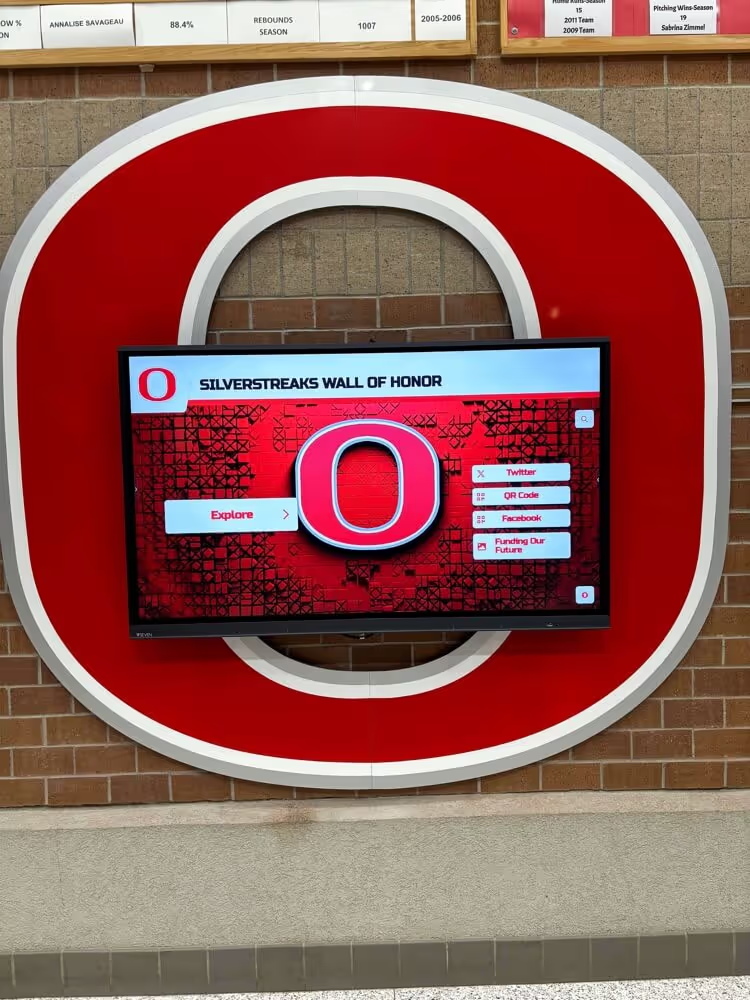
Interactive recognition displays and touchscreen hall-of-fame installations benefit significantly from authority-controlled data. When a visitor searches for an athlete by nickname, an authority-aware system returns the correct profile because the nickname is registered as a variant form of the athlete’s preferred-form entry. When a new inductee profile is added to a display, the authority file ensures the name matches every other mention of that person across the system. Programs evaluating donor recognition and alumni engagement platforms — which share many of the same data management challenges — may find contemporary approaches to donor recognition systems useful for understanding how entity-based data models work in recognition display contexts.

The connection between name authority control and long-term digital record stability is direct. A related challenge — keeping record URLs and profile links stable through platform migrations — is addressed in detail in a companion guide on athletic archive persistent identifiers for athlete profiles, team records, and award pages. Authority control and persistent identifiers address different fragmentation risks (name inconsistency versus link breakage) but work together as the two foundational layers of a durable athletic archive.
For school programs that use physical recognition materials alongside digital systems — including fundraising campaigns that depend on accurate recognition of named donors and alumni athletes — the alignment between physical display content and digital records requires the same name authority control principles. The connection between recognition data consistency and effective fundraising campaign displays is explored in digital donor wall approaches for modern recognition and fundraising programs.
Maintaining the Authority File Over Time
A name authority file that is created once and never updated will gradually diverge from the records it is supposed to normalize. Maintenance requirements are modest but consistent.
Add new entries at the point of record creation. Every new athlete inducted, every new coaching hire recognized, every new season record entered should generate an authority file entry before the record is finalized. This prevents the backlog problem that makes retrospective normalization labor-intensive.
Review and update existing entries when corrections surface. When a discrepancy between an authority file entry and a source document is discovered — a name spelled differently, a date range that needs extension, a new variant form encountered — the entry should be updated immediately rather than deferred. Small corrections handled promptly prevent the accumulation of inconsistencies that requires a large retrospective audit later.
Document name change events as they occur. When a coach or alumni athlete reports a name change, update the authority file immediately with a cross-reference entry for the new name pointing to the preferred form under which their athletic records are held. This is most reliably done at the moment of contact — alumni communications, donation processing, and nomination review are all moments when name changes surface naturally.
Conduct a periodic authority file audit. Once per year, review a sample of recent record entries against the authority file to confirm that intake procedures are being followed consistently. Inconsistencies identified in spot-check audits usually indicate that an intake step was skipped or that a new staff member was not trained on the authority control procedure.
For schools building recognition programs that need to acknowledge and engage alumni at scale — including programs that send periodic alumni communications or manage ongoing donor acknowledgment — the principles of consistent name management connect directly to the effectiveness of those outreach efforts. The timing and methods for acknowledging supporters across recognition programs is covered in the guide on when and how to acknowledge donors and supporters in recognition programs.

Name Authority Control and Equity in Athletic Recognition
Name inconsistency in athletic archives does not affect all groups equally. Women athletes whose recognition records often span a name change through marriage face higher rates of fragmented profiles than male athletes whose surnames typically remain stable across their athletic and post-athletic careers. Athletes from cultural backgrounds with naming conventions that differ from the dominant convention of the record-keeping era — different ordering of family and given names, diacritical marks in names, transliteration variants — face higher rates of inconsistent recording across different source documents.
A name authority control process that is designed to accommodate these realities — rather than one that treats Western English-language naming conventions as the default and treats everything else as an edge case — produces more equitable and more complete recognition coverage.
Specific design choices that support equitable authority control:
- Accept diacritical marks and non-ASCII characters in preferred-form entries rather than stripping them to ASCII equivalents
- Document the convention used for name order in source records (e.g., whether a Korean-American athlete’s given name and family name were recorded in Western or Korean order in different source documents)
- Apply the same cross-referencing rigor to maiden-name records as to any other variant form, rather than treating the maiden-name record as the “real” record
- When building authority entries for athletes from communities where naming conventions differ from the dominant institutional convention, consult with the athlete or their family if contact is possible
These practices reflect the same principle that underpins authority control generally: the purpose of the system is to serve recognition accuracy, not to enforce a single naming convention at the expense of completeness.
Programs working to expand the reach of their recognition efforts to underrepresented communities may also find useful context in the guide on national recognition programs and how students from diverse backgrounds engage with institutional recognition systems.
Frequently Asked Questions
What is name authority control in an athletic archive?
Name authority control is the practice of assigning a single preferred form of name to each person, team, or organization in the archive and documenting all variant forms that refer to the same entity. It prevents duplicate profiles — where the same athlete appears under multiple name forms as if they were separate people — and ensures that recognition content is consistently attributed to the right individual regardless of how their name appeared in different source documents.
How is an authority file different from a spreadsheet of athlete names?
A simple name list records one form of each person’s name. An authority file records the preferred form, all known variant forms, the sources where variants appear, and cross-references to related entries. The authority file is a relational document that supports lookups from any variant form to the preferred form — which a flat name list does not provide.
Do we need special software to implement name authority control?
No. A spreadsheet with columns for authority ID, preferred form, variant forms, entity type, active period, and notes is sufficient for most school athletic programs. Dedicated recognition platforms and digital hall-of-fame systems often build authority control into their data models, which makes the process more efficient but is not required to implement the fundamentals.
How do we handle an athlete who legally changed their name after competing?
The preferred form in the authority file uses the name under which the athlete competed, since that is the name that appears in the historical athletic records. The post-change name is documented as a cross-reference entry with a note indicating the effective date. This allows anyone searching under the current name to reach the correct athletic record while preserving the accuracy of historical documentation.
What should we do when we find two athlete records that appear to be the same person?
Investigate using multiple sources — yearbooks, enrollment records, newspaper archives, and any contact information in alumni files — to confirm the records refer to the same individual. Once confirmed, create a single authority entry using the preferred form, document all variant names as variants, and update every record that used a non-preferred form to reference the authority entry. Do not delete the variant-form records; redirect them.
How often does the authority file need to be updated?
The authority file should be updated at every point of record creation (for new entries) and at every point of correction (for updates to existing entries). An annual spot-check audit ensures intake procedures are being followed consistently. Programs with active induction processes typically update the authority file several times per year; programs managing only historical records may update less frequently.
Build an Athletic Archive Where Every Name Connects to the Right Record
Rocket Alumni Solutions builds interactive digital halls of fame with entity-based data models that support consistent athlete, coach, and team records across decades of school history. Schools use Rocket-powered platforms to give each inductee a unified, searchable profile that stays accurate as names evolve, records are corrected, and recognition programs grow.
Schedule a Free Demo