



Universities and schools face a persistent challenge when creating alumni wall displays: how do you honor distinguished graduates in ways that genuinely inspire current students, strengthen alumni bonds, and remain sustainable for decades? Traditional plaques fill quickly, static photo boards become dated, and meaningful recognition often gets reduced to names on crowded walls that few people notice or remember.
The most effective alumni wall installations transcend simple name lists. They tell compelling stories of achievement, demonstrate diverse pathways to success, and create emotional connections that inspire current students while reinforcing alumni pride. Whether you’re planning your first alumni wall or reimagining an existing display that no longer serves your institution’s needs, thoughtful recognition design transforms how communities celebrate graduate excellence.
Why Alumni Wall Design Matters: Recognition walls significantly influence institutional culture and engagement metrics. Well-designed displays strengthen alumni connections that drive giving rates, create visible proof points for prospective families evaluating schools, inspire current students by demonstrating achievable success pathways, and preserve institutional legacy across generations. Generic or poorly executed walls become invisible, while compelling designs create gathering places where communities actively engage with institutional stories.
This comprehensive guide explores how educational institutions create alumni wall displays that deliver lasting value. From understanding core design principles through selecting appropriate technologies and implementation approaches, you’ll discover strategies that help your institution honor graduates authentically while serving multiple strategic objectives simultaneously.
Understanding What Makes Alumni Wall Displays Effective
Before selecting specific display formats or technologies, institutions must clarify what they want alumni walls to accomplish and for whom.
Defining Your Alumni Wall’s Primary Purpose
Different institutions emphasize different objectives when creating alumni recognition systems, and these priorities fundamentally shape design decisions.
Honoring Distinguished Achievement
Some alumni walls primarily celebrate graduates who attained exceptional professional success, made significant community contributions, or brought particular honor to their alma mater. These recognition-focused walls emphasize individual achievement narratives, comprehensive biographical content, and formal presentation appropriate to honoring distinction. Selection criteria typically establish high thresholds ensuring recognition remains exclusive and meaningful.
Inspiring Current Students
Student-focused walls prioritize demonstrating achievable pathways from student experience to meaningful success across diverse fields. These displays emphasize relatable storytelling showing how ordinary students achieved extraordinary outcomes, diverse achievement types representing multiple definitions of success beyond traditional career measures, and accessible placement in areas where students naturally congregate rather than administrative wings they rarely visit.
When inspiration drives wall purpose, content should answer the implicit student question: “If they could achieve this after attending my school, what might be possible for me?” This focus influences both whom you recognize and how you tell their stories.
Building Alumni Engagement and Fundraising
Advancement-oriented walls strengthen emotional connections between alumni and institutions while demonstrating graduate success to prospective donors. These engagement-focused displays emphasize visible placement during campus visits ensuring prospective families and donors encounter them, professional presentation reflecting institutional quality and investment in recognition, and integration with broader advancement strategies including naming opportunities and donor recognition programs.
Institutions pursuing this objective often create broader recognition criteria enabling more graduates to receive acknowledgment, understanding that increased inclusion strengthens engagement among larger alumni populations who might contribute to institutional success.
Preserving Institutional History
Archive-focused walls document institutional evolution through alumni achievement across generations, preserving stories that might otherwise be lost as decades pass. These historical displays emphasize comprehensive coverage spanning multiple eras, contextual information connecting achievements to historical periods and institutional development, and permanent preservation ensuring accessibility for researchers, historians, and future community members.
Most effective walls serve multiple objectives simultaneously, but clarifying priorities helps when design trade-offs require difficult choices between competing goals.
Key Factors Influencing Alumni Wall Success
Several fundamental considerations shape whether alumni wall displays deliver meaningful long-term value or become forgotten background elements.
Space Availability and Physical Constraints
Physical space significantly constrains traditional display options. Small alcoves accommodate limited plaques or compact digital displays but cannot support extensive installations. Expansive hallways or dedicated alumni centers enable ambitious multi-wall installations or large interactive displays. Honestly assessing available space prevents selecting concepts requiring square footage you don’t possess.
Location matters equally to size. High-traffic areas where students, visitors, and community members naturally pass create far greater impact than beautiful displays tucked in isolated corners only deliberately seeking visitors encounter.
Budget Realities and Funding Sources
Alumni wall budgets vary dramatically based on institutional resources, ranging from modest $5,000-$10,000 implementations to $50,000+ installations in well-funded institutions. Understanding realistic constraints narrows options while preventing designs requiring unobtainable funding.
Many schools successfully fund alumni walls through alumni association budgets allocated for engagement infrastructure, capital campaigns including recognition components, corporate sponsorships from companies founded by distinguished alumni, or individual donor naming opportunities. The recognition wall itself often becomes a fundraising vehicle when positioned as permanent celebration of the alumni community.
Technical Capabilities and Ongoing Management
Some alumni wall concepts require minimal technical expertise—traditional plaques need only periodic cleaning and eventual space for additions. Others demand ongoing content management, technical troubleshooting, and regular updates requiring staff time and capabilities many institutions lack.
Honestly assessing your institution’s technical capacity and staff availability prevents selecting solutions you cannot realistically maintain long-term. The most sophisticated technology proves worthless if it sits unused because staff lack time or skills for operation.
Institutional Aesthetic and Architectural Context
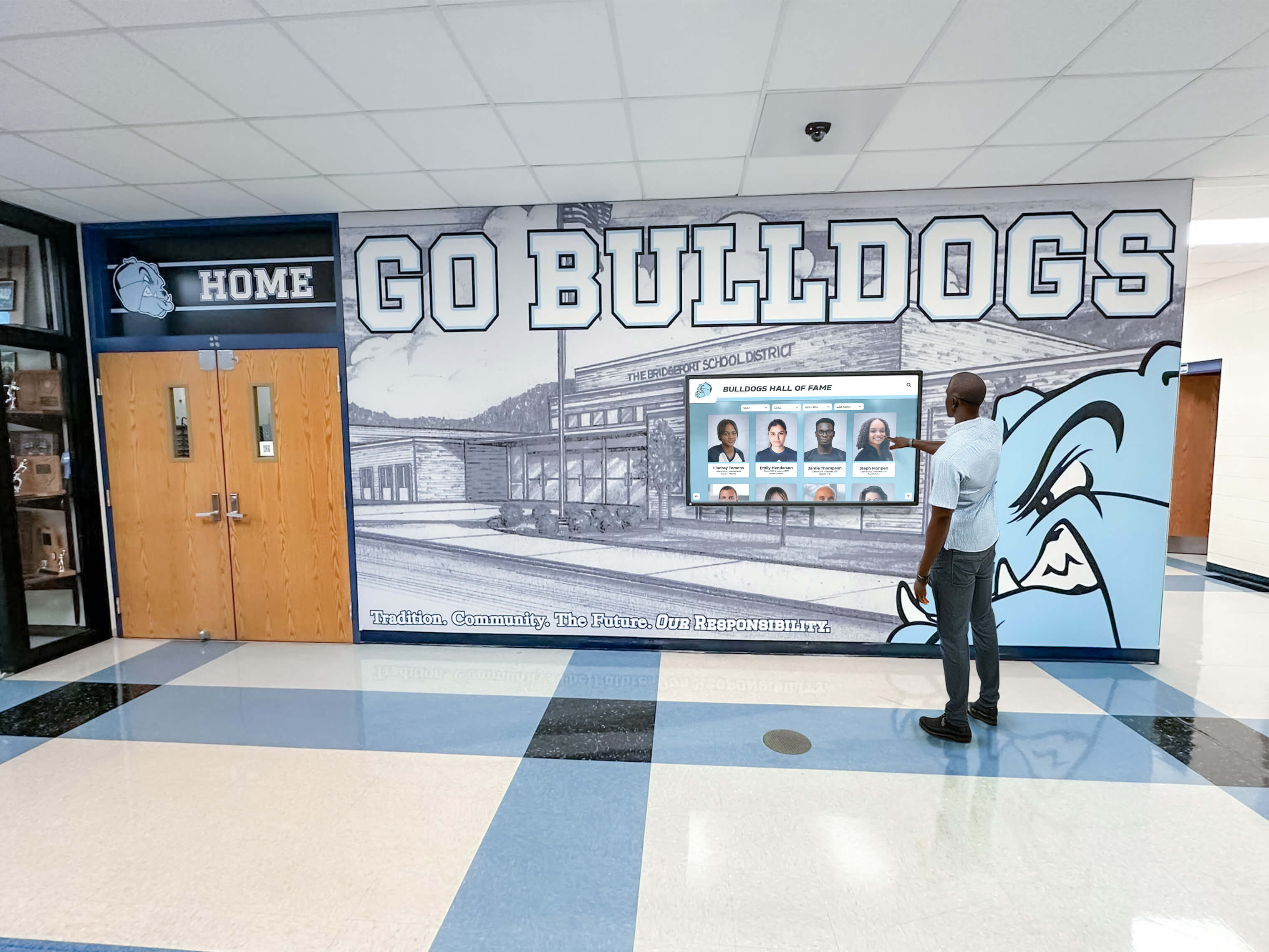
Alumni walls should complement existing campus architecture and institutional branding rather than appearing visually disconnected from surrounding environments. Traditional brick-and-ivy institutions may prefer classic brass plaques reinforcing timeless aesthetics, while modern campuses might embrace sleek digital installations reflecting contemporary design sensibilities.
Alignment with institutional visual identity creates cohesive appearances appropriate to recognition significance while ensuring displays feel authentically connected to institutional character.
Traditional Physical Alumni Wall Approaches
Classic recognition methods have proven effective across generations, creating formal, permanent displays that command respect while honoring distinguished graduates through timeless materials and professional craftsmanship.
Engraved Plaque and Nameplate Walls
Traditional engraved recognition provides permanence and gravitas appropriate for formal alumni acknowledgment.
Classic Brass or Bronze Plaque Installations
Individual brass or bronze plaques mounted on dedicated wall space create impressive displays growing over time as new alumni receive recognition. Each plaque typically includes name, graduation year, and brief achievement summary engraved professionally. Plaques arranged in organized grids or staggered patterns create visual interest while maintaining formal dignity.
Professional engraving ensures lasting quality, and brass develops distinctive patina over time that many institutions appreciate aesthetically. However, plaques require significant per-person costs ($100-$300 each typically), space eventually fills requiring difficult expansion decisions, and corrections or updates require complete replacement rather than simple editing.
Tiered Recognition Wall Systems
Similar to donor recognition walls, categorize alumni by achievement type or distinction level with differentiated plaque sizes reflecting recognition tiers. Categories might include “Distinguished Alumni Hall of Fame,” “Rising Stars” for recent graduates achieving early success, “Lifetime Achievement” for sustained excellence, or field-specific groupings like “Business Leaders,” “Public Service,” “Arts and Culture,” and “Science and Innovation.”
Tiered approaches create clear recognition hierarchies while providing multiple pathways to wall inclusion, potentially increasing total honoree numbers and engagement across broader alumni populations who see achievable recognition criteria.
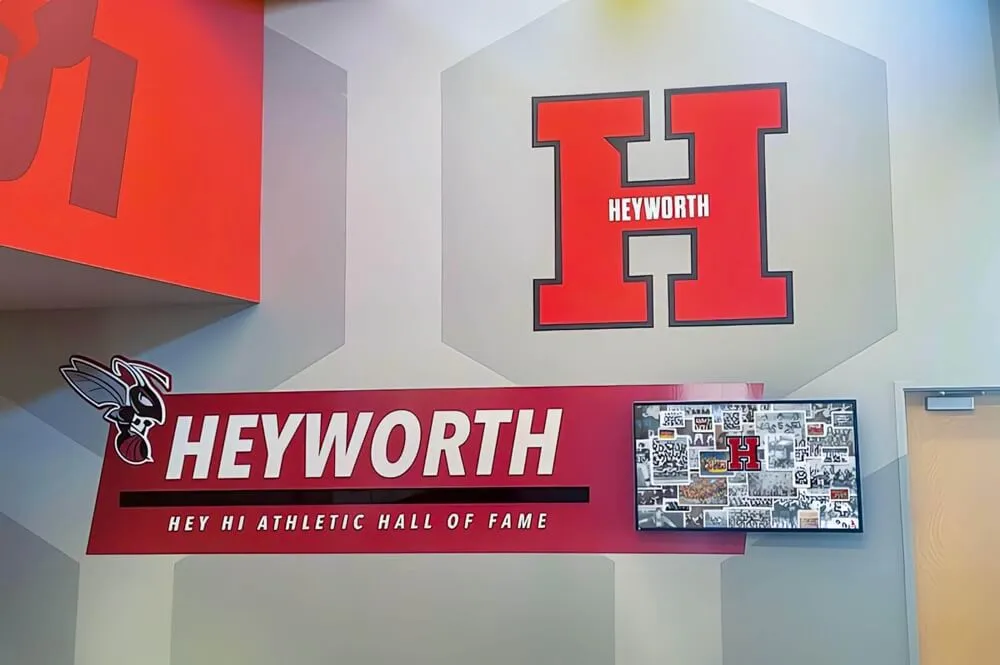
Sculptural and Three-Dimensional Recognition
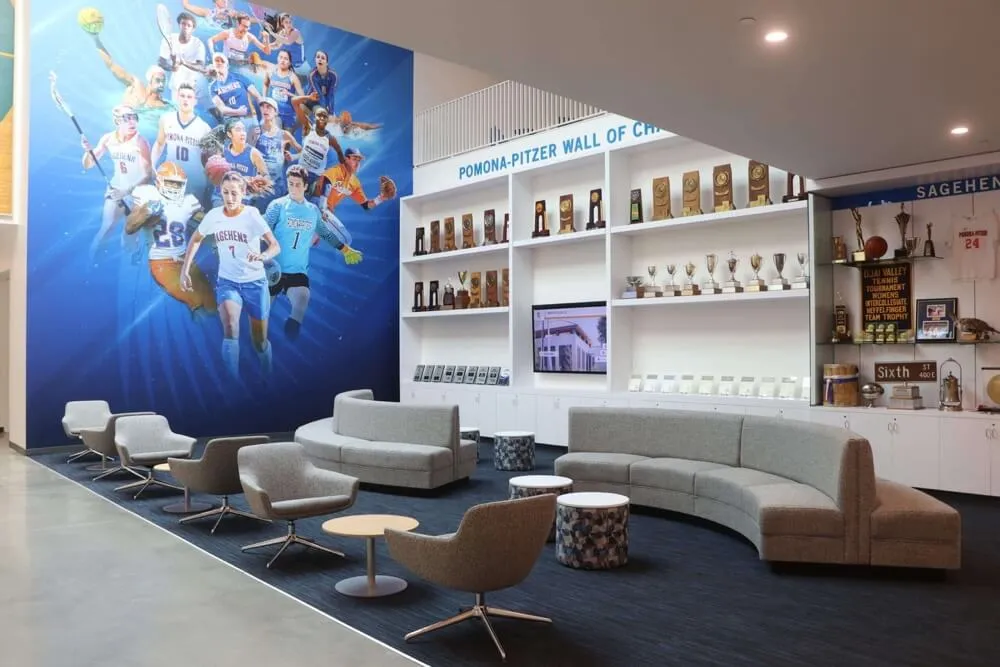
Rather than flat wall mounting, some institutions create distinctive recognition through metal “trees” where leaves represent individual alumni with engraved names, sculptural installations where nameplates form meaningful shapes like school logos or symbolic representations, or modular panel systems creating architectural interest through varied depths and angles.
Sculptural approaches add artistic dimension to recognition while creating unique installations distinguishing your institution from generic plaque walls ubiquitous in educational settings.
Photo-Based Recognition Displays
Incorporating photographs creates more personal connections than names alone, helping viewers relate to honored alumni as real individuals rather than abstract listings.
Framed Photo Gallery Walls
Commission uniform frames displaying professional alumni photographs alongside engraved plates with names, years, and achievements. Gallery walls work particularly well when photos maintain consistent styling—similar backgrounds, lighting, color treatment, and composition—creating unified presentations despite images spanning decades.
Consider chronological arrangement showing institutional evolution through changing photography styles and cultural contexts, thematic grouping by achievement field or career category, or intentional mixing of eras creating visual interest through contrast while emphasizing connections between generations.
Photo Composite Boards
Large composite displays position multiple alumni photos on single boards organized by decade, achievement category, or other logical groupings. Composites work well for institutions recognizing substantial alumni numbers where individual frames prove impractical or prohibitively expensive.
Digital printing on quality materials enables high-resolution photo reproduction maintaining image quality while allowing flexible layouts accommodating varying numbers of alumni per category.
Trophy Cases and Artifact Displays
When alumni achievements include physical artifacts, three-dimensional displays create engaging presentations impossible with flat walls.
Professional Trophy Case Installations
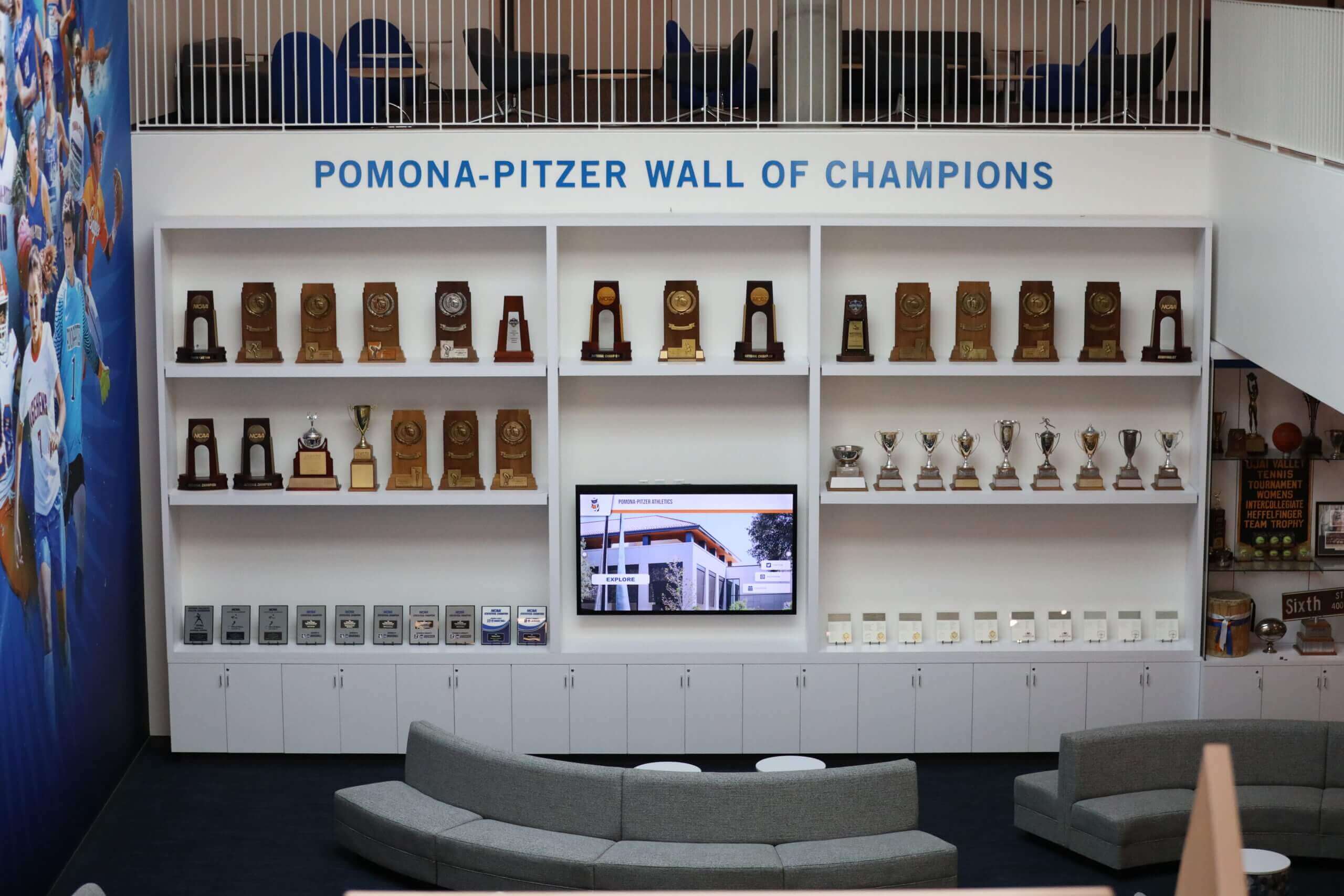
Quality trophy cases display physical awards, medals, championship trophies, published books, artwork samples, or other tangible achievement artifacts alongside explanatory plaques providing context. Professional cases feature proper lighting highlighting contents, climate control protecting delicate items from humidity and temperature fluctuations, and lockable doors preventing theft or damage to valuable materials.
Consider rotating displays periodically to showcase different alumni or achievements, preventing cases from feeling static while allowing greater total content than simultaneously displayable capacity accommodates. This rotation maintains visitor interest across repeated encounters while enabling recognition of more alumni than physical space alone permits.
Modern Digital Alumni Wall Solutions
Digital technology revolutionizes what’s possible in alumni recognition, overcoming traditional limitations while enabling engaging experiences resonating with contemporary expectations for interactivity, multimedia richness, and unlimited information access.
Interactive Touchscreen Recognition Systems
Large touchscreen installations transform passive viewing into active exploration where visitors control their engagement, discovering alumni achievements through intuitive digital interfaces.
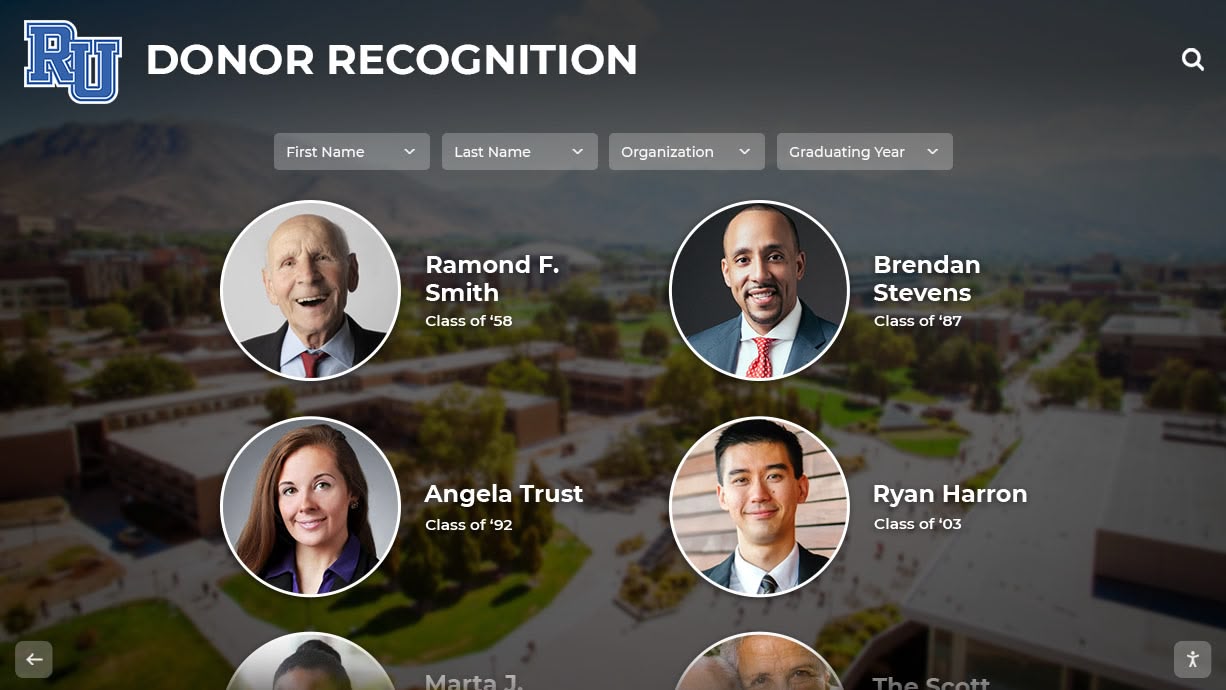
Comprehensive Alumni Database Displays
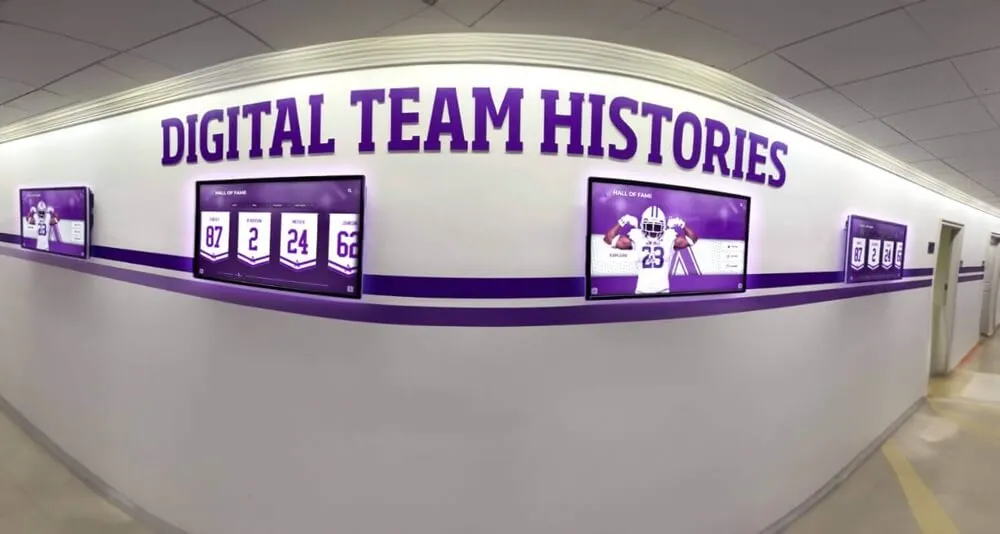
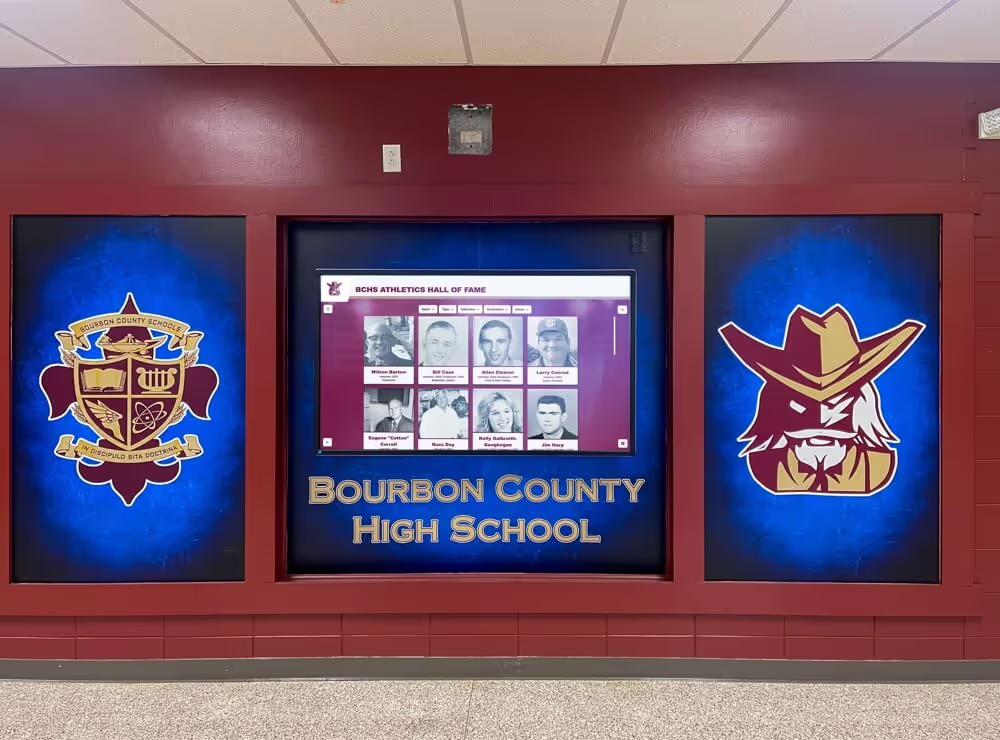
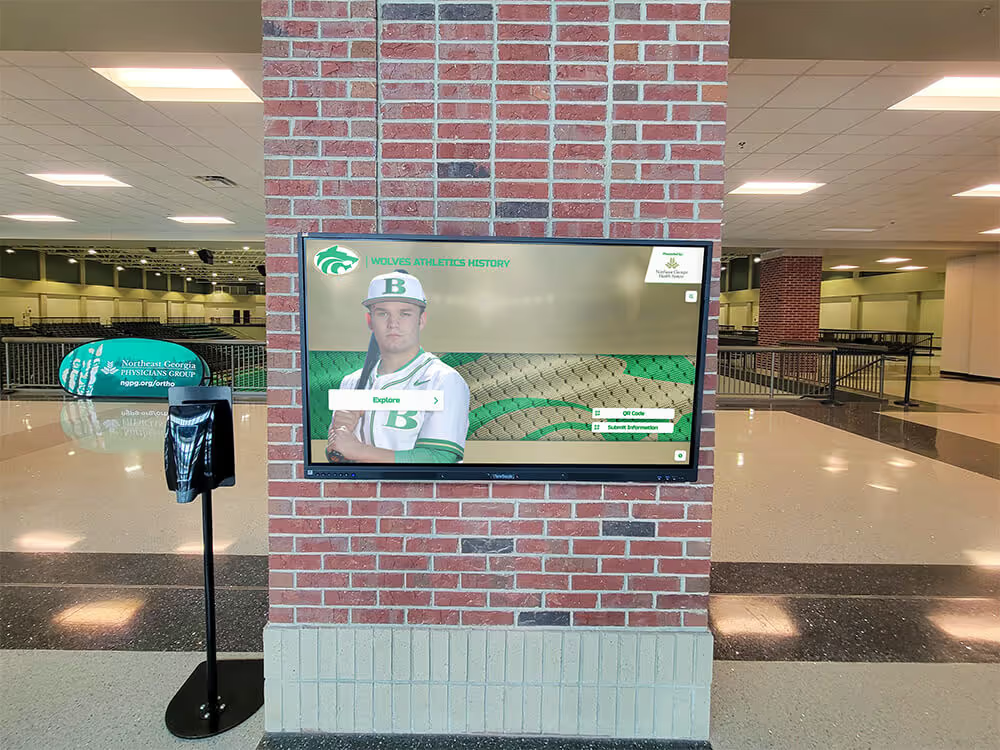
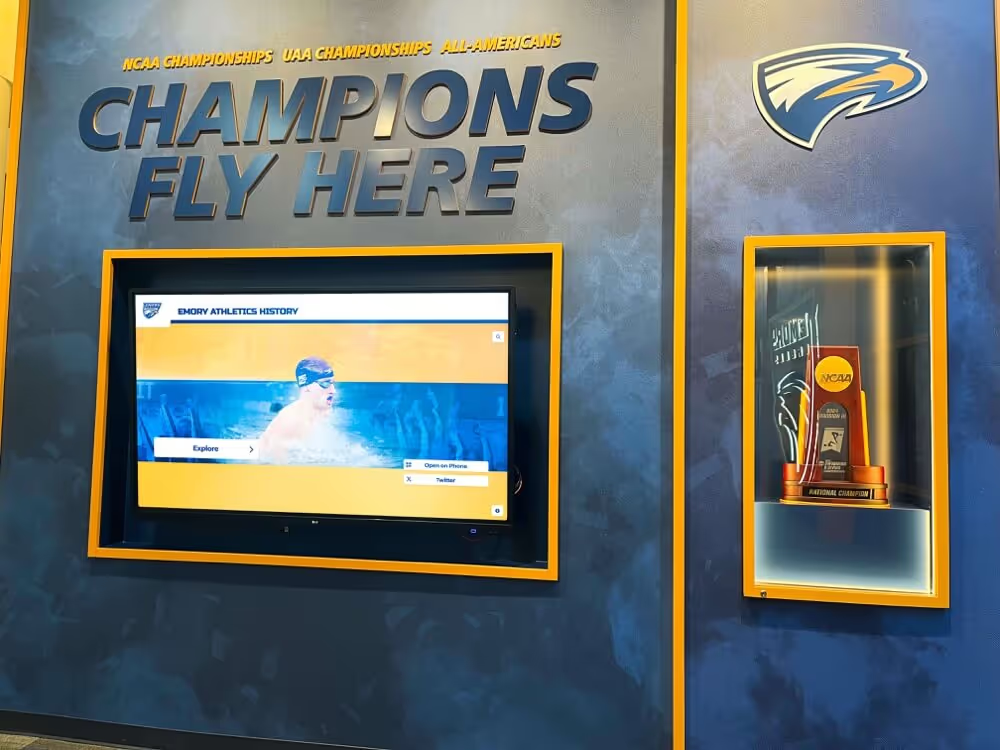
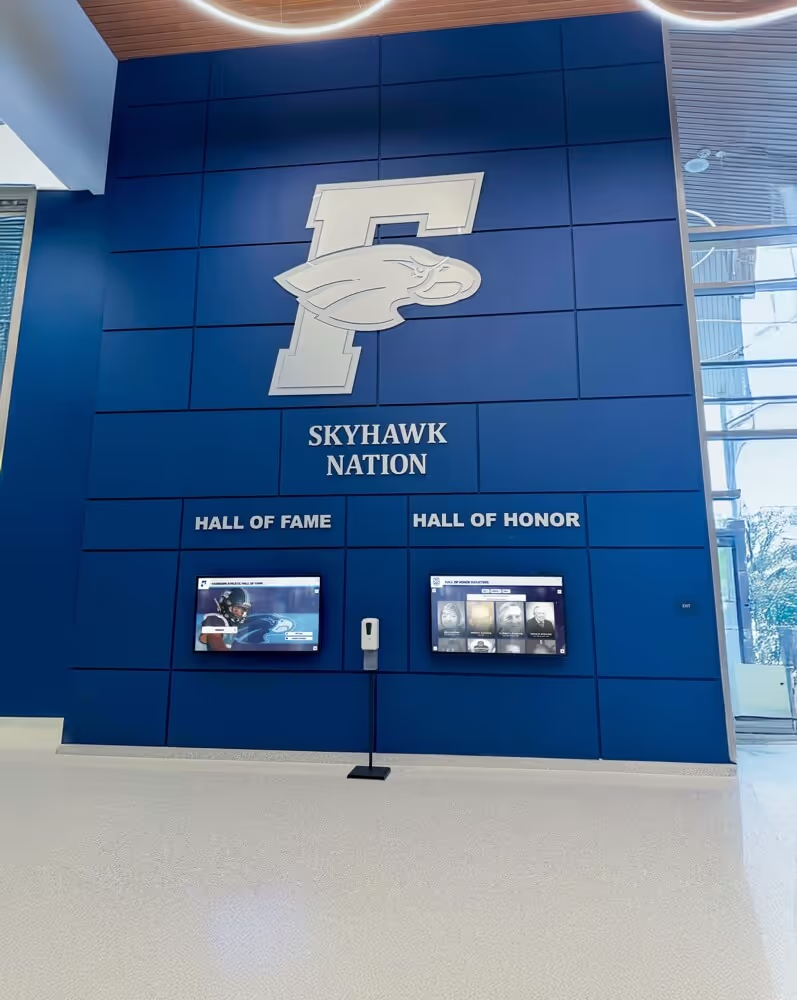
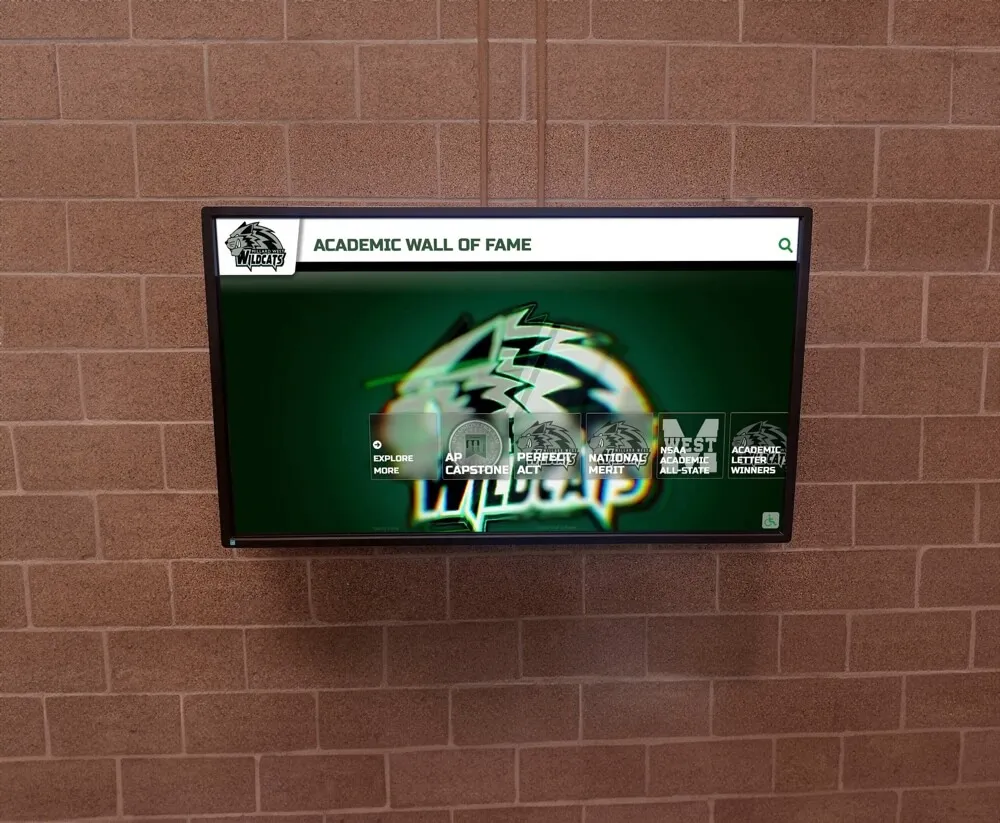
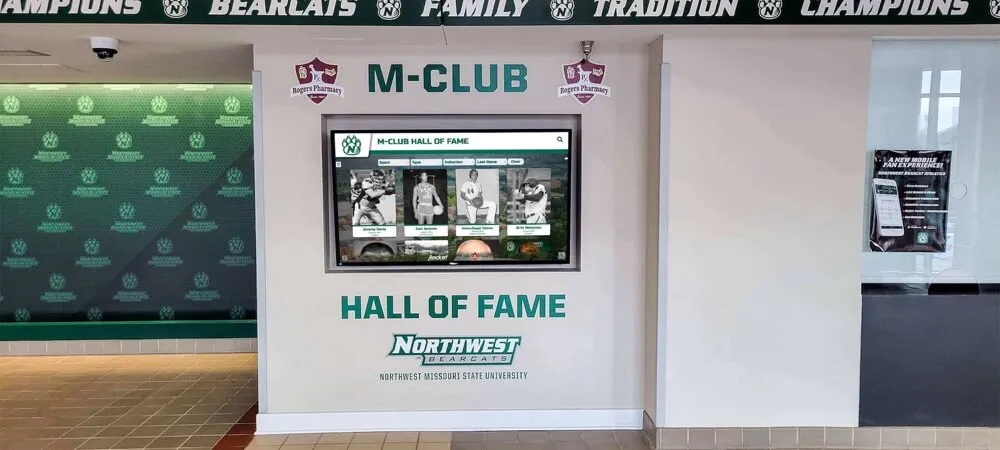
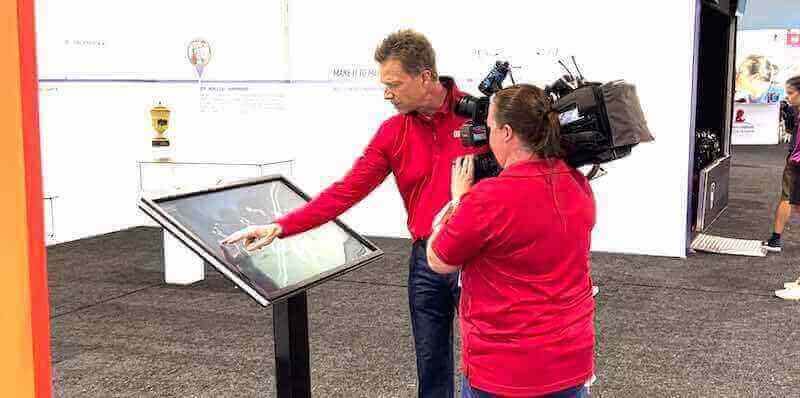
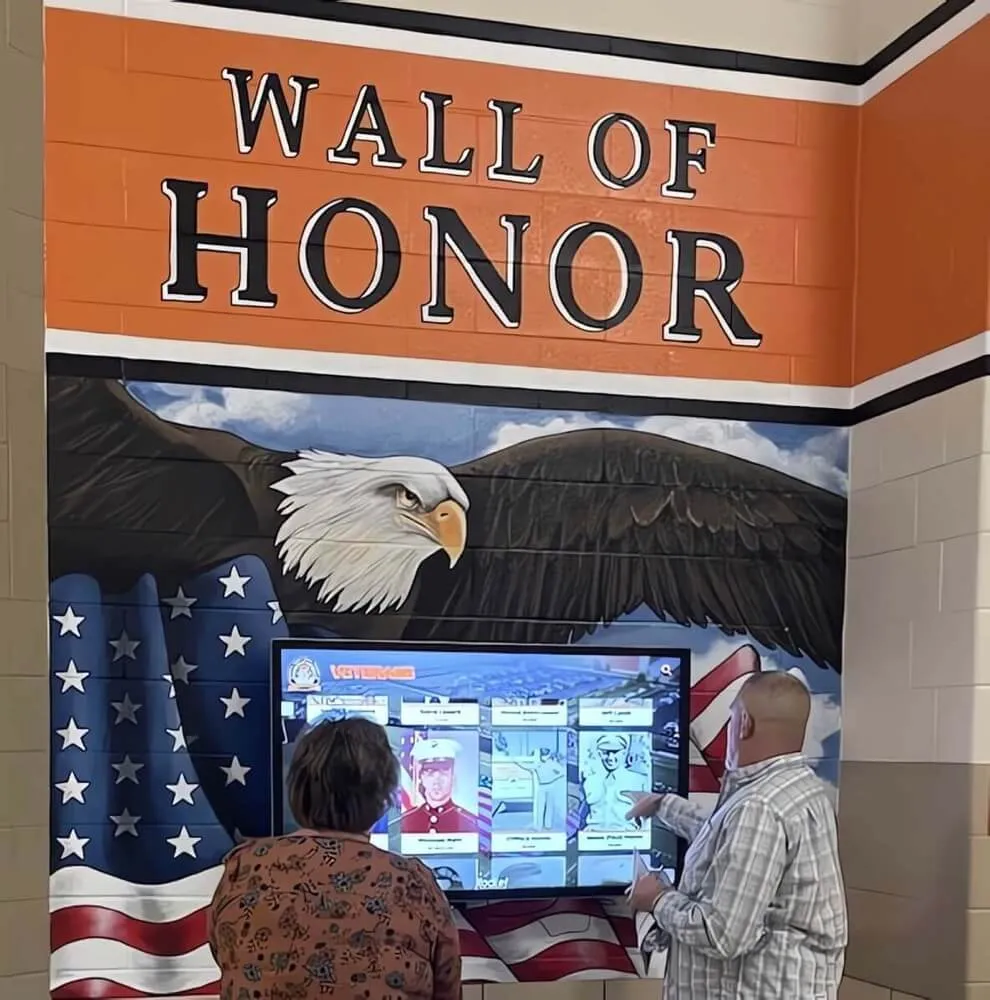
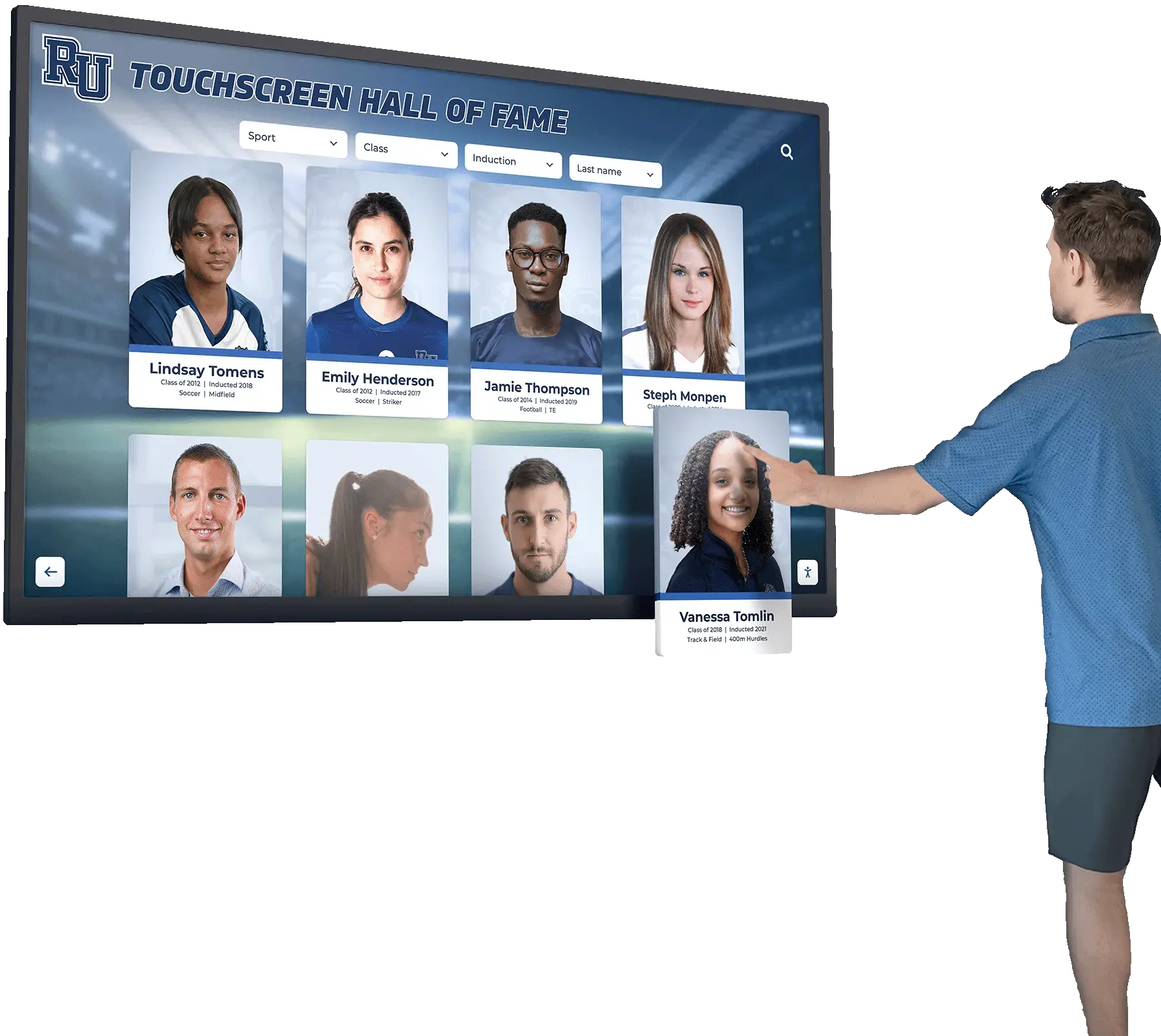
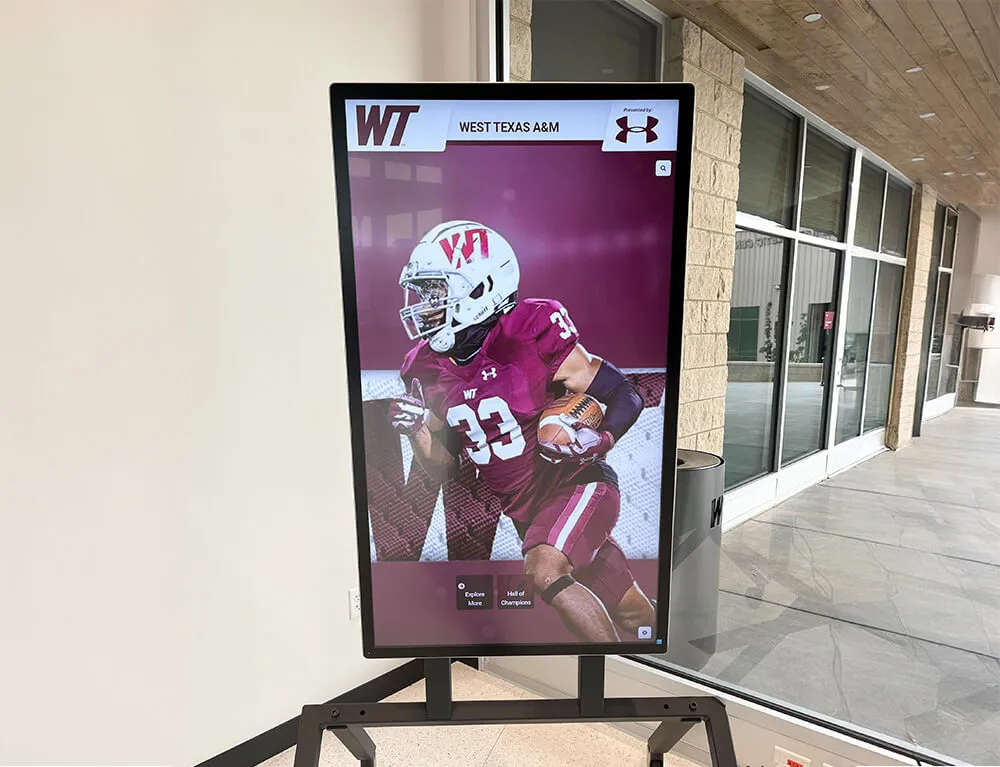
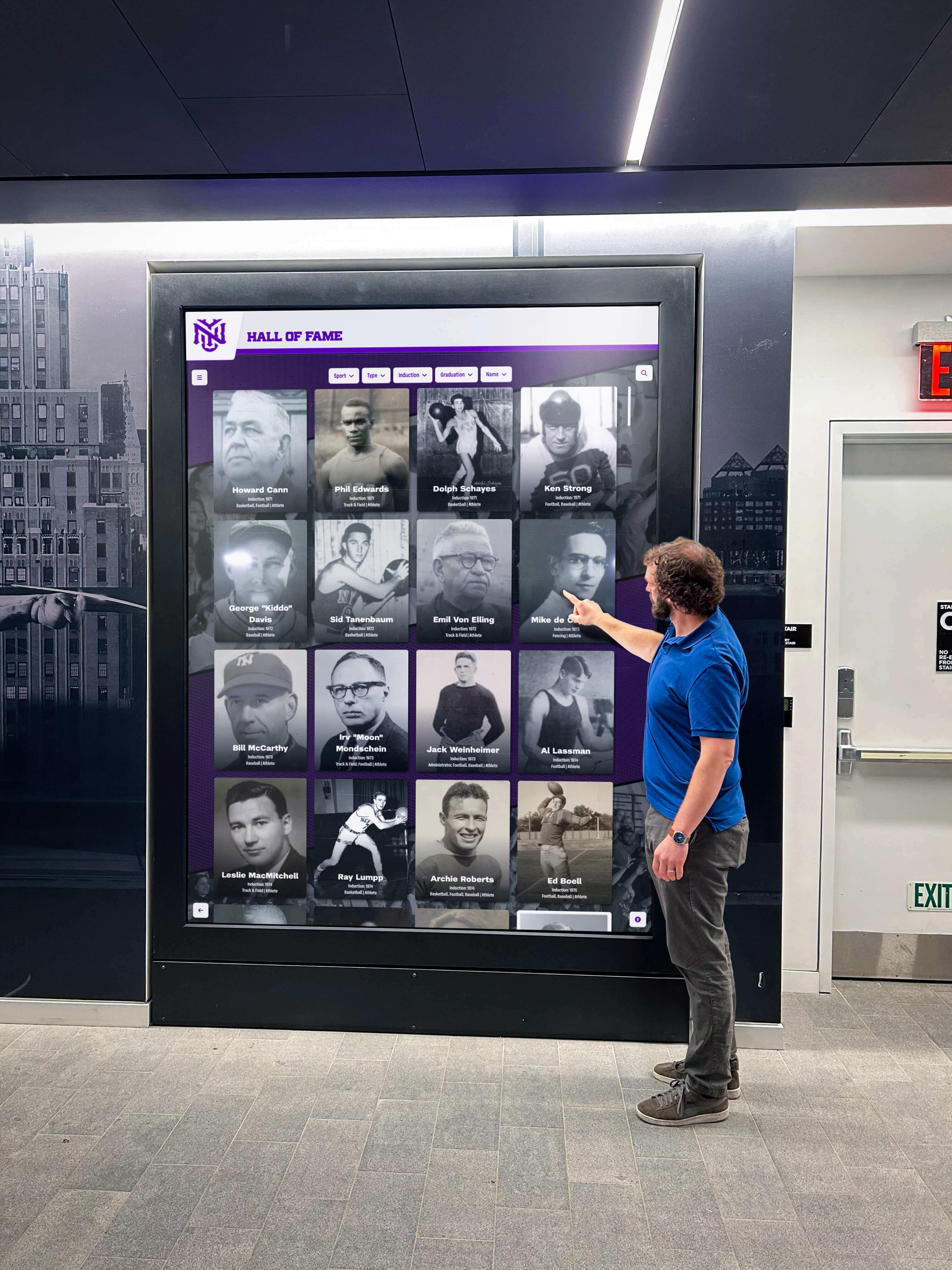
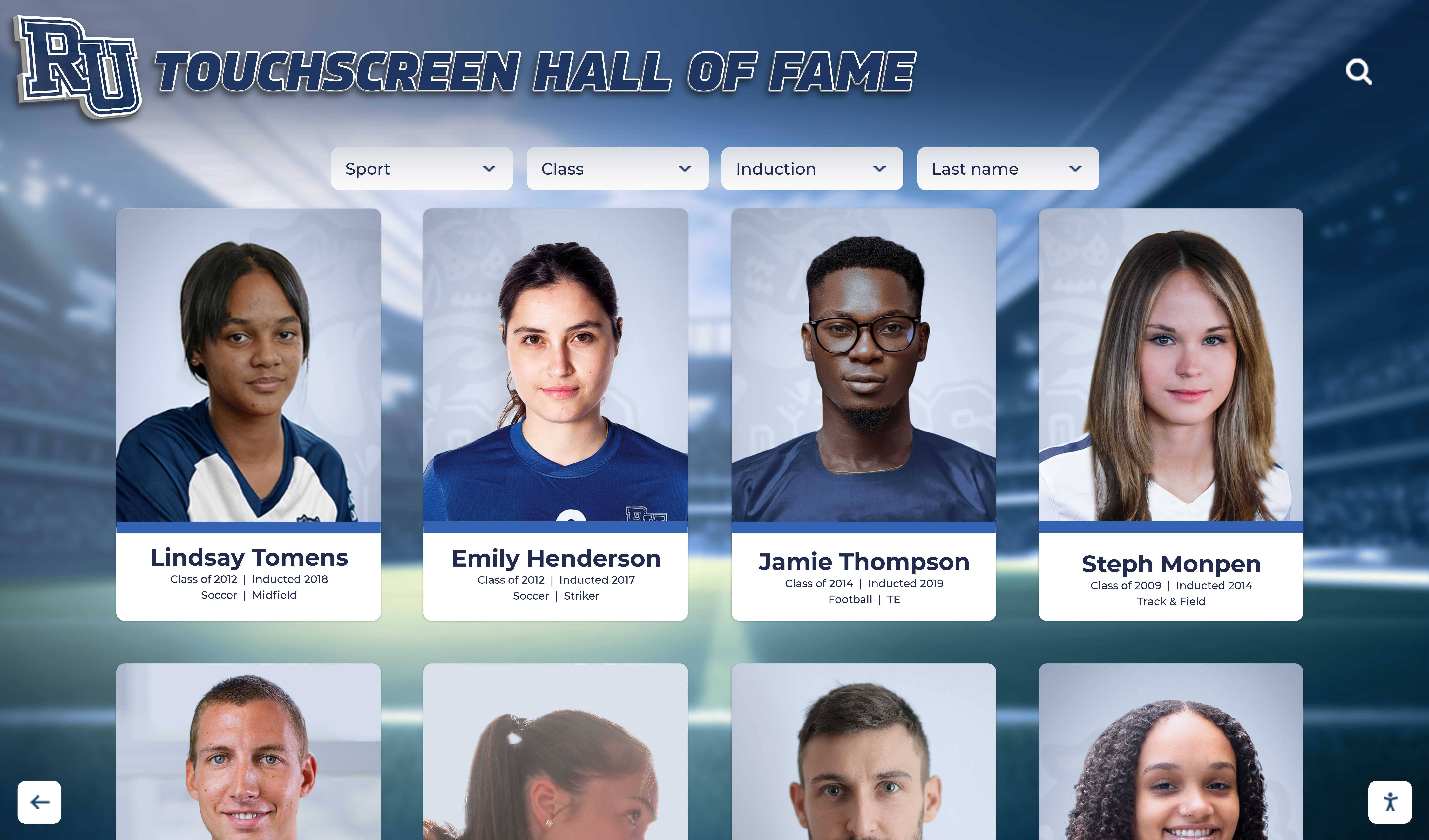
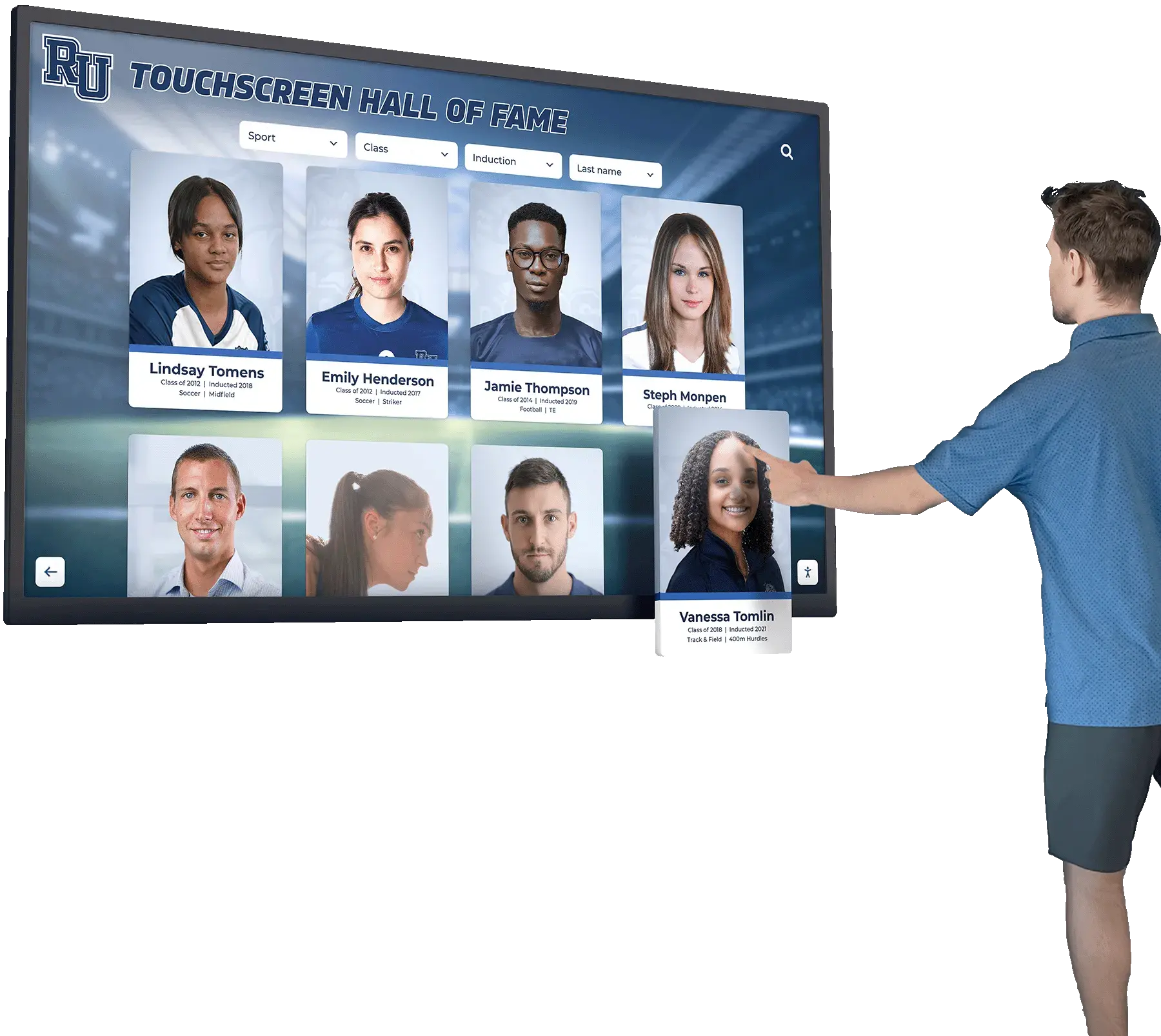
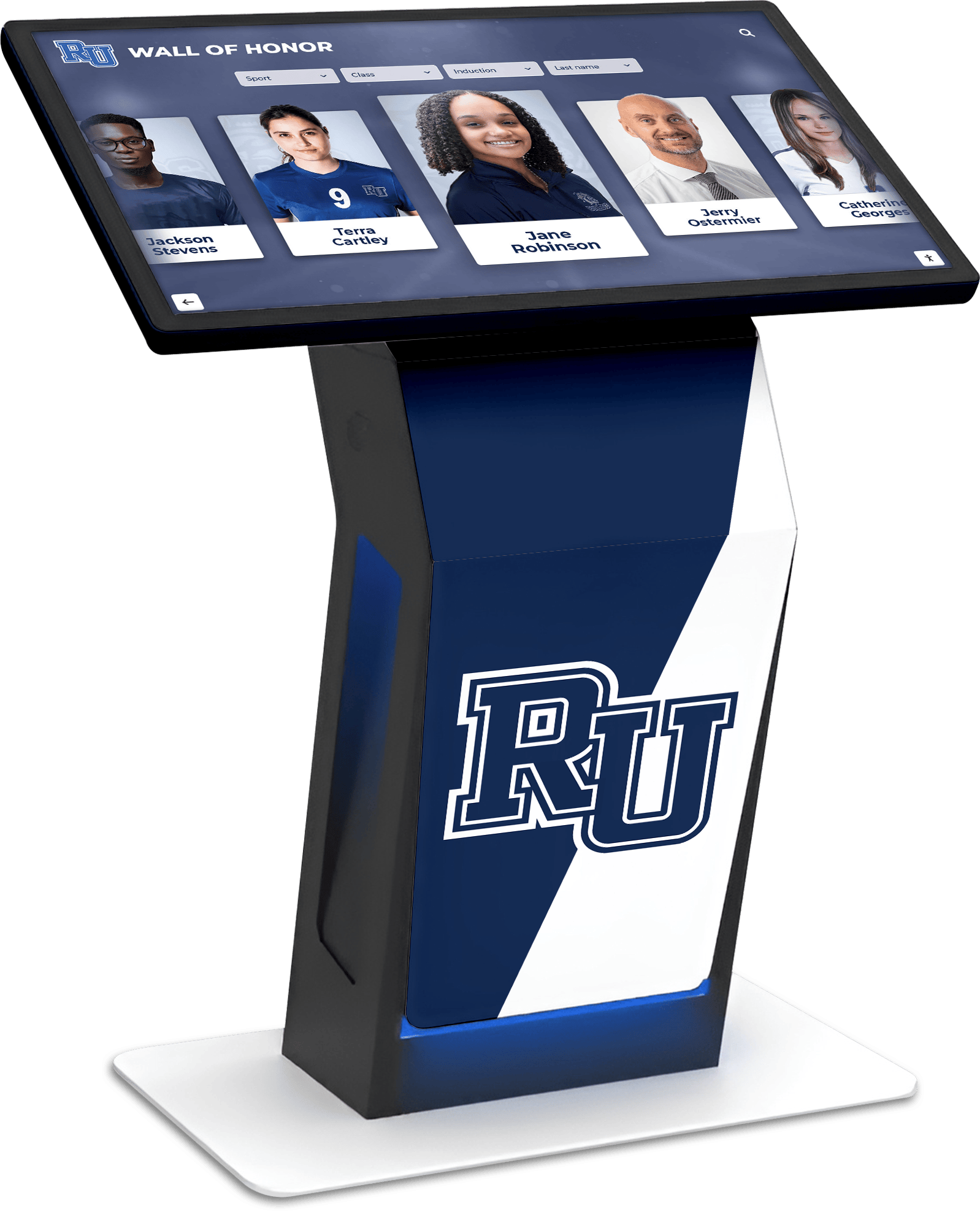
Floor-standing or wall-mounted touchscreen systems enable visitors to browse complete alumni databases through multiple access methods: search by name finding specific individuals instantly, filtering by graduation year, achievement type, career field, geographic location, or academic major, browsing featured alumni highlighted prominently on home screens, or discovering random profiles through shuffle functions encouraging serendipitous exploration of alumni you might not deliberately seek.
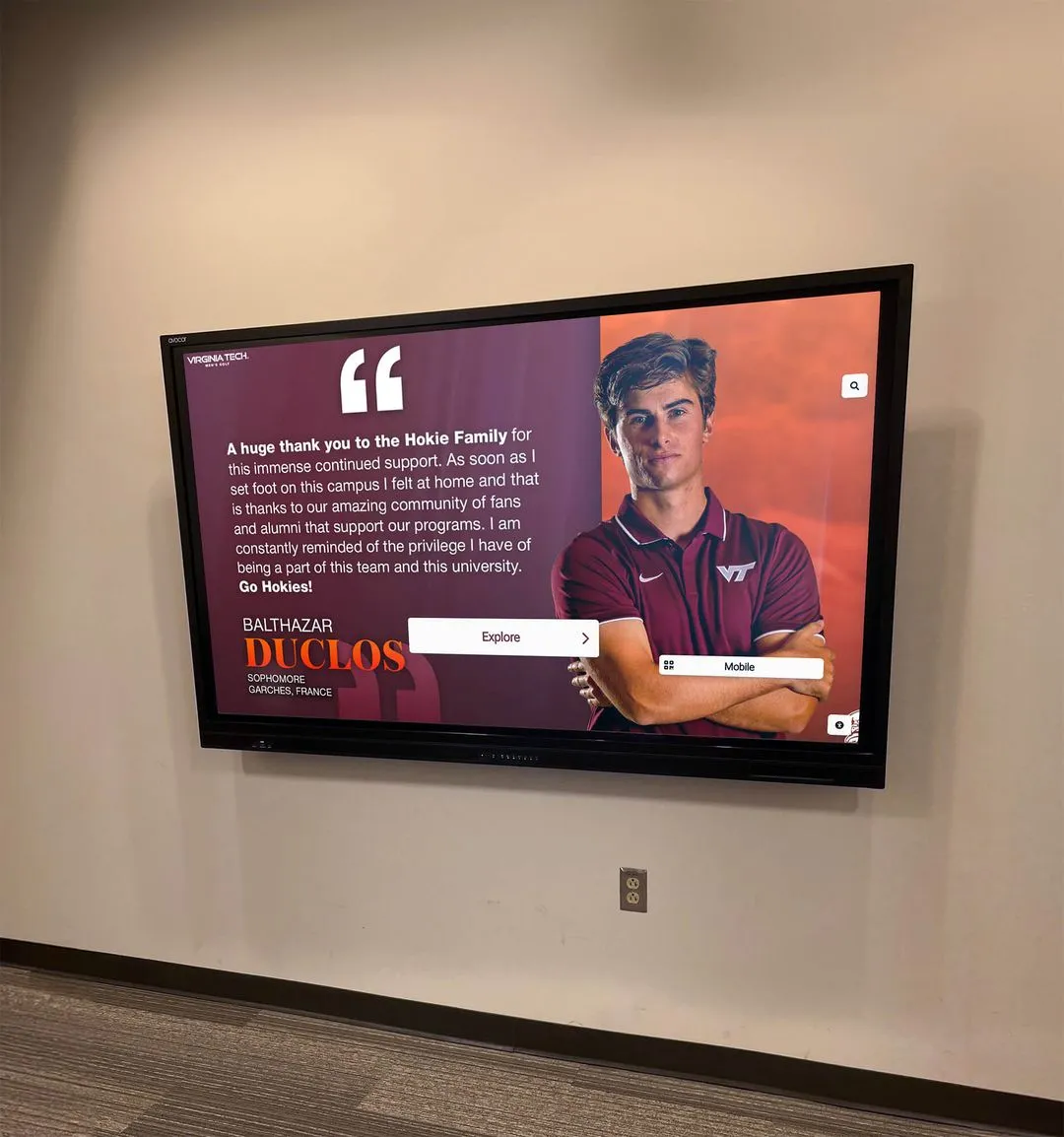
Each profile includes comprehensive biographical information traditional plaques cannot accommodate—professional photos and personal images showing career contexts, detailed achievement narratives explaining what makes each alumnus distinguished, video interviews when available capturing reflections in alumni’s own voices, and related content connecting alumni with shared characteristics or complementary achievements.
Interactive touchscreen displays accommodate unlimited alumni profiles without physical space constraints—whether recognizing 50 distinguished graduates or 5,000, the display footprint remains constant. This scalability proves particularly valuable for growing recognition programs or institutions with large alumni populations deserving acknowledgment.
Solutions like Rocket Alumni Solutions provide purpose-built platforms designed specifically for educational recognition needs, combining intuitive touchscreen interfaces with powerful content management systems enabling non-technical staff to maintain displays independently without ongoing IT support requirements.
Multi-Touch Collaborative Exploration
Large-format touchscreens (65"-85"+) support multiple simultaneous users, enabling groups to explore together. Multi-touch capability allows friends browsing together discovering classmates’ achievements, families viewing accomplishments of relatives or family friends, tour groups exploring notable alumni during campus visits, or prospective students investigating potential career pathways through graduate examples.
Collaborative displays positioned in central locations create gathering points where alumni recognition becomes social experience rather than isolated individual viewing. This social dimension significantly increases engagement time and emotional impact compared to displays supporting only single users.
Themed Digital Recognition Experiences
Rather than comprehensive databases, some digital displays focus on specific themes rotating periodically. Themes might include “Alumni Making a Difference” featuring community service leaders, “Entrepreneurs and Innovators” showcasing business builders, “Arts and Culture Leaders” celebrating creative professionals, “Scientific and Medical Pioneers,” or seasonal themes connecting to current events and institutional priorities.
Themed displays allow deeper exploration of specific achievement categories while keeping recognition fresh through periodic theme rotation maintaining visitor interest across repeated encounters throughout academic years.
Web-Based and Mobile Alumni Recognition
Digital recognition extends beyond physical installations through online platforms accessible globally, reaching alumni, families, and communities worldwide regardless of geographic location.
Online Hall of Fame Websites
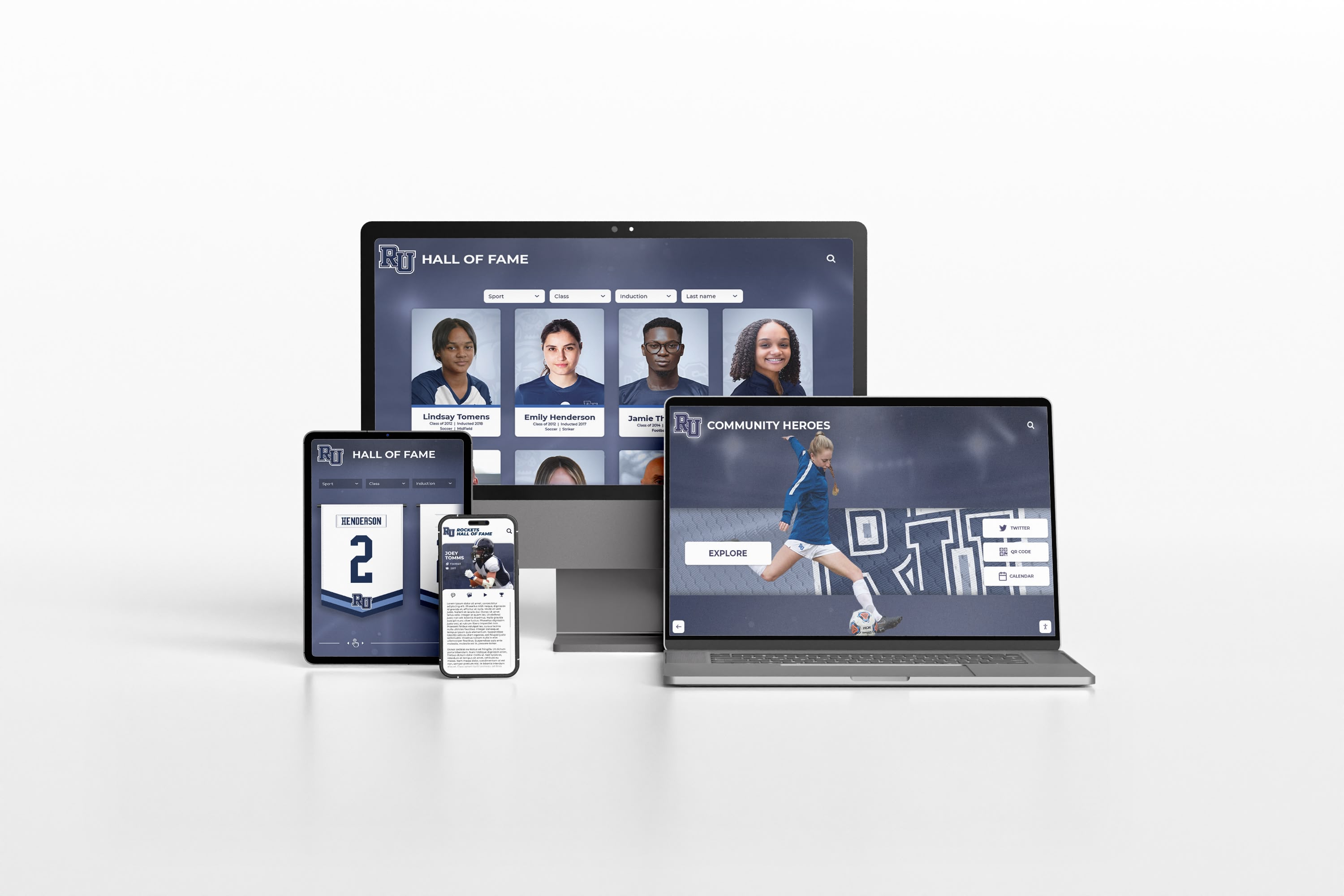
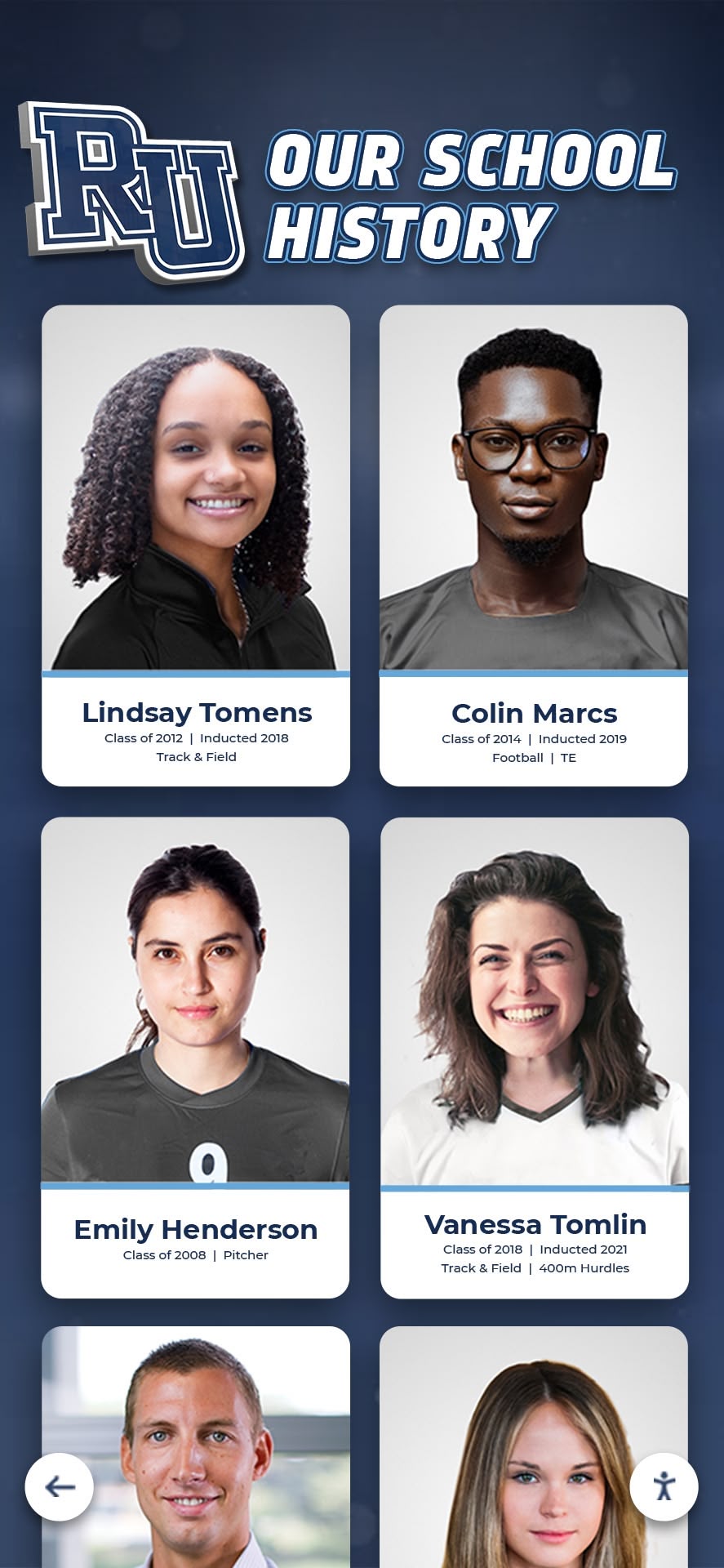
Dedicated websites provide comprehensive alumni databases accessible through any internet-connected device worldwide. Effective online platforms include fully searchable databases finding specific individuals through multiple criteria, mobile-responsive design ensuring smartphone accessibility without requiring separate apps, social sharing capabilities enabling alumni to share profiles across personal networks exponentially extending recognition reach, permanent archives preserving recognition indefinitely rather than risking physical damage or removal, and seamless integration with existing alumni directories facilitating networking among graduates.
Online platforms prove particularly valuable for institutions with geographically distributed alumni populations who may never physically visit campus but can engage with recognition digitally from anywhere. These platforms also enable families, employers, professional networks, and media to access achievement information far more readily than physical displays permit.
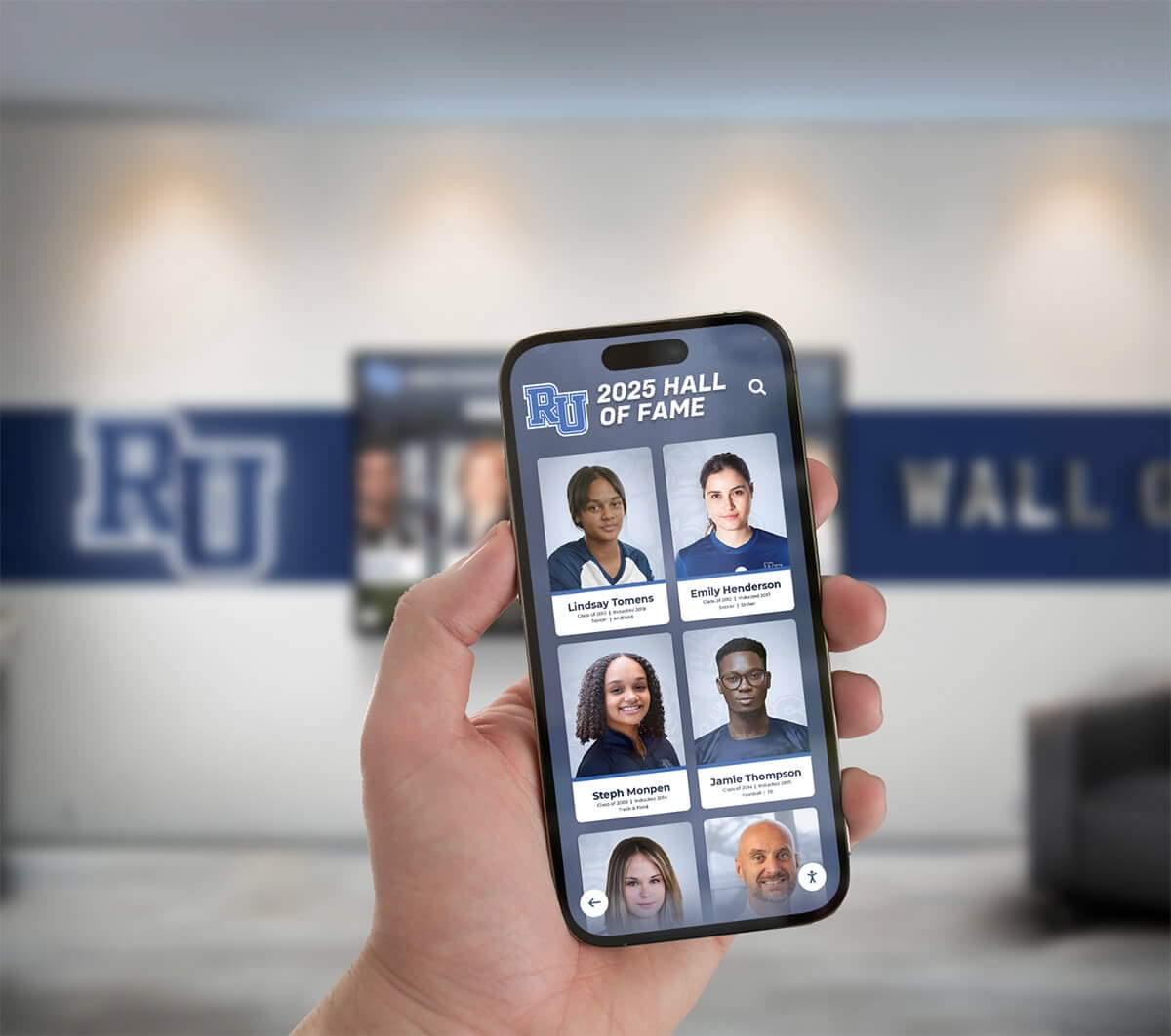
Mobile Applications and Push Notifications
Dedicated mobile applications extend recognition access to smartphones and tablets through features including on-demand alumni database access without requiring web browsers, notification systems alerting users when new honorees from their graduation eras are added creating ongoing engagement, event integration featuring relevant alumni recognition during campus gatherings like homecoming and reunions, and offline functionality allowing content viewing without internet connectivity useful during campus visits with poor coverage.
Mobile apps maintain recognition visibility beyond fixed campus locations while enabling continuous engagement regardless of physical proximity to campus. Push notification capabilities create ongoing touchpoints reminding alumni of recognition programs throughout the year rather than only during infrequent campus visits.
Creating Hybrid Alumni Wall Implementations
Many institutions find that combining traditional and digital elements creates the most effective recognition experiences, balancing permanence and gravitas of physical displays with flexibility and engagement capabilities of digital technology.
Physical-Digital Integration Strategies
Hybrid approaches leverage complementary strengths of different display types while overcoming individual limitations.
Traditional Name Wall with Digital Detail System
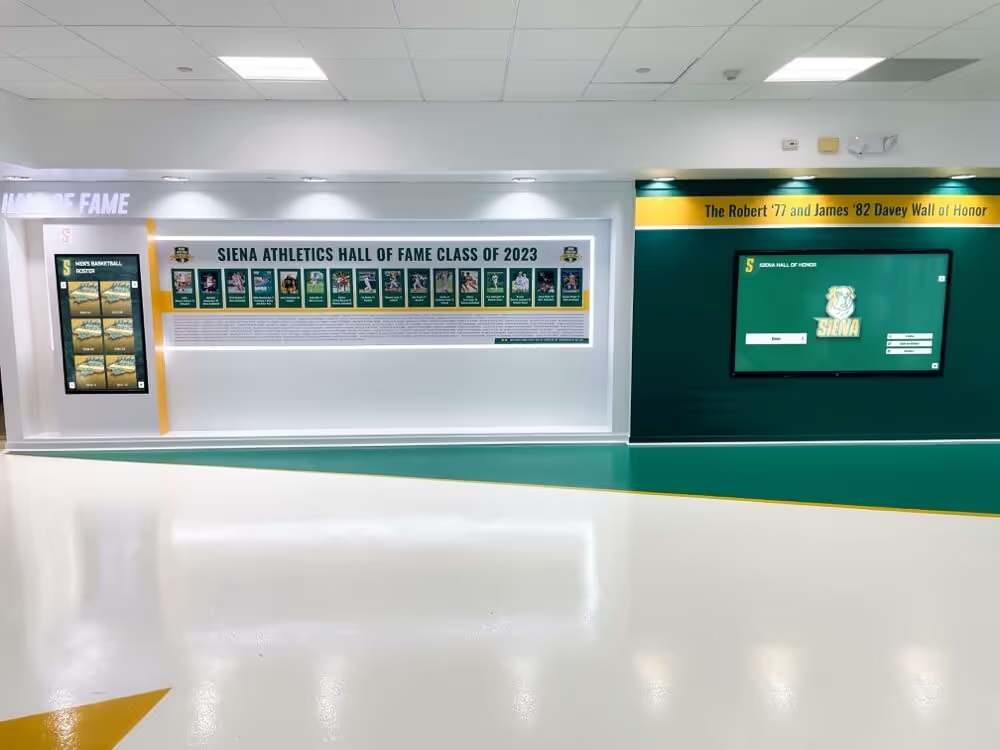
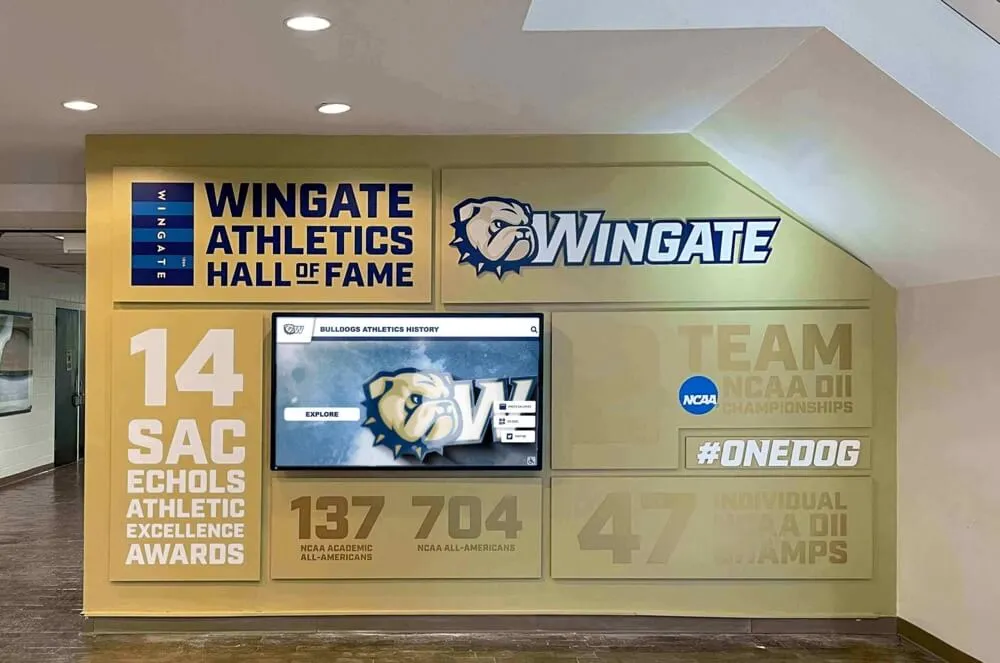
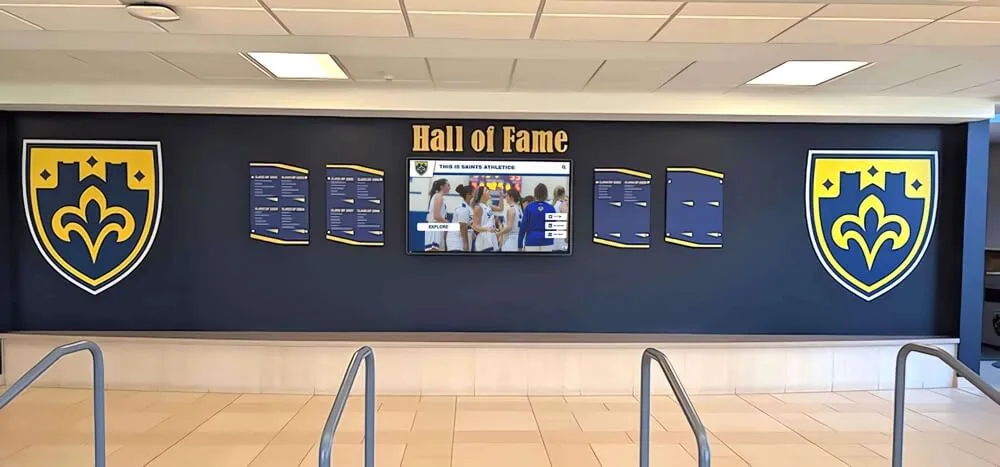
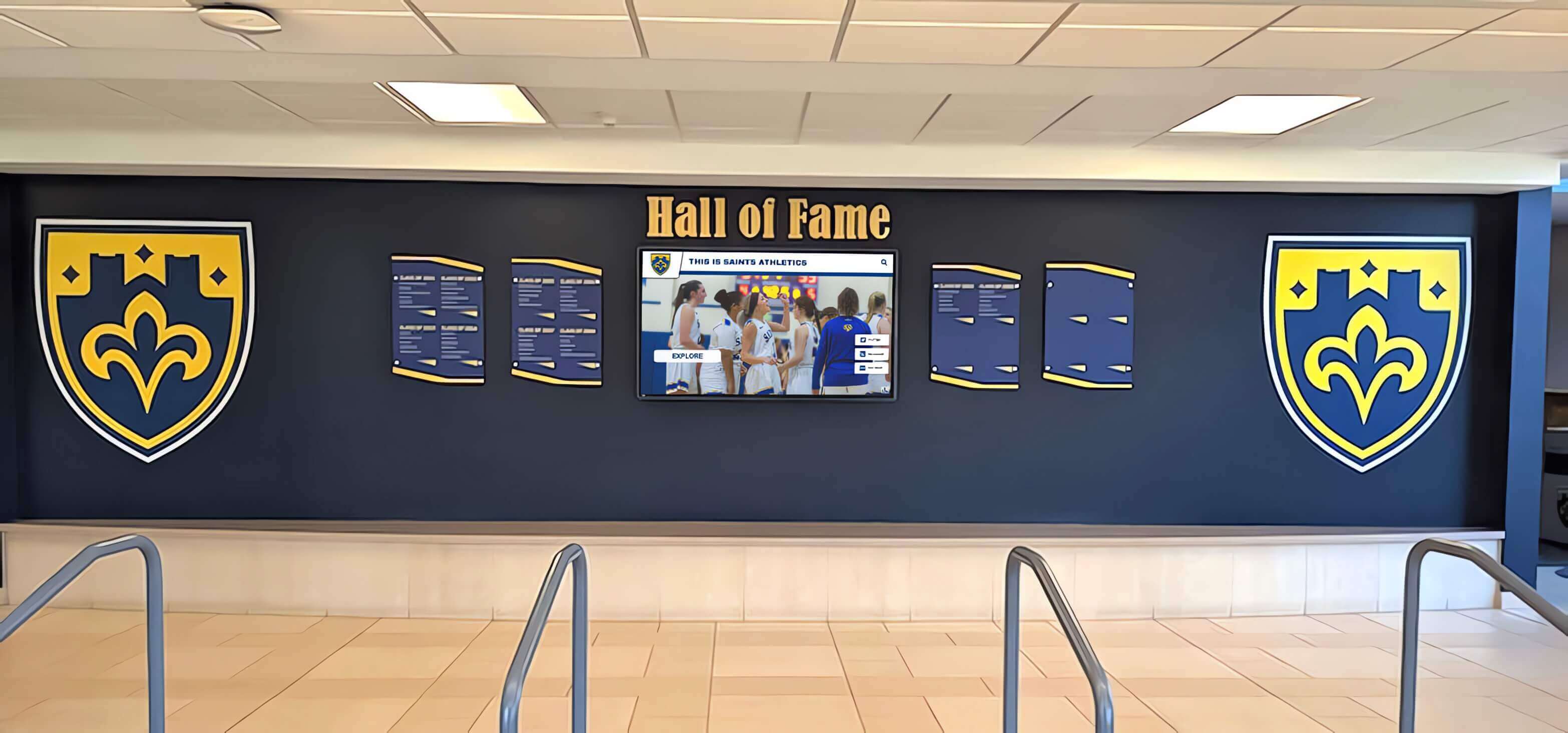
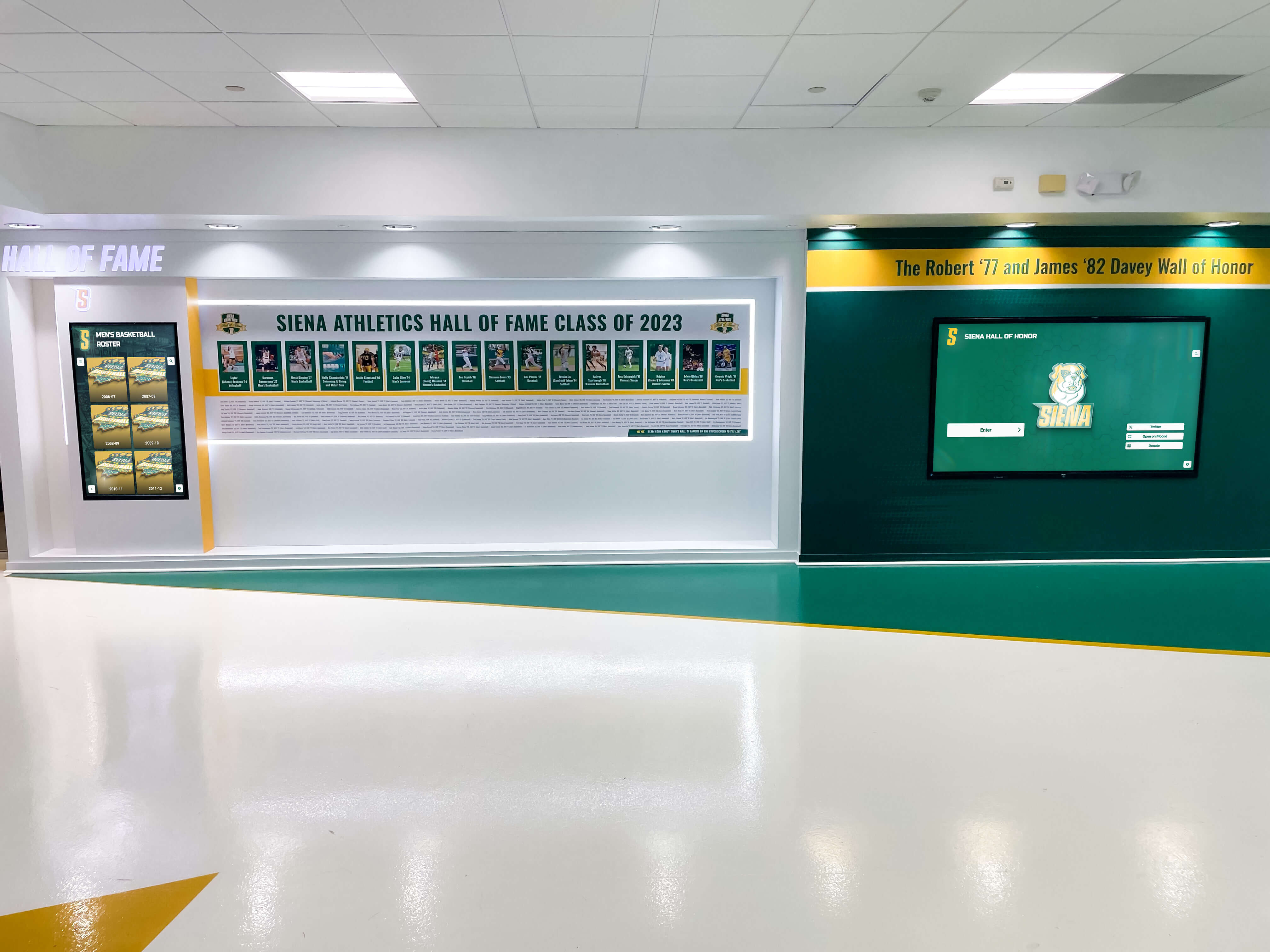
Mount permanent brass or bronze plaques listing all honored alumni names, graduation years, and basic information on traditional wall spaces establishing formal recognition permanence that satisfies stakeholders valuing tangible acknowledgment. Adjacent to plaque walls, position interactive touchscreen displays enabling visitors selecting specific alumni to access comprehensive profiles with detailed biographies, professional photos and personal images showing career progression, achievement narratives and context explaining significance, video interviews and multimedia content impossible to include on physical plaques, and related information connecting alumni with shared backgrounds or complementary achievements.
This hybrid approach satisfies stakeholders valuing traditional permanence while providing comprehensive information and engagement capabilities digital systems uniquely enable. Physical walls establish gravitas and formality appropriate to significant recognition, while digital displays deliver depth and interactivity contemporary audiences expect.
QR Code Enhanced Physical Displays
Traditional photo displays or plaques incorporate small QR codes that visitors scan with smartphones to access extended digital content without requiring dedicated interactive hardware. Scanning codes opens mobile-optimized web pages with video interviews providing richer context than text alone, extended biographical narratives telling complete achievement stories, photo galleries showing career progression from student through professional accomplishments, achievement timelines visualizing career development across decades, or related content connecting alumni with similar backgrounds or complementary achievements.
QR integration enables unlimited digital content extension without requiring dedicated touchscreen installations while leveraging smartphones visitors already carry. This approach reduces infrastructure investment while maintaining physical display presence and extending recognition capabilities substantially beyond what physical space permits.
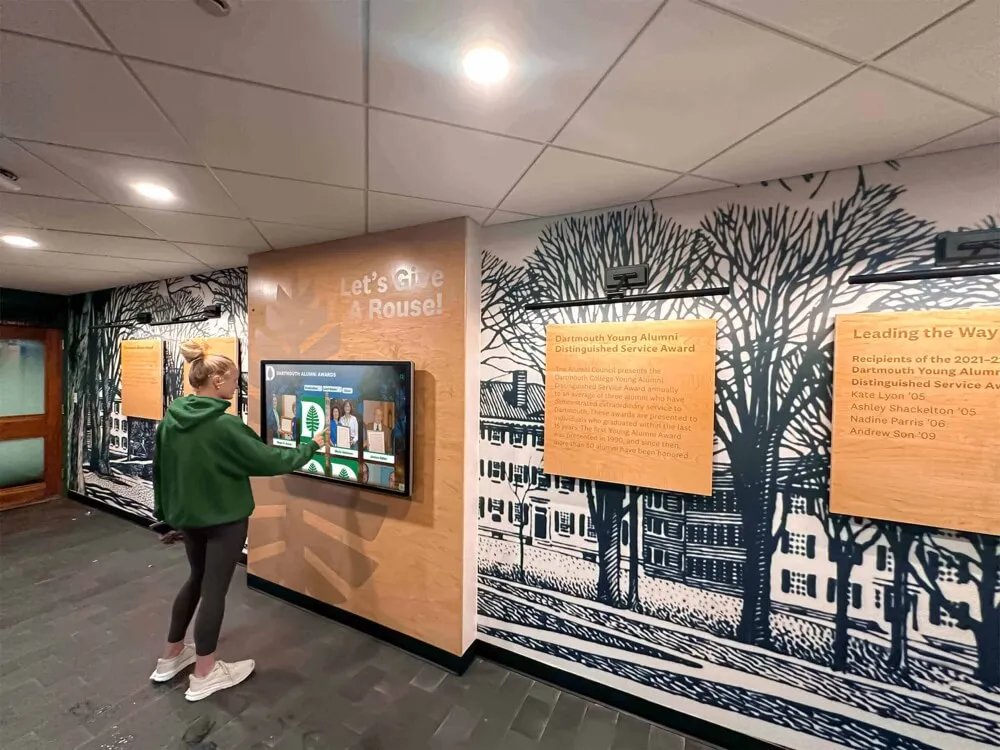
Architectural Installations with Embedded Digital Elements
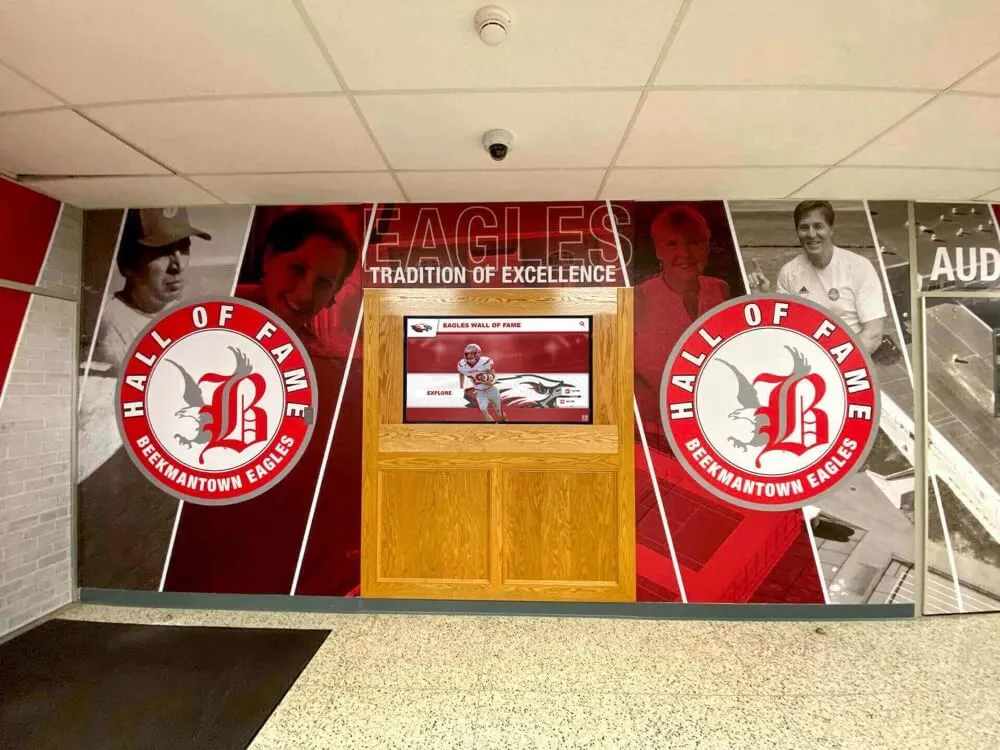
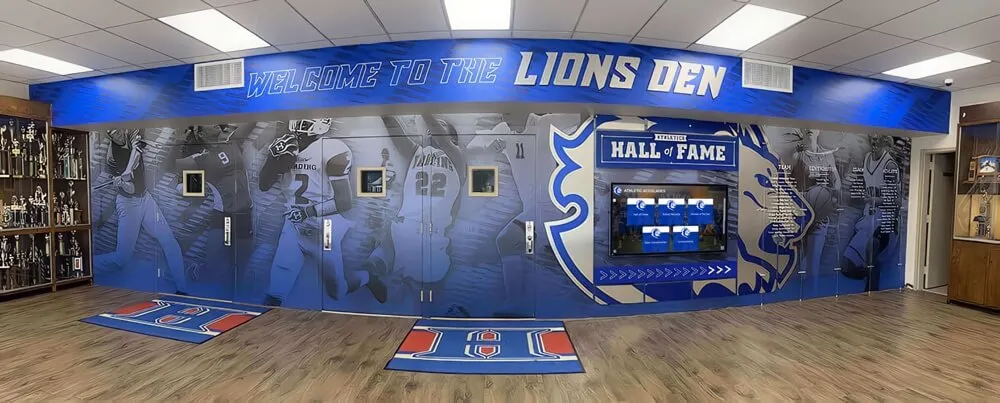
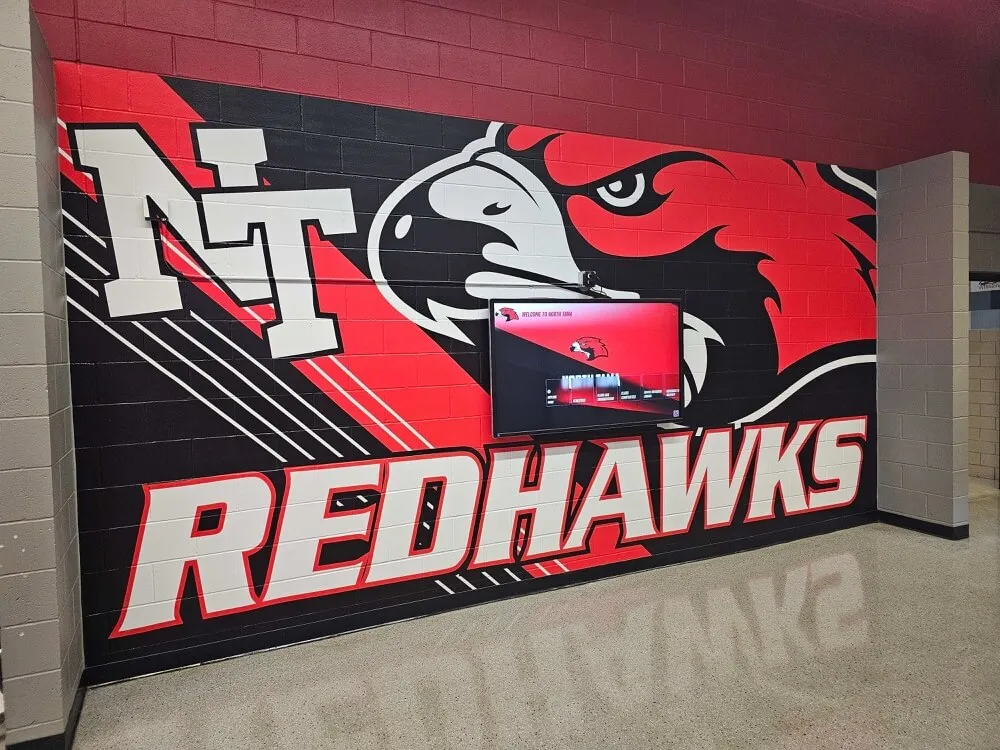
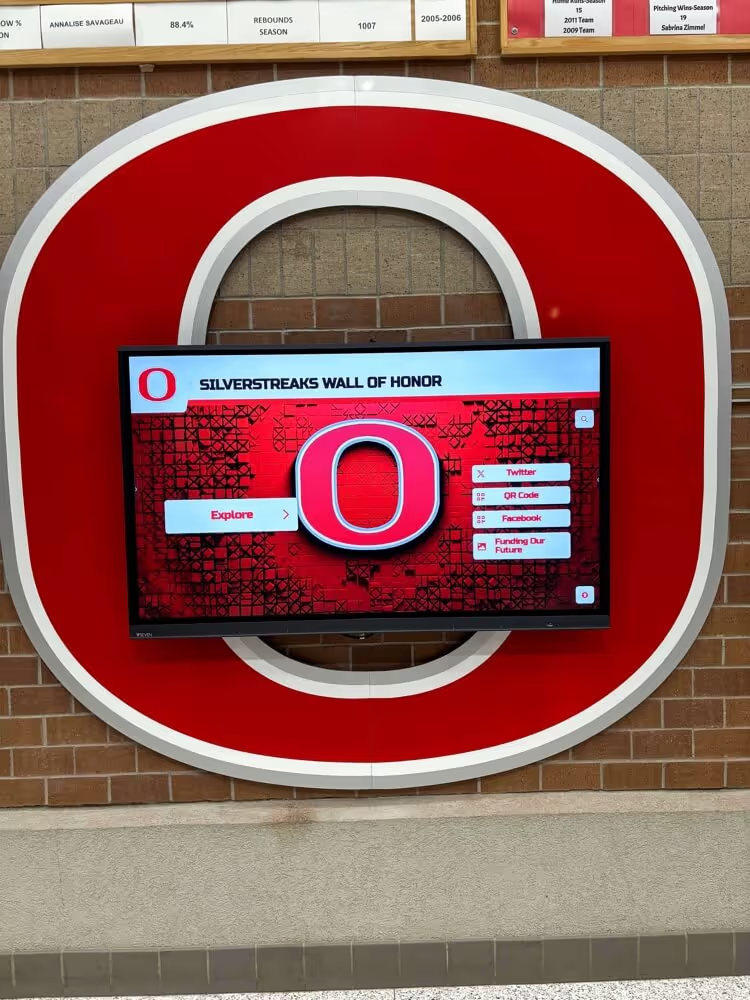
Create custom architectural features where digital displays integrate seamlessly within traditional materials and design aesthetics rather than appearing as obvious technology additions. Examples include wooden or metal frameworks with built-in screens appearing as intentional architectural elements, backlit panels transitioning between static engraved information and dynamic digital content creating visual interest, or sculptural installations where digital displays form integral design components rather than afterthought additions.
Custom integration requires greater initial investment through professional design and fabrication but creates distinctive installations distinguishing institutions from generic recognition displays while achieving seamless aesthetic cohesion between traditional and digital elements that feels intentional rather than compromised.
Location-Specific Design Considerations
Strategic placement and context-sensitive design enhance recognition impact beyond standalone displays isolated from institutional environments.
Main Entrance and Lobby Placements
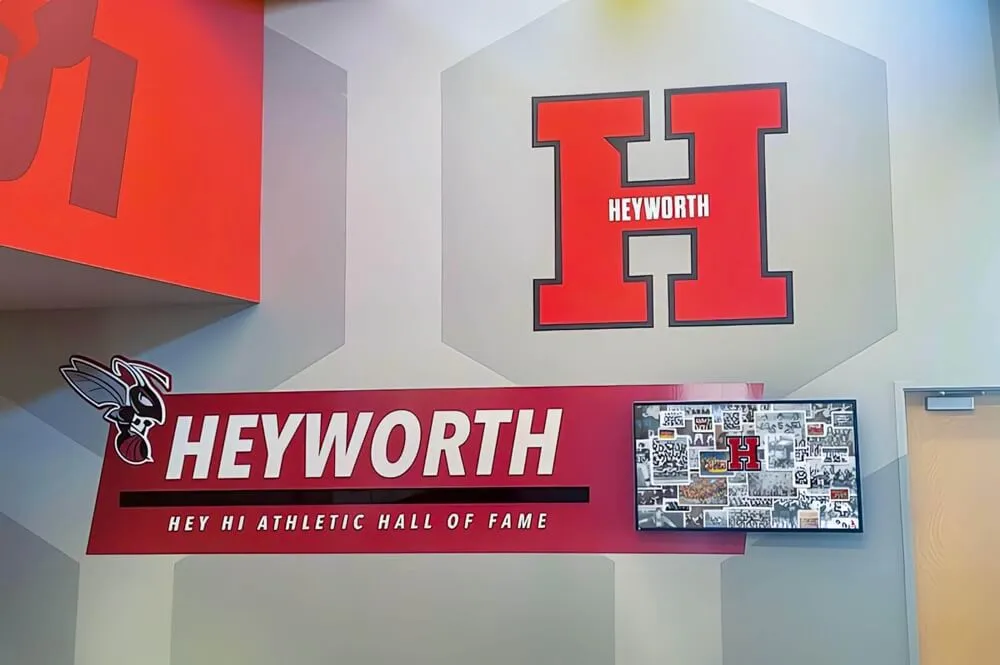
Position recognition prominently in main entrance lobbies where all visitors encounter alumni achievement immediately upon arrival. Entrance displays communicate institutional pride while creating positive first impressions for prospective students, families, donors, and community members evaluating your institution.
Consider grand installations occupying entire entrance walls making dramatic statements about institutional values, interactive kiosks serving dual purposes as wayfinding tools and recognition systems, or rotating digital signage maintaining fresh welcome messages featuring different alumni seasonally. Entrance positioning ensures maximum visibility while integrating recognition into daily institutional experience for all community members rather than requiring deliberate seeking in isolated locations.
Library and Learning Center Installations
Install alumni recognition in libraries or learning centers emphasizing connections between education and achievement. Context reinforces messages that learning leads to meaningful success while positioning alumni as continuation of student journeys current learners are experiencing. Library installations might emphasize alumni who became scholars, authors, researchers, or knowledge leaders, organize recognition by academic disciplines connecting alumni achievements to fields of study represented in collections, or feature academic recognition programs alongside professional achievement.
Department and Program-Specific Recognition
Rather than centralized comprehensive walls recognizing all distinguished alumni, some institutions create discipline-specific recognition within academic departments and programs. Science buildings showcase STEM alumni working in research, technology, medicine, and engineering. Business schools highlight entrepreneurial graduates who founded companies or achieved corporate leadership. Education departments celebrate alumni who became teachers, principals, or education policy leaders.
Departmental displays enable deeper exploration of field-specific achievements while creating role models particularly relevant to students studying in those disciplines. Current students encounter alumni who pursued career paths they’re considering, making success feel more achievable and relevant than generic recognition covering all fields simultaneously.
Developing Compelling Alumni Wall Content
Technology enables recognition but compelling content creates impact. The difference between displays people ignore and those that genuinely inspire lies primarily in content quality rather than display sophistication.
Creating Rich Biographical Profiles
Comprehensive profiles tell complete achievement stories rather than listing bare facts, creating emotional connections with audiences while demonstrating fuller dimensions of alumni accomplishments.
Essential Profile Components
Effective profiles include graduation year and any honors earned during school attendance providing institutional context, significant student involvement and activities demonstrating leadership and engagement patterns, educational path including advanced degrees and continuing education showing commitment to learning, career highlights and progression demonstrating professional achievement and growth, community service and leadership contributions showing values beyond career success, personal reflections on institutional impact when available adding authentic voice, and advice for current students creating relevance to contemporary audiences.
These comprehensive elements transform simple recognition into storytelling that humanizes achievement while demonstrating pathways current students might follow.
Crafting Engaging Narratives
Move beyond chronological resume listings to tell compelling stories emphasizing what made each alumnus exceptional rather than simply recounting accomplishments anyone could list. Effective narratives highlight pivotal moments and decisions that shaped careers, challenges overcome demonstrating resilience and determination, mentors and relationships that proved influential, how institutional experiences directly contributed to subsequent success, and the values and principles guiding their achievements.
Write in active voice with specific details bringing achievements to life. Rather than “became CEO of technology company,” write “founded cybersecurity startup in dorm room that grew into industry-leading firm protecting Fortune 500 companies, eventually going public at $2 billion valuation after fifteen years of bootstrapped growth.”
Incorporating Multimedia Storytelling
Digital platforms enable rich multimedia that text and photos alone cannot achieve. Systematically collect video interviews capturing alumni reflections in their own voices providing authenticity impossible through third-person writing, photo galleries showing career progression from student years through professional accomplishments visualizing achievement journeys, audio recordings particularly valuable for historical figures where video may not exist, scanned documents and press articles providing primary source materials and historical context, and interactive timelines visualizing achievements across career spans showing patterns and progression.
This multimedia content creates immersive experiences accommodating different learning preferences and engagement styles while significantly increasing time visitors spend exploring profiles compared to text-only presentations.
Ensuring Content Quality and Accuracy
Professional presentation quality demonstrates respect for honored alumni while maintaining institutional credibility.
Fact-Checking and Verification
Implement rigorous verification processes ensuring all biographical information, dates, and achievement claims can be documented from reliable sources. Errors undermine credibility and potentially embarrass both institutions and honored alumni. Establish clear documentation standards requiring nomination forms to include supporting evidence like news articles, official records, letters of recommendation, or direct confirmation from alumni themselves.
When information gaps exist—particularly for historical alumni where comprehensive records may be unavailable—clearly indicate what’s documented versus what represents institutional memory or legend. Honest acknowledgment of uncertainty maintains credibility better than presenting unverified claims as fact.
Consistent Formatting and Style
Establish style guides ensuring uniform presentation across all profiles regardless of when they were created or who developed content. Consistency demonstrates professionalism while making recognition feel cohesive rather than appearing as disconnected individual efforts accumulated over years by different contributors with varying standards.
Style guides should address biographical structure and organization, photography standards including image resolution, composition, and color treatment, tone and voice guidelines maintaining appropriate formality, and naming conventions for achievement categories and recognition tiers.
Implementing Your Alumni Wall Project
Moving from planning to reality requires systematic execution addressing timeline, stakeholder engagement, technical implementation, and sustainable operations.
Project Planning and Timeline Management
Alumni wall implementation typically requires 12-18 months from initial planning through formal launch for comprehensive installations, though simpler projects can proceed more quickly.
Phase 1: Planning and Requirements Definition (2-4 months)
Initial phases establish foundational elements including clarifying institutional objectives and recognition scope, determining physical versus digital versus hybrid approaches, establishing budget parameters and securing funding commitments, defining selection criteria and governance structures, and forming committees or working groups responsible for implementation oversight.
Rushing through planning creates problems persisting throughout the recognition program’s existence. Invest adequate time ensuring stakeholder alignment and clear objective definition before committing to specific implementation approaches.
Phase 2: Design and Content Development (4-6 months)
Once frameworks are established, focus shifts to creating actual recognition content and displays. This phase includes conducting initial selection processes identifying inaugural honorees, researching and documenting selected alumni achievements through archival work and direct outreach, developing biographical content and collecting multimedia materials, designing physical displays or configuring digital platforms, and securing necessary approvals from institutional leadership.
Content development often proves more time-consuming than anticipated, particularly for historical alumni where information must be gathered from scattered sources rather than readily available databases.
Phase 3: Implementation and Installation (2-3 months)
Final implementation includes physical display fabrication and installation or digital platform deployment, content loading and system configuration, quality assurance testing ensuring everything functions properly, staff training on content management and system operation, and developing promotional materials communicating launch to stakeholders.
Plan installation carefully to minimize disruption to institutional operations while ensuring professional results that reflect well on the institution and honored alumni.
Phase 4: Launch and Ongoing Operations
After initial launch, sustainable management processes include annual nomination and selection cycles adding new honorees regularly, regular content updates maintaining accuracy and freshness, physical maintenance or digital platform management ensuring continued operation, promotional activities maintaining visibility throughout academic years, and measurement and assessment tracking impact and identifying improvement opportunities.
Successful alumni walls function as ongoing programs rather than one-time projects, requiring sustained attention and resource commitment beyond initial implementation.
Securing Funding and Building Support
Alumni wall projects require appropriate financial investment and stakeholder buy-in for long-term success.
Understanding Cost Structures
Traditional physical displays typically require initial investments of $5,000-$30,000 depending on materials quality, customization level, number of initial honorees, and installation complexity. Digital interactive systems typically require $15,000-$50,000 for initial setup including commercial-grade touchscreen hardware, specialized recognition software platforms, professional installation and network infrastructure, and initial content development for inaugural honoree class.
Annual operating costs for digital systems typically range $2,500-$6,000 for software subscriptions and support contracts, hosting and cloud services, technical maintenance and updates, and content management time. Traditional displays require minimal ongoing investment beyond periodic cleaning and eventual expansion for new inductees.
Identifying Funding Sources
Most institutions fund alumni walls through multiple sources including regular operating budgets from alumni relations or advancement offices, alumni association dedicated funds allocated for engagement infrastructure, capital campaigns incorporating recognition components, corporate sponsorships particularly from companies founded by distinguished alumni, and individual major donor naming opportunities offering permanent recognition alongside alumni acknowledgment.
Frame alumni wall proposals to leadership as strategic investments in engagement infrastructure generating measurable returns through increased giving rates, enhanced recruitment appeal strengthening enrollment, improved alumni satisfaction and connection, and preserved institutional legacy serving multiple priorities simultaneously.
Building Stakeholder Coalitions
Successful projects require support from multiple stakeholder groups including senior institutional leadership providing resource commitments and strategic alignment, alumni association leaders ensuring alumni community support, advancement professionals integrating recognition with fundraising strategies, communications teams promoting recognition programs, and facilities staff accommodating physical installations or technical infrastructure needs.
Early engagement with all stakeholder groups prevents implementation obstacles while ensuring recognition design serves multiple institutional priorities rather than narrowly optimizing for single objectives.
Measuring Alumni Wall Success and Impact
Institutions must demonstrate recognition program value through evidence-based assessment of whether displays achieve intended objectives.
Quantitative Success Metrics
Measurable indicators reveal whether alumni walls deliver meaningful impact beyond anecdotal impressions.
Engagement and Utilization Data
Digital platforms provide detailed analytics documenting actual usage including visitor frequency and interaction duration showing sustained engagement versus brief glances, most-viewed profiles revealing which alumni resonate most strongly, search patterns indicating what visitors seek, and peak usage times informing optimal promotional timing. These metrics objectively demonstrate whether displays attract sustained attention or get ignored.
Physical displays require more approximate observation-based assessment through informal visitor counts, documented tour group responses, and periodic intercept surveys gathering feedback from individuals actually engaging with recognition.
Alumni Connection and Participation Metrics
Effective alumni walls strengthen alumni engagement measurable through increased giving participation rates from recognized alumni compared to non-recognized peers, higher event attendance at induction ceremonies and related programming, greater response rates to alumni surveys and communications, increased volunteer participation in mentorship and advisory roles, and social media engagement as alumni share recognition content across personal networks.
Correlation analysis comparing recognized alumni behaviors to control groups provides evidence of recognition’s causal impact on engagement rather than simply reflecting pre-existing connection patterns.
Institutional Visibility and Reputation Indicators
Alumni recognition contributes to broader institutional visibility through media coverage referencing distinguished alumni and recognition programs, prospective student and family feedback during recruitment processes, social media reach as recognition content gets discovered and shared, peer recognition through awards or acknowledgment from educational associations, and external partnership opportunities resulting from recognized alumni making connections.
Track mentions and references systematically rather than relying on anecdotal impressions to understand recognition’s broader institutional impact.
Qualitative Impact Assessment
Beyond quantitative metrics, stakeholder perspectives reveal whether alumni walls deliver meaningful subjective value.
Current Student Feedback
Survey current students about whether alumni recognition influences their perceptions, motivations, and aspirations. Questions might address whether they feel inspired by seeing alumni achievements, understand career pathways available after graduation more clearly, feel greater pride in institutional affiliation knowing distinguished alumni, recall specific alumni whose stories particularly resonated, and engage with alumni content voluntarily beyond required activities.
Focus groups provide richer qualitative insight into how recognition influences student experience and whether displays actually inspire or simply exist as background elements students ignore.
Alumni Perspectives and Testimonials
Recognized alumni can articulate whether recognition felt meaningful and valuable. Gather feedback about ceremony experience and how recognition was communicated, pride in acknowledgment and willingness to share recognition with personal networks, ongoing connection to institution and recognition program, and suggestions for improving recognition approaches or processes.
Many institutions find that alumni value recognition primarily for validation from institutions they care about rather than public visibility itself, suggesting that ceremony experience and personal communication matter more than display sophistication.
Administrative and Leadership Assessment
Institutional leaders should evaluate whether alumni wall implementation delivered on initial objectives, required sustainable administrative effort within realistic capacity, generated positive stakeholder response justifying continued investment, and advanced strategic institutional goals around engagement, fundraising, and reputation.
Regular review prevents programs from continuing primarily through inertia rather than demonstrated value, enabling resource reallocation when initiatives no longer serve priorities effectively.
Common Challenges and How to Address Them
Alumni wall implementations encounter predictable obstacles that proactive planning can help navigate successfully.
Maintaining Selection Process Fairness and Credibility
Recognition program legitimacy depends on perceptions of fair, consistent selection processes.
Establishing Transparent Selection Criteria
Publish clear criteria explaining exactly what achievements warrant recognition, ensuring guidelines apply consistently across all nominees regardless of influence or advocacy. Criteria should be specific enough to guide decisions while flexible enough to accommodate diverse achievement types. Balance quantitative thresholds like “achieved national prominence in professional field” with qualitative assessments like “demonstrated institutional values and character consistently throughout career.”
Transparent criteria prevent perceptions that recognition reflects favoritism, politics, or inequitable standards varying based on nominee characteristics unrelated to genuine achievement.
Managing Political Pressure and Advocacy
Selection committees often face pressure from influential alumni, donors, or community members advocating for specific nominees who may not meet established criteria. Maintaining integrity requires confidential deliberation processes preventing external influence during discussions, clear documentation justifying selections based on published standards, and willingness to decline inducting individuals who don’t meet criteria regardless of outside advocacy or potential donor implications.
Committee composition including members with institutional loyalty but relative independence from development pressures helps resist inappropriate influence while maintaining focus on achievement rather than fundraising potential.
Ensuring Equitable Representation
Many institutions recognize that historical recognition patterns reflected systemic biases underrepresenting women, minorities, or certain career paths. Proactive equity efforts include conducting representation audits identifying underrepresented populations, targeted research identifying overlooked achievements from historically underrepresented groups, potentially establishing special recognition categories or expedited processes rectifying historical inequities, and ongoing monitoring ensuring contemporary selection processes don’t perpetuate historical biases.
This work demonstrates institutional commitment to equity while strengthening recognition comprehensiveness and credibility.
Preventing Stagnation and Maintaining Relevance
Recognition programs risk becoming invisible background elements without sustained attention and regular refreshment.
Regular Content Updates and Additions
Establish routines ensuring new inductee profiles appear immediately after selection rather than languishing for months, existing profiles receive updates as alumni achieve new milestones or provide additional information, featured content rotates seasonally highlighting different achievements and themes, and multimedia elements expand continuously as new materials become available.
Digital platforms make updates straightforward through cloud-based content management systems, while physical displays require more substantial effort for additions. Plan expansion space and update processes during initial implementation to ensure sustainable operations.
Technology Refresh and Platform Evolution
Digital recognition systems require periodic technology refresh as hardware ages and software platforms evolve. Budget for display replacement every 7-10 years as screens deteriorate, software platform updates or migrations to improved systems as technology advances, and network infrastructure improvements supporting evolving requirements.
Working with providers like Rocket Alumni Solutions committed to ongoing platform development ensures recognition systems benefit from continuous technological improvements rather than becoming obsolete installations that undermine rather than enhance institutional reputation.
Responding to Evolving Institutional Priorities
Institutional values and strategic priorities evolve across decades. Periodically review whether current recognition criteria and processes remain aligned with contemporary values and priorities, gather stakeholder feedback about recognition effectiveness and potential improvements, and make thoughtful adjustments when warranted while maintaining core standards that preserve recognition meaning.
This adaptive approach prevents recognition from becoming rigid historical artifact disconnected from current institutional reality while maintaining consistency and credibility.
Conclusion: Creating Alumni Recognition That Delivers Lasting Value
Alumni walls represent significant institutional investments requiring substantial planning, implementation effort, and ongoing management commitment. When executed thoughtfully, they deliver remarkable value compounding across years and decades—strengthening institutional culture, preserving institutional history, engaging alumni, and inspiring current students through compelling achievement stories.
The most effective alumni wall displays share common characteristics regardless of institutional size or resources. They honor diverse achievements and populations fairly through transparent, consistent selection processes. They evolve continuously rather than remaining static through regular content updates and periodic technology refresh. They engage stakeholders actively through meaningful ceremonies, regular communications, and intentional integration with broader institutional activities. And they align authentically with institutional values and strategic goals rather than existing as isolated initiatives disconnected from broader priorities.
Contemporary recognition technologies enable institutions to honor alumni achievement more comprehensively than ever before. Digital platforms eliminate space constraints that forced previous generations to make painful choices about which accomplishments warranted recognition. Interactive experiences engage visitors actively rather than passive glancing at crowded plaques. Web accessibility extends recognition reach beyond campus boundaries to alumni worldwide. Multimedia storytelling creates emotional connections impossible through text and photos alone.
Yet technology merely enables recognition—the substance lies in the achievements honored and the institutional values alumni walls express. Whether your institution establishes its first formal recognition program or modernizes traditions spanning decades, the principles remain constant: honor achievement authentically, implement sustainable processes within realistic resource constraints, engage stakeholders meaningfully throughout development and operation, and create recognition systems serving your institution’s unique needs and values.
The alumni who invested themselves in your institution deserve recognition matching their dedication and achievements. Thoughtful planning guided by clear objectives, realistic assessment of capabilities and constraints, and genuine commitment to honoring excellence ensures your alumni wall delivers that honor for generations to come.
Ready to explore how modern recognition solutions can help your institution celebrate alumni excellence effectively? Discover how Rocket Alumni Solutions combines intuitive technology with proven best practices, making it easier than ever to create comprehensive alumni recognition programs that strengthen connections between past, present, and future members of your institutional community.